The Blessing and the Name of Jesus

Arriving from home just today and finding my room in all its clutter, I thought I would be able to put everything in order and then make my homily for the new year. But when I hit the bed for a nap, I never realized I would spend the last day of the year in bed.

Nevertheless, promises are promises and I intend to keep them. So, I am posting one homily I remember by Fr. Victor Salanga SJ. Fr. Vic was my teacher in Scripture, and it was from him that I learned to explain the Scripture readings as an important component of homilies.

1 January 2005: Solemnity of Mary Mother of God & Imposition of the Name of Jesus
Num 6, 22-27/ Ps 67/ Gal 4, 4-7/ Luke 2, 16-21: Titular Feast of the Society of Jesus


My brothers and sisters, as we gather this evening to celebrate the Eucharist, I suggest we focus our reflections on two points: first, the meaning of ‘blessing’ and second, the meaning of the name, Jesus.

The first reading from the book of Numbers is appropriate on New Year’s Day. We ask God to bless us during the year ahead. The text says: “The Lord blesses you and keeps you! The Lord let his face shine upon you, and be gracious to you! The Lord look upon you kindly and give you peace!”

One way of understanding ‘blessing’ in the Bible is taking its opposite. The opposite of ‘blessing’ is ‘curse’. To curse a person is to separate him and put him at a distance from, even cut his links with his group, family, clan or tribe. The curse is intended to destroy a person’s solidarity with others. That is why, for example, the curse on Cain turns him into a fugitive and a wanderer on earth, fearful that he might be killed by others. If the curse destroys solidarity with others, the blessing, on the other hand, strengthens solidarity with his group, family, clan or tribe.

For us then, when we ask for God’s blessing, we ask Him to build up our bonds with one another. I think we are aware how easily we can undermine solidarity, by tsismis, by spreading rumors, by giving a fellow person the silent treatment, hindi pinapansin. Instead, we beg God to deepen our union of minds and hearts, especially as we build a community here in the Parish of the Holy Sacrifice, through the Eucharist.

I have met many of the older Jesuit fathers who are now in our Infirmary. Many of them have been great men when they were young. Now in the hospital, they looked completely helpless. A few years ago they would reveal that in their sufferings and aloneness, they had made the prayer of Fr. Pedro Arrupe, SJ, our former Superior General their own: They have placed themselves totally in God’s hands. Now in their sick bed, Fr. Arrupe’s prayer became so apt: “More than ever, I now find myself in the hands of God. This is what I have wanted all my life, from my youth. And this is still the one thing I want. But now there is a difference: the initiative is entirely with God. It is indeed a profound spiritual experience to know and feel myself so totally in His hands.” I think their acceptance of their sickness and transforming it into a powerful spiritual resource is an example of what I mean when we pray for God’s blessing. As we experienced great natural disasters, economic and political strife, and as we encounter personal failures, we pray for genuine experiences which build up and strengthen our union with one another and with God.

Now to the second point: the meaning of the name, Jesus. The Hebrew root of the name Jesus is “hoshia”. “Hoshia” implies bringing help to those in trouble rather than rescuing them from it. The distinction is crucial. The human person, as “hoshia”, as “savior”, can help those in trouble, but God alone can truly rescue them from it. In the person of Jesus, God-made-made, He is able to do both: help those in trouble and rescue them from it.

We bear the name of Jesus. We are Christians. And following the meaning indicated by “hoshia”, our work is to help those in trouble, not rescue them from it. We remember three words: spiritu, corde, praxis. To act “in the Spirit” (Spiritu) meant to refer all to God and divine grace. To act “from the heart” (Corde) meant to bring the feelings to bear on whatever was being done, and never to act “only theoretically”. To act practically (praxis) meant that our affectivity should be directed to helping others. In a word, to act ‘practically’ meant to act pastorally. And thus, this New Year, we act with this triad: spiritu, corde and practice.

Tonight, in our Eucharist, we ask God’s gracious blessing: that He strengthens our bonds of solidarity as a community in this parish, and that He continues to draw us day by day, nearer and nearer to the ideal of becoming another ‘hoshia’, another Jesus in our world today.

On this feast of the Divine motherhood of Mary and as we offer this new year 2006 to her, let us seek her kind intercession that God grant our request. Let us then pray the “Hail Mary” together.

Christmas Break

Dear Friends, I will be gone for a week. So will not be able to update this blog, however, I will be able to have a new year homily when I get back on the 31st of December.

Thank you very much for supporting this blog. My prayers and masses for all of you. Merry Christmas and a blessed new year to all!

The Vows Jesuits Make

Once in awhile, I come across homilies that inspire and remind me of who I am, and what my life should be. Days ago, Atoy, a scholastic, pronounced his perpetual vows, the same vows I pronounced in 1991. I am reprinting the homily given by Fr. José Cecilio J. Magadia SJ, Rector of Loyola House Studies. This homily facilitates an understanding of the vows Jesuits make; however, the points here may also apply to all in general.
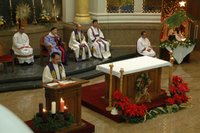
Homily for the First Vows of Scholastic Honorato Salazar, S.J. by José Cecilio J. Magadia, SJ
16 December 2005, Oratory of St. Ignatius of Loyola
Loyola House of Studies, Ateneo de Manila University

This afternoon, we gather to witness the ceremony of the First Vows of our friend, Atoy Salazar. If I were a celebrity journalist, I would begin a news report on this afternoon’s event by describing Atoy as being a “dashing and debonair doctor, daring to defy convention, by not shifting to nursing and finding a better job abroad.” But I am no journalist, and neither is Atoy really a celebrity --- not yet, at least – nor is he definitively dashing and debonair. So I guess, I will settle for the more modest and apt adjectives, “determined and driven,” for that he certainly is.

Some four years ago, this “determined and driven” young doctor, fresh out of medical school, thought he knew exactly what he wanted in life. But he began to be disturbed by something he could not exactly put his finger on --- a gap of sorts, an unfamiliar emptiness, a longing that refused to be satisfied so easily. It was an experience similar to what many young people go through once they reach the threshold of their ambitions, who, after all the blood and sweat and tears of pursuing a single dream, realize that it was not enough and that something else was missing.

Some young people simply ignore this feeling and pretend that it isn’t there, and they learn to live their lives contentedly, but with an incomprehensible tinge of unhappiness deep down. Others just pick up their bags and set out on a new journey in pursuit of what they thought was their star, but they followed false stars that led nowhere. And they would go off again and again, and never seem to settle down, and end up in a constant state of being without a center, without direction, without zeal. Some eventually get tired and settle for second-best. Some remain forever lost.

Then finally, there are those young people who take time to stop and face this strange and disturbing disquiet squarely, and silence themselves, and listen well to what their hearts are really whispering. They are the lucky ones, who learn early on what it was they were searching for in the first place.


Today, that young doctor who took time to listen to his heart is now just a little older, and a little more scarred, and a little less frustrated, and a little more secure, and he finds himself ready to take vows of perpetual chastity, poverty, and obedience in the Society of Jesus. Perpetual, mind you --- not part-time, not time-bound, not in installments, not in convenient and disposable sachets, but the whole caboodle, sik-sik, liglig, at umaapaw (dense and overflowing*).

This afternoon, as we accompany Atoy in this important event, I propose that we simply try to understand what these religious vows are all about.

To simplify things, one might say that the vow of poverty is about embracing simplicity and surrendering the privilege of personal possession. The vow of chastity is about loving universally and inclusively, and sacrificing the great gift of having an exclusive partner. The vow of obedience is about allowing God to take control of one’s life and being completely open to the Spirit moving in the world and moving in religious superiors, and renouncing sole control for determining one’s actions. More importantly, these vows, noble as they may seem to be, are not taken for their own sake. They are embraced so that a Christian can take on the mission completely, to give and not to count the cost, to fight and not to heed the wounds.

But no one said that it would be easy. Father John Courtney Murray, a great Jesuit theologian who taught many of our own Philippine Province men, spoke of “the danger of the vows.” With poverty, he says, we run the risk of irresponsibility, as we win a sense of security with less of a struggle, and we are freed from feeling the need to earn a living as we depend on the Order for our very existence. We become glorified free-riders. With chastity, we run the risk of pride and emotional immaturity, of having a hardness of heart because of isolation from the facts and forces of human nature, which remind us of our radical dependence on God. With obedience, we run the risk of being without drive, as we depend on superiors to make our decisions for us and lose our own sense of assertiveness, our determination, our raw energy, since we are liberated from making the hard choices that others seldom escape. And the danger of the vows has to do with becoming less of a man, and more of a wimp. Yes, Jesuit life can turn into an easy and carefree one. It can skip into sheer complacency and a desire for comfort, and even luxury.

And the only way we can save ourselves from falling into this trap is by making sure that we cling to our sense of being creatures, of being sinners, of not knowing what the future will hold and yet pushing ourselves to give more and not to hold back. We do so with great fear and trembling, and yet encouraged because we know that through the vows, we are empowered to give the world of today two great gifts--- the gift of conviction and the gift of gentleness.

First, the gift of conviction. The gift of conviction is given to the world of postmodernity, of fast-shifting changes, indeterminate futures and wavering principles. It is a world that says that objective truth is dead, that lasting values are passé, and that all we have are short-lived preferences that are always relative and always easy to give up. The vows pronounces that it is possible to say yes, in a world that has gotten used to maybe’s and we’ll-sees, that there are still absolute values that withstand the shifts in human history, and that the absolute truth is that there is a God who cares and who inserts himself into our lives in a definitive way, and invites us to a profound unity, and so become less selfish, less greedy, and less controlling and become the shining and burning lamp that John the Baptist is in today’s Gospel, as a pointer to the one true light, Jesus the Christ. And that is our conviction.

But there is a second gift --- the gift of gentleness. The gift of gentleness is given to the world of efficiency and managerial precision. It is a world with clear benchmarks of success, measured in terms of outputs and income and quality, that insist on making everything fit in into packaged plans and well-prepared schemes. The vows tell such a world that it is still possible to relax and take it easy, and have faith in a God who sees more than we will ever see, who invites and never imposes, who can wait even if we dilly-dally and waver and allow our fears and anxieties to get the better of us sometimes. The vows tell the world that chastity and poverty and obedience are not about what we cannot do, but about what more we are willing to do, because of the great gifts we have received in such overflow. And so, we can afford to be gentle on ourselves and on others.

Atoy, these are your gifts to the world as you make these vows, and as you do so, you are likewise given a gift. And your gift is this --- it is the promise that as you share this conviction and this gentleness to the world, you will not be alone. You will be joined by this group of crazy men, some 20,000 of us worldwide, some young, some not-so-young, some clowns, some scholars, some authentic saints, some self-made neurotics, many intelligent and talented in very different ways, yet also hard-headed and opinionated, with different intensities of creativity, offering you respect and companionship, yet also unafraid to challenge you and push you to your limits. Most of us are sane, yet clearly all wacky of sorts, because we share a dream bigger than ourselves. All stumbling through in our daily works, some failing miserably, others even foolishly. Many of us gamblers and risk-takers, all sinners yet knowing that we are deeply loved by Christ and called to dedicated service to His mission. Atoy, when you look at the men you are given as companions in the least Society of Jesus, you might very well be tempted to go for the nagging wife, but that might not be as exciting for your taste. But do look again, and maybe, you will see that these men will inspire you and they will show you flashes of the very gifts that that young doctor was looking for, four years ago.

But most of all, Atoy, you are gifted with the promise of the presence of the Lord of the banquet, Himself, who is always Emmanuel, God-with-us, God who will never ever abandon us.

My prayer for you, Atoy, is that as you fumble through your Jesuit life, with the rest of us, fumblers, you hang on to the spirit of Father Ignatius’ ad majorem Dei gloriam, the greater glory of God. At a meeting in Hong Kong some months ago, Father Beda, the Chinese Provincial explained to us the Chinese characters of AMDG, and the Chinese character of majorem or greater, incorporates the character for heart, and that the image literally means “to go beyond the heart.” That is our prayer for you on your vow day, that you might never stop giving so generously, to the point of going beyond the heart.

* own translation from Filipino.

Filipino Christmas after the Midnight Mass

25 December 2005: Christmas Mass during the Day
John 1, 1-18: What's Next?

At the end of Christmas Day, when the Misa de Aguinaldo is over, when the Midnight Mass has been done, and text messaging becomes easier from last night, and the celebrations become sober, and we have all opened our gifts, a thought sometimes comes to me: What’s next?

What’s next? Christmas in the Philippines is far the longest of all celebrations. And its peak reaches on Christmas eve, when we troop to Midnight mass and noche buena. During the day, the excitement drops and the whole world suddenly becomes silent and restful. After the Christmas frenzy, what’s next?

Yes, what’s next? After we have eaten the last piece of the Christmas cake, or the last chunk of lechon from the table, or the last plate of spaghetti, we ask, what’s next? After all the magic of the season, what’s next?

Two things come to me: It is the why of Christmas. First, Christmas reminds us of our faith in Christ, the reason for the celebration.

There is one Christmas Carol that has always baffled me. Have you ever wondered about THE TWELVE DAYS OF CHRISTMAS? What in the world do leaping lords, French hens, swimming swans, and especially the partridge who won't come out of the pear tree have to do with Christmas?

From 1558 until 1829, Roman Catholics in England were not permitted to practice their faith openly. Jesuits* during that era wrote this carol as a catechism song for young Catholics. It has two levels of meaning: the surface meaning plus a hidden meaning known only to members of their church. Each element in the carol has a code word for a religious reality, which the children could remember.

1. The partridge in a pear tree was Jesus Christ.
2. Two turtledoves were the Old and New Testaments
3. Three French hens stood for faith, hope and love.
4. The four calling birds were the four gospels of Matthew, Mark, Luke & John.
5. The five golden rings recalled the Torah or Law, the first five books of the Old Testament.
6. The six geese a-laying stood for the six days of creation.
7. Seven swans a-swimming represented the seven sacraments of Baptism, Confirmation, Eucharist, Reconciliation, Anointing of the Sick, Marriage and Holy Orders.
8. The eight maids a-milking were the eight beatitudes.
9. Nine ladies dancing were the nine fruits of the Holy Spirit: Love, Joy,
Peace, Patience, Kindness, Goodness, Faithfulness, Gentleness, and Self
Control.
10. The ten lords a-leaping were the Ten Commandments.
11. The eleven pipers piping stood for the eleven faithful disciples.
12. The twelve drummers drumming symbolized the twelve points of belief in The Apostles' Creed.

And finally, we remember why Christmas is celebrated. In the Gospels, the story of Christmas, or the Infancy Narratives tell us that God has always extended gracious mercy even to sinners. God has always lifted the lowly and has always heard the prayers of the faithful and obedient. God has always willed that the revelation given to the chosen holy ones be shared more widely for the glory of Israel and as a light to the nations.

And so we ask: What’s next? There's a Christmas song called, “The Work of Christmas” in BukasPalad's album "Pasko Na!" The lyrics is below:

When the song of angels is stilled,

When the star in the sky in gone,

When the prince and princess are home,

When the shepherds are back with their flock,

The work of Christmas begins.

To find lost, to heal the broken,

To feed the hungry, free the prisoners,

To rebuild nations.

To bring peace among brothers,

To make music in the heart.

Perhaps that is what’s next. It is a cliché to say that Christmas is every day. But it is true. We make people experience God’s gracious love to all of us sinners, by sending His only beloved Son, and our faith reminds us that it is something that we should do and put into practice.

One final thought: In Manila, people do tell you right away: Merry Christmas: Where’s my gift? Though jokingly, it tells us a grain of truth.

Christmas is not about expecting gifts. We teach children to expect gifts. We tell them that Christmas becomes meaningful if we receive many gifts.

Christmas, rather, is about thanksgiving. Our parents have dedicated their lives for us, don’t you think that Christmas is the time to thank them: it is our turn to give gifts to them.

Because, it is in giving that we receive. And it is in dying that we are born to eternal life.

*information source from Fr. William J. Bausch, retired pastor and nationally recognized speaker, storyteller, and workshop leader, is author of over 10 books on Catholic ministry, history and pastoral practice. He is the 1996 recipient of the President's Award from the National Federation of Priests' Councils.

A Promise Kept


24 December 2005: Saturday of the 4th Week of Advent
Luke 1, 67-79: Last Day of the Simbanggabi/Misa de Gallo

There are few times in a year that makes us easily smile and uplift our spirit, and perhaps, bring a few tears of remembrance than Christmastime. Nothing surpasses the season’s magic, and the world is transformed from a world of darkness, to a world of light. When traffic is caused, not by people off to work, but by people off to find a present for a loved one; when bus terminals are packed with people, not on their way to sell their wares, but on their way to be with their families; when our minds are bombarded not with business deals, but the gifts we bring. When what matters is not how much we earn, but how much we love. It is a time when we fulfill our promises of love.

Two weeks ago I went home to visit my mother who was hospitalized. When I called her, she requested that I bring with me my youngest brother. At first my youngest brother hesitated because of his work and he would be home for Christmas anyway. Christmas was just two weeks ahead. But I have kept my promise. As the eldest, I did everything to convince our youngest. Since he works in a television station, he had to finish his scripts, his shoots and edits to be able to make the trip. I told him I promised mom, and I intended to keep it. When my mother saw him, I saw how happy she was, her weakness disappeared, and her pale face glowed as ever: she knew that that is the only time this year--- when I was also at home--- that our family would be complete. To keep my promise was an assurance that we would be able, though early, to celebrate Christmas together. As a priest, I would not be with them on Christmas eve.

Life is complicated. Yet, in a deep sense, life is finally about one thing: it is about how much we love, how much we make other feel loved.

In 1999, ATD Fourth World published the story of Aling Sonia and her Christmas:

Aling Sonia carries a big wooden box filled with cigarettes in her arms. She, a tiny young woman, is selling them at the traffic lights. She leads us down under the bridge, over some half-broken steps through a dark and narrow passageway between the shanties on the estero to the door of her mother’s room. She offers us the only two chairs she has, and she herself sits on a little stool.

Some weeks ago, she gave birth to her fourth child. During the past year, we have witnessed her tremendous efforts to survive and keep her family together. Recently, she has placed the baby and her youngest child into foster care. “For temporary placement only,” she quickly adds. “With only the two elder ones at home, I can sell cigarettes and at least earn enough for our food and send the eldest to school. Remember, you bought him his schoolbag! And your friend, the social worker at Caritas, is also helping us.” When I say that selling cigarettes in the streets is hard work, she answers: “Yes, all the other vendors are men. But I can manage. For my children!” Tomorrow she’ll go to visit her two little ones.

We have brought Aling Sonia a letter from Ate Fabie, who had befriended her and her children during the Street Libraries, in the previous three years. Aling Sonia opens the envelope and takes out a pretty, colorful Christmas card. She looks silently at the card in her hands and then says: “Ate Fabie has not forgotten me. True, she has not forgotten me!” Moved and with tears of happiness in her eyes, she adds, “This is the first time in my life that I have received a Christmas card from a friend!”

Suddenly, there is Christmas in that small room under the bridge. Aling Sonia feels connected to someone dear to her out there in the world.

Christmas is indeed a time of hopeful love. A love that conquers us only by winning our hearts. A love that doesn’t count the cost, because it is so engrossed with giving. Christmas is the story of God’s connection to all of us in the world who are dear to him. It is story of God’s self-giving.

You see, we ask ourselves, in anguish, why we are suffering, why we are sorrowful and lonely and in despair, we are plagued with tragedy and senseless accidents. Why we are not lucky. And God promised us a Savior.

At Christmastime, God answers at last. He keeps his promise. And we are silent and still: God is born a child, and makes himself as one of us, as part of our history. Here, in this magical season, God does not speak words to tell us WHY we are suffering, simply, he shares our suffering. He does not tell us WHY we are in pain and plagued with problems, simply, he shares the pain and accompany us in our struggles. He does not explain, WHY we are broken, simply, he himself is broken. We are no longer alone in an immense world of suffering. His name bears humanity’s answer: Emmanuel. God is with us. Leonardo Boff, OFM, says, “God does not ask questions, but lives out answers; he does not give any explanations, but whose life is the explanation itself.”

There is a story of a five-year-old named Janie who woke and began screaming for her parents, as a violent storm occurred. Her mother came quickly to comfort her. After calming her down, her mother began to leave. The child protested vigorously. Her mother, trying to reassure her, gently responded, “God is always here with you.” Unpersuaded, Janie replied: “But I need someone with skin.”

God knows we need someone with skin: people with whom we can connect as ‘one of us’ as ‘flesh of our flesh’. At Christmastime, God has put on skin. And we too are asked to reconnect with the whole of humankind, of people with skin. Those without skin cannot express love the way we need it: the hands that wipe our tears, the arms around our shoulders that relieves our aching heart, the kind words that soothes our souls. Or, simply, those who rush through traffic to touch the life of love ones with gifts of love, those at the terminal who eagerly awaits reconnection with family, those whose minds recall sweet and tender moments, the Ate Fabies who lights the lives of the Aling Sonias of the world, are those who live out the answers to humanity’s questions. They are the Emmanuels of our lives who teach us the way God loves. These are the people we remember at Christmas. God’s gifts to us.

Let us gaze on the child’s eyes in the manger and adore him. God made flesh. Love made flesh. Let the ever self-giving goodness awaken in us our own goodness, let light shine in the darkness of our hearts. Much of our suffering comes from a heart of stone. Even those we love--- our families, our friends, our partners--- we have deeply hurt. And let God’s grace transform our hearts with that of his heart. The great philosopher, Soren Kierkegaard said, “When one has once fully entered the realm of love, the world--- no matter how imperfect--- becomes rich and beautiful, for it consists solely of opportunities of love.” If only politicians will honor their promise, if only friends will fulfill their promises, if only husband and wives will live their promises to each other, how different our world would be. Let God’s grace enable us to unhesitatingly grab all opportunities of love, and to keep our promises and the commitments of our lives.

And just as Zechariah, in his old age, proclaims with gratitude in the gospel today, that “God… raised a horn of saving strength as he promised… he remembered the holy covenant he made, the oath he swore”, we too remember that God indeed keeps his promise to be with us till the end of time.

What's in the Name


23 December 2005: Friday of the 4th Week of Advent
Luke 1: 57-66: The Naming of John the Baptist

In Palestine, the birth of a boy was an occasion of great joy. At the time of birth, friends and musicians gathered at the house of the parents. When the child was a boy, the people sang with jubilation: they believed that a boy causes universal joy! If the child was a girl, the people and the musicians just left silently. For Elizabeth, her joy was doubled. She had a child at last, and she had a son!

The Gospel unfolds during the eighth day since childbirth. The eighth day was the day designated for circumcision and the naming of the boy (a girl’s naming happens within 30 days). During the time of Jesus, the naming of a boy was an important occasion where friends and families meet. The naming of a child is descriptive. It can be by circumstance attending the child’s birth (Esau and Jacob), a description of the child (Laban means white or blond), a parental name (Saul/Samuel), what one asked for, and historical significance (e.g. Elijah: “Jehovah is my God” a testimony when Elijah’s parents asserted their faith in the time of Baal worship).

In the past, names are given with meaning, not just because it was a popular name, or it was nice to hear. A child was named according to a saint such as Antonio, Juan, Santiago, Francisco, Ignacio, Maria, Barbara: together dedicating their child to the care of the saints. Often the names become a guide to moral life: their names are reminders on how they live their lives. For example, Gerard was derived from the Germanic element ger "spear" combined with hard "brave, hardy". The Normans introduced this name to Britain. Gonzales is from the medieval name Gundisalvus, which was the Latin form of a Germanic name composed of the elements gund "war" and salv which sounds like salvation. Jesus is the English form of Iesous, which was the Greek form of the Aramaic name Yeshua. Yeshua is itself a contracted form of Yehoshua. Yeshua ben Yoseph (after his father Joseph) is the name of Jesus Christ. It might be helpful for us to regain the meaning of our names, and see whether its meaning may provide a motto or a guide for us to live by.

When Zechariah named his son, John, he meant several things. First, John means Jehovah’s gift or God is gracious, an acknowledgement of the truth surrounding John’s birth. Second, it is a discreet way of showing gratitude to God. Finally, it is obedience to God: it is the name which God asked Zechariah to name his child. Despite the people’s expectation to name the child after his father or ancestors, Zechariah defied convention if it was God’s will. Zechariah then proved his trust in God’s word, and finally regained his voice. Because of this, people began to wonder what the child will turn out to be.

A child is a bundle of possibilities. You will never know who they will turn out to be. For parents, a child is reason enough to thank God for. On the other hand, a child is his parents’ supreme responsibility. Often it depends on parents and those who stand in their place such as teachers, family members, friends how these possibilities will or will not be realized.

For many of us, we therefore look back on how we have contributed or not contributed to another person’s realization of their growth and possibilities. We first take into consideration ourselves, and see how others contributed or not contributed to our growth as persons. We look at our relationships in the family, with our friends, at our school or workplace and see how they are helping you grow and realize your possibilities. Finally, we look at ourselves: how do we contribute or stifle another person’s growth and the realization of their possibilities.

When God Breaks into Ordinary Lives


21 December 2005: Wednesday of the 4th Week of Advent
Luke 1, 39-45: The Visitation


We remember that the message of the Annunciation was that both Mary and Elizabeth would become pregnant. The visit of Mary confirmed what the angel had told her, and it was a proof that God kept His word. Moreover, Elizabeth's greeting to Mary also confirmed God's word: "Blessed are you among women, and blessed is the fruit of your womb." Elizabeth also knew about Mary's pregnancy.

As both of them rejoiced, Mary sings the Magnificat (the Gospel tomorrow): she sings about how God reverses all plans and designs, defies conventions, chooses the weak instead of the strong and lifts up the lowly like Elizabeth and her. Mary sings with joy and gladness! She sings because she knows she does not deserve to be the mother of the Savior, nor does Elizabeth deserve to be the mother of a future prophet (all she asked was a son!). In their being ordinary, God broke into their lives. The reaction of both women was not surprising to common folk. I have seen the difference. One Christmas I gave the same CD to two different friends: one poor, the other wealthy. They both acknowledged the gift, but one can't stop thanking me for remembering her. My friend from the urban poor area where I was assigned was elated more than the one from the affluent. Indeed, when one has nothing, a little gift means a lot!

Mary does not sing about herself, but about God: praising God for the attention He has given to two simple insignificant persons. God's attention means a lot to them! And if Mary and Elizabeth experienced such personal care, then God too would do the same for many of us--- simple, insignificant, lonely, lowly, poor and ordinary. In fact, Mary's description of herself is thus, "I am the Lord's handmaid (a servant, a slave girl)."

The world's standard has it that kings are born of queenly rich women. God's standard is its reverse. We are all unworthy of God's presence, or for God's visitation, as Christmas is. His arrival on earth was not our achievement. God chose us, thus, because of His choice, we were made worthy. He made us worthy of His breaking into our lives. And this is the reason by Mary and Elizabeth rejoiced: they shared this Good News of God's preference to those who are poor.

Today, we reflect on our ordinary lives in order for us to be aware of God's direct coming. As we prepare for the coming of the Lord, we also prepare our hearts by opening it magnanimously for God's entry into our lives. We also look at how we regard and treat ordinary folks like Mary and Elizabeth.

Zachariah and Elizabeth: Lessons about Barrenness


19 December 2005: Monday of the 4th Week of Advent
Luke 1, 5-25: Simbanggabi

There were two reasons why Zachariah in the Gospel was lucky. First, he was a priest, belonging to the section of Abia. Priests were estimable in Jewish belief. Second, Elizabeth, his wife was a direct descendant of Aaron, and all of Aaron’s descendants were priests. To marry a descendant of Aaron was highly praiseworthy. But Zachariah and Elizabeth had but one tragedy: they were childless. Jewish culture regards childlessness as a misfortune, belonging to the list of people who were excommunicated from God. Childlessness therefore was a ground for divorce.

With this in mind, it is not difficult for us now to imagine what Zachariah was praying at the temple when the angel Gabriel appeared to him. You see, Zachariah had the time of his life. There were too many priests at that time, and among all the priests, he was chosen to burn incense at the altar where burnt offering of a male lamb was offered. The smoke from the burnt offering and the incense brings the sacrifice to God. It was not unusual that many priests will not be able to burn incense the whole of their lives. And if the lot fell on any one of them, it would be the greatest day of their life. Such was Zachariah’s lot on the day the birth of John the Baptist was announced. It was indeed an answered prayer. However, owing to the fact of old age, Zachariah began to doubt. Who would not among us doubt the possibility of children at an old age? Nonetheless, for God nothing was impossible. Elizabeth in a short time was with child.

We can pause here to look at Zachariah and see what we can glean from him. Zachariah was lucky on many aspects. And like him, we too are lucky on some aspects of our lives. However, like Zachariah, we also have our deepest desire, the thing that we definitely yearn and pray for. It is the petition which we yearn God would answer in His time. So we ask, what do we pray for? Among all our petty needs, what seems to be the constant yearning and desire in our lives? What are answer from God are we waiting for?

Second, we can look at Elizabeth’s barrenness. Barrenness reminds us of a passage from the Gospel of John: “Every branch in Me that does not bear fruit He takes away” (John 15, 2). Some of us interpret this passage like the Jews interpreting barrenness: if you don’t bear fruit, you are out of God’s hands, you can’t be a Christian. But if we think more closely: can anyone be out of God’s attention? Every one is within God’s heart, sinner or saint, fruitful or fruitless. Jesus used the phrase, “every branch in Me” almost like how believers are described as “in Christ” (1 Cor 1,30; 2 Cor 5, 17; Eph 2, 10 and Phil 3,9). Many Christians do not bear fruit, but they are nevertheless belonging to Christ; they are in Christ. We know this by heart: we have resolutions at the beginning of the year, and we find ourselves not fulfilling them; we have plans for our lives, but we find the plans only written on paper; and we have been trying on work, but we have not saved on things we intend to acquire. There are things to do, but we have not started any of them.

The Greek word used in John 15 is airo, meaning to ‘take up’ or ‘lift up’ not ‘take away’. Airo was used when the disciples took up the twelve baskets of food in the miracle of the loaves and fish, when Simon took Jesus’ cross, and John the Baptist called Jesus the Lamb of God who takes away the sin of the world. Airo never means “cut off”. “Lifts up” gives us the image of a vinedresser leaning over a branch and lifts it up. You see for vineyard owners, every branch is important to be cut off. Each branch promises a large number of grapes. When grape branches begin to grow, many of the branches trail from the trellises, down to the ground where it gets coated in mud. When a branch drops to the ground, it does not bear fruit. Thus, the vinedresser “lifts up” (airo) the branch, cleanses it in water (like the cleansing of our sins), and puts or ties it on the trellis. Soon, that branch bears fruit. The barren branch becomes fertile. Elizabeth’s barrenness needs God’s hands to be fertile. Like all those who are childless, the couple cannot do anything about it: it needs God’s intervention.

We all have experiences of barrenness. We are stuck on certain issues in our lives. We cannot let go of an anger or hurt. We have a behavior or an attitude which we have to confront. We know our dark secrets and our sins. We know a certain tendency that we find ourselves powerless to control. We have people in our families we are ashamed of. We have certain experiences in our personal histories that we deny. And all these contribute to our wayward behavior: instead of gaining from these experiences, we find ourselves unable to move on --- we cannot function in freedom from them. In addition, just as barrenness means emptiness as a womb unable to fill in a child, we also feel that there are certain things that we lack: that hole in our hearts that needs fulfillment. The emptiness may be the reason why our lives have become static, rigid and lifeless. The emptiness that can only be filled by a person whom we yearn to be with, a friend who is far away and can’t make it home this Christmas, and a relationship that needs repair.

I would like to believe that Zachariah’s inability to speak after his doubt, was God’s way to intervene in his life of barrenness: for him to learn that God keeps his promises, that God listens to our deepest yearnings, that God has plans though his ways may often be painful. Like parents who discipline their child, they have to do it for the good of child. Let me give you an insight I got while working with parents: they said that when they discipline their child, they also get hurt in the process: it is also painful to them. I guess the Lord is also hurt when He disciplines us. In the end, it is the child’s obedience to his parents that frees him from misbehavior, the way Zachariah was freed from his inability when he followed the Lord’s bidding to name his child, John.

There is a story about the Reuben Donnelly Company of Chicago who has the nation's largest printer of magazines. They have a huge machine that sends out notices to people whose subscriptions have expired. One day a tiny spring in the machine broke and a rancher in Powder Bluff, Colorado, received 9,734 notices that his subscription of National Geographic had expired. He rode the ten miles to the post office, sent his money, and wrote, "Send my the magazine. I give up!"

That's how God brings many a person to salvation. He hits them with the message so many times that they finally give up. Also, that's how God's blessings and love are toward us. He piles them on so much that we must surrender to him.

So we pray that the Lord may awaken us of our barrenness, lift us up from it, and strengthens our trust in His plans.

The Annunciation of Jesus' Birth


18 December 2005: 4th Sunday of Advent and
20 December 2001
: Tuesday of the 4th Sunday of Advent
Luke 1, 26-38: The Annunciation

Mary's obedience to the will of the Father is lovely. Mary forgets the most common prayer--- "Let your will be changed" or "Let my will be done" ---- and prays the greatest prayer "Let Your will be done." Her Son, Jesus will pray the same thing at the Agony in the Garden: "Not my will, but Your will be done." Maybe, He learned the prayer from His mom. And it stuck that he taught it to his friends. And his friends in turn taught it to us: the "Our Father."

Mary's prayer teaches us three things. First, it teaches us that the greatest prayer indeed is simple and unadorned. And second, it teaches us that the simplest and greatest prayer is a prayer of commitment, a "YES" to the will of the Father.

First, the greatest prayer is simple and unadorned. Even if it is a cry of the heart in the midst of a scandal. You see, just as the family tree of Jesus contains saints and sinners, Jesus' birth is also surrounded by scandal. Mary is found to be pregnant before she has lived with Joseph. Joseph, who is a just man, decides to divorce her quietly. In other words, he will put her out of his life. Joseph is not open to scandal. The angel who appears to him entreats him not to fear scandal. Joseph should take Mary into his home. And thus, this story drives home the proper attitude toward the strange and scandalous: do not be afraid to take it into your home.

A disciple came to his Master at midnight. He was distraught.

"Master, I need to talk to you immediately. I am filled with anxiety and fear."

"Right this way," said the Master. The master opened a door that led down a long corridor. It was unlit, but the master had a candle in his hand.

"You go first," said the master.

As the disciple moved down the corridor, the master blew out the light.

Mary's prayer was simple. She said yes, though she was anxious of the scandal that that consent might bring her. Her attitude towards scandal was to bring it home. Her attitude towards fear is to enter into the darkness. They say "There is no other way to face fear, than to face it."

This is simple prayer. Most of us yearn for prayer and hide from prayer. We are afraid to pray because we want to have everything "just right" in order to pray. We used to think that we need to get all our motives straightened out before we could pray. We want to have our motives purified. We want to pray pure, without the scandals that mess our souls, without the fear that cripples our hearts.

But the truth of the matter is, we all come to prayer with a tangled mass of motives: other-centered and selfish, merciful and hateful, loving and bitter. We come with some parts clean and some parts messy. We come to pray, trusting God, like Mary, that He would work His way even in the midst of all this mixture. That the heart of God is big enough to receive us. To accept the scandals in our lives. In our families.

And so, indeed it is true: that we can pray like this: "I'm afraid Lord to face the darkness. But, I will trust." "I'm angry Lord at my parents." and so on and so forth. Tell him. He knows all things (1 John 3:20), so there is no reason for pretending. Ordinary people bringing ordinary concerns to a loving and compassionate Father. We open our hearts and make our requests.

Because, we will never have pure enough motives, or be good enough, or know enough in order to pray rightly. You see, Jesus said, that prayer is like children. They come with all their crazy requests, mean and selfish sometimes, like "I want Jollibee hotdog!" at midnight! But what matters is that we are glad they do come to us, mixed motives and all. What is worse is when they do not come at all.

We make mistakes, we sin, we fall down, then we begin again. We pray again. We seek to follow God's will again. And again, our selfishness comes in and defeats us. Never mind. We confess, and begin again. Again, and again, and again. What matter is that we come. Like children.

My final point. The prayer "Let Your will be done" is a prayer of commitment that involves our whole lives. It is not a one shot deal. Not a donation.

There is a story of a pig and a hen who lived with their Master. On the night of their Master's birthday, the hen asked the pig what gift they would give to their Master. The pig answered that the hen should know because "she was good at it." So the hen suggested that they would cook breakfast. "Sa akin ang itlog, sa iyo ang tocino." Sabi ng baboy, "Madaya ka, sa iyo, donation, sa akin commitment."

A warning before we end. Most of our Christmases are empty because we busy ourselves with the externals: buying gifts, fixing our rooms. We forget what is essential. And when we do remember the essence of the celebration, we are too late. Let us not live the folktale of Befana:

Befana, the Housewife, scrubbing her pane,

Saw three old sages ride down the lane,

Saw three grey travellers pass her door---

Gaspar, Balthazar, Melchior.

"Where journey you, sirs?" she asked of them.

Balthazar answered, "To Bethlehem,

For we have news of a marvelous thing.

Born in a stable is Christ the King."

"Give Him my welcome!"

Then Gaspar smiled,

"Come with us, mistress, to greet the Child."

"Oh, happily, happily would I fare,

Were my dusting through and I'd polished the stair."

Old Melchoir leaned on his saddlehorn.

"Then send but a gift to the small Newborn."

"Oh, gladly, gladly I'd send Him one,

Were the hearthstone swept and my weaving done.

As soon as ever I've baked my bread,

I'll fetch Him a pillow for His head,

And a coverlet too," Befana said.

"When the rooms are aired and the linen dry,

I'll look at the Babe."

But the Three rode by.


She worked for a day and a night and a day,

Then, gifts in her hands, took up her way.

But she never found where the Christ Child lay.

And still she wanders at Christmastide,

Houseless, whose house was all her pride.

As I we go to spend our Christmas vacations with our families, I pray: May we not be late. May we find the Christ Child in a stable we all call "Home."

The Genealogy of Jesus


17 December 2005: Dawn Masses
Matthew 1,1-17. The Importance of Ancestors

The genealogy or family tree for the Jews is very important. It tells us who he is and what is his worth. The reason for this interest in genealogies or pedigrees was that the Jews set the greatest possible store on the purity of lineage. If in any man, there was a slightest admixture of foreign blood, he lost his right to be called a Jew, and a member of the people of God. Thus, Matthew first presented the lineage of Jesus. Matthew established that Jesus was a descendant of Abraham and of King David. To trace the lineage of Jesus to Abraham, he proved that He was indeed a Jew; and to trace his lineage to King David, Matthew established that Jesus indeed is the Messiah, fulfilling the prophecy that the Messiah is to come from the line of David.

But the most amazing of Matthew's genealogy of Jesus are the names of the women who appear in it. It is not normal to find the names of women in Jewish family trees. The woman had no legal rights; she was not regarded as a person. She was regarded as a thing. She was merely the possession of her father or of her husband, and she is in his disposal to do as he liked. In fact, the regular morning prayer of a Jew is to thank God that he had not made him a Gentile, a woman or a slave. Jesus will radically change all these as illustrated by his lineage.

But when we look at who these women are, the genealogy of Jesus becomes interesting and more amazing. Rahab, was a prostitute of Jericho (Joshua 2:1-7). Ruth was not a Jewess, but a Moabitess (Ruth 1:4). And as a foreigner, she was not allowed to enter the assembly of the Lord. To make things worse, the Jews hated the Moabites. Tamar was a seducer and adulteress (Genesis 38). And finally, Bathsheba, the mother of Solomon, was the woman whom David seduced from Uriah, her husband (Samuel 11 & 12). These are the women in Jesus' genealogy.

And what does it say to us?

First, the barrier between Jew and Gentile is down. Rahab, the prostitute of Jericho and Ruth, the woman of Moab, find their place in the lineage of Jesus. Thus, in Christ there is no Jew nor Greek. God's love includes everybody. God's love is universal. It goes beyond color and race; beyond rich or poor.

In a communion line, a rich woman with her sparkling jewelry wanted to insert. The poor woman at the line motioned to her that she should line up like the rest. The rich woman was annoyed. She asked sternly, "Whose daughter are you?" The poor woman answered, "I am a child of God. How about you?"

Second, the barrier between male and female is down. The old contempt for women is gone. Men and women stand equally dear to God, and equally important to His purposes.

An English professor on the blackboard wrote these words, "Woman without her man is nothing," and directed the students to punctuate it correctly.

The men wrote: "Woman, without her man, is nothing."

The women wrote: "Woman! Without her, man is nothing."

There is another saying that "A woman is like a tea bag, you never know how strong it is, until it's in hot water."

Finally, the barrier between the sinner and saint is down. Somehow God uses anyone, sinner or saint, for his purposes. The greatest saints like Mary Magdalene, Augustine and Ignatius were the greatest sinners before their conversion. Sinner or saint, we all fit in the scheme of God. We, sinners, have a place in God's plan. "I came," Jesus said, "not to call the righteous, but sinners" (Matthew 9:13). Jesus frees us from slavery from sin.

One day Satan and Jesus were having a conversation. Satan had just come from the Garden of Eden, and he was gloating and boasting. "Yes sir, I just caught the world full of people down there. I set a trap, used bait I knew they couldn't resist. Got 'em all!"

"What are you going to do with them?" Jesus asked.

Satan replied, "Oh, I'm gonna have fun! I'm gonna teach them how to marry and divorce each other, how to hate and abuse each other, how to drink and smoke and curse. I'm gonna teach them how to invent guns and bombs and kill each other. I'm really gonna have fun!"

"And what will you do when you get done with them?" Jesus asked.

"Oh, I'll kill 'em," Satan glared proudly.

"How much do you want for them?" Jesus asked.

"Oh, you don't want those people. They ain't no good. Why, you take them and they'll just hate you. They'll spit on you, curse you and kill you!! You don't want those people!!"

"How much?" He asked again. Satan looked at Jesus and sneered, "All your tears, and all your blood."

Jesus said, "DONE!" Then He paid the price for the sinners by dying on the Cross.

And thus to save us from our slavery, he came down to earth and gave us himself. And so we pray with Gerald Manley Hopkins' "Now Begin on Christmas Day."

"Moonless darkness stands between,

Past, O Past, no more be seen!

But the Bethlehem star may lead me

To the sight of Him who freed me

From the self that I have been.

Make me pure, Lord; Thou art holy;

Make me meek, Lord; Thou wert lowly;

Now beginning, and always;

Now begin on Christmas Day!"

Tribute to Those Who Prepare our Way


15 December 2005: Thursday of the 3rd Week of Advent
Luke 7, 24-30. A Tribute to John the Baptist

Today, Jesus pays tribute to his cousin, John the Baptist. He says of him: “Yes, I tell you, and more than a prophet. This is he of whom it is written, ‘Behold, I send my messenger before thy face, who shall prepare thy way before thee.’ I tell you, among those born of women, none is greater than John.” As Christmas draws near, and much emphasis has been given to material things, we take time to pay tribute to all those who have prepared the way for us: the generations of people who have passed on traditions, standards, and values to many of us.

There is a story about a family who had a treasure. It had been handed down through several generations. It was a genuine antique vase. It was kept on the mantel in the living room as a special object of enjoyment. One day when the lady of the house came home, she was greeted by her daughter. The daughter said, “Mama, you know that vase you told us has been passed down from generation to generation?” Her mother acknowledged that she did, in fact, said the vase was an important family heirloom. And then the daughter said, “Mama, this generation just dropped it.”

Our generation has been dropping many things --- many of the values, standards, and attitudes about the common good. But many people have symbolized and staunchly held on to these values. These are our personal heroes. Like John the Baptist who stood his ground, and prepared the way of the Lord for us by promoting the values of repentance and reparation, we look into our lives and give our gratitude towards those who have passed on values we live by, attitudes that promote growth, and experiences that have taught us to live authentically.

Finally, Advent is the season to thank the Lord for His graces. Because we have been gifted, we ask ourselves whether we have done something in exchange for the gifts bestowed on us. A final story:

It was the day after Christmas at a church in San Francisco. The priest of the church was looking over the belen when he noticed that the baby Jesus was missing from among the figures. He hurried outside and saw a little boy with a red wagon, and in the wagon was the figure of the little infant Jesus. So he walked up to the boy and said, “Well, where did you get your passenger, my fine friend?”

The little boy replied, “I got him from the church.”

“And why did you take him?”

The boy said, “Well, about a week before Christmas I prayed to the little Lord Jesus and I told him if he would give me a red wagon for Christmas I would give him a ride around the block in it.”

Today, let us pay tribute to the John the Baptists in our lives: our parents, our teachers, those who have been our friends. They are the ones who continue to prepare the way for us, those who have contributed to our hope as Christians. After all, we Filipinos pass on utang na loob as an endearing value.

Where You Least Expect It


14 December 2005: Wednesday of the 3rd Week of Advent
Luke 7, 18-23: St. John of the Cross

In a funeral, they were burying a rather unpleasant character who had never been near a place of worship in his life. The services were being conducted by a priest who had never heard of him (many priests actually do not know many of those they bury). Carried away by the occasion, he poured on praise of the departed man (often a formula homily for people we do not know). After ten minutes of describing the departed as an exceptional father, a loving husband, and a considerate boss, the widow whose expression had grown more and more confused, nudged her son and whispered: “Go up there and make sure it’s Papa.”

Perhaps John would have asked his disciples to go to Jesus and ask who he was because he would like to make sure that He indeed was the Messiah. You see, John was accustomed to the wide open spaces of the desert, and now he was imprisoned in the castle of Machaerus, a little dungeon. When such a man, a few days before his beheading, found himself looking back at all his life, dedicated in preparing the way of the Lord, it would be a great consolation to know that his life had not been in vain, and that he could go in peace. However, he had heard of what Jesus was doing. And it was not what people expected of a Messiah. Jesus told John’s disciples to look at what was happening as proof of his being the Savior: the blind recovered their sight; the lame walked; the lepers were cleansed; the deaf could hear; the dead were raised up; the poor had the Good News told to them.

Like the wife in the funeral, John wanted to know if what the news he was receiving about Jesus was indeed the Messiah he was expecting. “See if what they are talking about is the Messiah,” John commanded his disciples, “Ask Jesus if He is indeed the savior.” You see, that was not what was expected of the Messiah. They thought the Messiah would come like a political leader who would make Israel an empire again as during the time of King David; a savior who would free them from the domination of Rome.

On the contrary, Jesus demonstrated the proof that the Kingdom of God is present by showing what he was doing: suffering is turned to joy, when those in pain are comforted, when the poor are blessed, when the love and mercy of God is deeply felt. Totally different from what was expected.

Today, we look back on the ways God reveals himself to us; how He makes himself known. What are our expectations of God’s entering into our life? Do we expect God to appear to us like an apparition and a flash of light? We have seen angels being sold and given away as gifts and forget their significance in Scripture. Angels come at very significant moments in history, acting as God’s messengers, guiding, inviting, and giving us directions. Do we expect God to come like angels literally?

Or, are we reminded to open our eyes and our ears to see and hear God present in all things not just in the extraordinary apparitions, but in our daily, ordinary lives? If we indeed believe that God is present all the time, everywhere, then all nooks and crannies are places where God is. Everything at Christmas becomes sacred. Thus we can see God in the least expected places: from the garbage dump of Payatas, to our comfort rooms in our homes, to places of war and violence, to sleazy bars and dens, to the remotest part of the world. This Advent is a good time to see God present in the least expected places and situations, in areas we do not expect his presence. This is the time to believe that He is indeed here. In the first place, the Jews expected the Messiah to be born in a palace, God reserved a stable instead.

Two Sons, Two Responses


13 December 2005, Tuesday of the 3rd Week of Advent
Matthew 21, 28-32: The Two Sons

The parable of the two sons is peculiar to Matthew and functions as a response to the criticism that Jesus accommodates those considered sinners and outcasts: prostitutes and tax collectors. The parable has three main characters: the vineyard owner represents God, the first son stands for the tax collectors, and the second son characterizes the Pharisees. The first son says no to his father’s request, but changes his mind and goes to the vineyard. The second son says yes, changes his mind, and never appears at the vineyard. To work in the vineyard therefore symbolizes obedience to God’s will.

If one looks closely, the parable does not praise both sons: each of their response is incomplete and lacks an element from the ideal that our word and our action should be consistent. The ideal is one who says yes unquestioningly and carries them out totally. In the parable the father gets hurt in either way: when a son says no, the father gets hurt; on the other hand, when a son says yes, but didn’t go, the father feels betrayed.

It seems that both sons characterize our response to God. Let me begin with the second son: it is easy to say yes to God in an outward appearance especially in an applauding crowd. We can look pious externally like the Pharisees who would display their “holy practices” with phylacteries. We can show to the world that we come to mass everyday, or we have a bible in our hand for all to see or a rosary dangling from our fingers. But what makes us disciples is our obedience to the Father’s will. Jesus said, “Not every one who says to me, ‘Lord, Lord,’ shall enter the Kingdom of God, but he who does the will of my Father who is in heaven” (Matthew 7, 21). How many times have we promise the Lord commitment and faithfulness under the influence of fear from the Lord’s ‘wrath’ (the undertone of being unlucky), or an emotionally high spiritual experience from retreats and charismatic prayer sessions, or a shaking experience of near death? But eventually, when all is calm and ordinary, we slide back into the usual, with a little sinfulness here and there.

On the other hand, like the first son, many of us come to say yes after a series of refusal, resistance, and delay. Thomas Merton, after a living a bohemian and sinful life, writes: "The whole thing passed in a flash... I was overwhelmed with a sudden and profound insight into the misery and corruption of my own soul... I was filled with horror at what I say... and my soul desired escape... from all this with an intensity and an urgency unlike anything I had known before." And for the first time he prayed. And for the first time, said yes after so many refusals to follow God’s will. Eventually, after becoming a reported for The New York Times at 24 years old, Thomas became a Trappist monk at 26. Many stories of priests and nuns follow such a pattern. Though they have seen that they may have a calling to enter into religious life earlier, their decisions to pursue it have been delayed by fear from parents who refuse to give them permission, fear of the unknown, and the desire to experience and enjoy their young life before entering.

The question of Jesus about who among them eventually does God’s will gives us an insight on what is ultimately important: doing God’s will. It is the importance accorded to action over plans and resolutions written on paper. The teaching of Jesus is primarily meant to be lived out, to be put into action. Reflections are useful only when it is carried on in reality. It is therefore not enough to make new resolutions or promises, to put beautiful projects on documents, or to memorize the Church’s encyclicals. Without action, all these words are plain fiction. In the Season of Advent, we are asked to look back and focus on the promises we broke, the resolutions we left on paper, and the commitments we left undone. And then put all of them into motion.

The Joy in Faith


11 December 2005: Gaudete Sunday
John 1, 6-8, 19-28: Joy


First, let me explain the Sunday today in the Season of Advent. Gaudete Sunday, the third Sunday of Advent, derived its name from the first word of the Introit at Mass: Gaudete meaning, Rejoice! The season of Advent originated as a fast for forty days in preparation for Christmas. The third Sunday becomes the break of the penitential seasons like the Laetare or mid-Lent Sunday. On Laetare Sunday, those discouraged during the season such as flowers are permitted, and rose-colored vestments replaces purple, the color of penitence. Gaudete Sunday, therefore, is a break like Laetare Sunday, about midway through a season with a penitential character, and signifies the nearness of the Lord's coming.

All breaks are joyful ones, like the grade school’s recess and the office’s snack break. They refresh and rejuvenate us, and allow us to gain energy for the work ahead. The Epistles encourages us to rejoice and asks us to meet the coming Savior with prayers, pleas, and thanksgiving. The feeling is an excited waiting for someone whom you know will soon arrive. The spirit of the Office and Liturgy all through Advent is one of expectation and preparation for the Christmas feast as well as for the second coming of Christ, and the penitential exercises suitable to that spirit are thus on Gaudete Sunday suspended for a while in order to symbolize that joy and gladness in the Promised Redemption which should never be absent from the heart of the faithful.

Second, the essence of Gaudete Sunday is therefore rest, relaxation and reflection about the beauty and joy of being a Christian. Before World Youth Day, Pope Benedict XVI said, “I would like to show them how beautiful it is to be Christian, because the widespread idea which continues to exist is that Christianity is composed of laws and bans which one has to keep and, hence, is something toilsome and burdensome. I want to make clear that it is not a burden ... but it is like having wings.” As Catholics, we are not offering joy in the shallow sense of that term, but rather, a joy expressed in the inner conviction that the Lord is with us…even in dark times.

It is like being home. There is a deep joy in being home: an assurance that even in dark times, our parents, brothers and sisters, will be with us. These are our stable relationships. No matter where we go, whatever problems we face, they will stay. Nevertheless, this deep joy must be rooted in the truth of who we are, what we are created for, and how we express ourselves according to our knowledge of ourselves. In other words, when we are disconnected from these sources, our ‘joy’ becomes just an empty, meaningless, dramatic sentimental expression.

Third, if we give ourselves in love and service, we will be happy, as Pope Benedict XVI says, “like having wings.” We know this: “Natutuwa ako kasi nakatulong ako. I am happy because I am able to help.” The joy that is rooted in love and service, and in the knowledge that we are doing so because we love Christ, is uplifting. And this is what Christians should feel: that being Christian is not about laws and rules that burden us; it is meant to be freeing, having wings, and flying high. So when we come to mass, when we pray, when we read the bible, it is not so much that we will gain something like a plenary indulgence (a reward), the reward is being with Christ--- Christ is the reward. As love is, the reward is being with the person we love.

How can we live Gaudete Sunday? The Gospel sets off with a question, "Are you the one who is to come or shall we look for another?" Christmas can be so commercial, that we have to reclaim it for us and our families as a holy time, a holy day, not just a holiday. So I have a slogan: "Put Christ back in Christmas." Put the belen at the center of our homes where all can see that the belen is makes all Christmas trees and lights meaningful. Give yourself the gift of time: a time to pray, time to reflect, and time to look back at the past year. A time to gather all your graces. Avoid expensive gifts: the more we take our attention away from the price, the more the recipient would see the personal love behind the gift. Whatever we do this Christmas, we should not remove ourselves from its faith-focus, the basis of the Christmas season. Our joy is ultimately rooted in our faith in the Lord Jesus and in His Church.

God's Odd Ways of Choosing People


The Solemnity of the Immaculate Conception of the Blessed Virgin Mary
8 December 2005. Luke 1, 26-38

Let me begin with behind the scenes stories of Christmas: While Joseph and Mary were on their way to Bethlehem, an angel had a secret meeting with the animals to choose which of them was to help the holy family in the stable. Naturally, the lion volunteered first.

"Only a king," said he, "is worthy to serve the ruler of the world. I'll tear to pieces anyone who gets anywhere near the child."

"Oh no, you're too overpowering," said the angel.

Next the sly fox sidled up and with an innocent face remarked, "I'll see to it that the Baby Jesus gets the sweetest honey, and I'll steal a chicken each morning for His mother."

"Oh no, you're too devious and scheming," the angel told him.

Next the peacock came up and unfolded her marvelously-colored tail feathers. Said she, "I'll decorate that little barn better than Solomon did his temple."

"I'm sorry," said the angel, "You're too vain."

Many others came up and offered their services. Not one was chosen. The angel took a final look around and then saw a donkey and an ox out in the field working with a farmer. The angel called them over. "What have you got to offer?" he asked the pair.

"Nothing," said the donkey as he dropped down his long ears. "We haven't learned anything but humility and patience. Whatever else we tried to learn only got us more whippings."

Then the ox added bashfully, "Well, maybe there is some little thing we could do, like keep the flies away by swinging our tails."

"Right on!" said the angel. "You are the two we want."

Stories like this reflect God's odd ways of choosing people. The Gospel of Matthew for example shows that even before Jesus' birth, the Lord has chosen people who are considered sinners. Jacob was a liar: he cheated Esau by putting on a coat of animal hair. Matthew also included women of questionable repute or in difficult marital circumstances or seen as publicly scandalous like Tamar, Rahab, Ruth and Bathsheba, Uriah's wife and the mother of King Solomon. These are Jesus' ancestors, listed in Jesus' genealogy or family tree. We can say that God has indeed used these people as true instruments of God's spirit and grace. They prepare for Mary who is "found with child" before living with her husband and yet is the vessel of the Holy Spirit in conceiving Jesus. Like the donkey and the ox who were chosen among the animals.

The Immaculate Conception, whose feast we celebrate today, illustrates God's strange way of choosing people to become the instruments of his plans. Like the donkey and the ox, Mary was a simple woman. Not a celebrity. Not a queen. Not a rich girl. And yet the angel Gabriel at the moment of the Annunciation salutes her as "full of grace." To become the mother of the Savior, Mary "was enriched by God with gifts appropriate to such a role." At the Announcement that she would give birth to "the Son of the Most High" without knowing man, by the power of the Holy Spirit, Mary responded with the obedience of faith, certain that "with God nothing will be impossible": "Behold, I am the handmaid of the Lord, let it be done according to Your word." Thus, giving her consent to God's word, Mary becomes the mother of Jesus.

But let me clarify a point: the Immaculate Conception refers to the Birth of Mary, not the birth of Jesus. The Immaculate Conception means that Mary's birth, by the grace of God, is free her whole life long of every personal sin because she will be the Mother of Jesus, God Himself. Here we see that God indeed has chosen a simple and pure woman, over the countless celebrities, queens and rich girls of her age. Over the countless lionesses, foxes and peacocks.

The second thing which we learn about the Immaculate Conception in relation to Christmas, is that "with God nothing is impossible” (Luke 1, 37). In fact, the story of Christmas is strange and wonderful as Fr. Horacio de la Costa SJ would say, “It is a story of darkness and light. It is a story of the impossible becoming possible. Of God becoming like one of us. A mother who is a virgin. A child who is God.” It is a story of God's work coming to reality despite the odds that may have prevented it to happen. The innkeepers who would not admit Mary and Joseph to their homes. The wicked King Herod who threatened to kill Jesus by first asking the Magi to point to them the exact location of his birth, and then, after the unsuccessful plot, kills all the male children at Bethlehem. But in this life threatening situation, God had other plans. Mary and Joseph found a stable for Jesus. And when the wicked Herod threatened to kill Jesus, had Jesus escape ultimately to return from Egypt and save his people. Like Moses and the story of Israel. In darkness, a light has shone.

It is similar too here in the University of the Philippines. Our moments of light come in situations of darkness. Despite people threatening to destroy faith-based activities by actively campaigning against it or pledges their non-support or threatens the very existence of this parish, that very activity to their shame becomes the school's glory and honor. We still feel the importance of spiritual activities despite all the skepticism and questions about faith, or despite all the scandals that rocked the Philippine Church. Despite complaints and fears expressed by people who have long been in this parish, we have seen that students indeed enliven the university with their varied and energetic activities --- whether at mass singing, serving and reading and teaching catechism and tutorials. And is it not sweeter that their successes shine like a torch of light in the darkness because they become manifestations that, as Mary believed, "with God nothing is impossible." If God wants it, not even a gossip, non-participation, or a complaint, will prevent Him from carrying out his plans. God believes in the power of the young. Mary was young when she became the mother of Jesus.

Furthermore, the Immaculate Conception reminds us that with our participation with His grace, God prepares us for the work He calls us. Mary was freed from personal sin in order to be the mother of God. However, God still asked her consent to His plan of salvation. God respects our freedom and our person, and thus invites us to cooperate with him. And when we make ourselves available like Mary, we may see how God can make great things from us.

When Burdens are Light and Easy


7 December 2005. Wednesday of the 2nd Week of Advent
Mt. 11, 28-30. When Burdens are Light

Jesus speaks to all of us who are desperately trying to find God and desperately trying to be good, and finding our tasks impossible and burdensome. Jesus speaks to all of us who have faithfully followed Christ, but find ourselves in the midst of the post-modern world at odds with its values. Jesus speaks to all of us who find ourselves in a complex and confusing world, where people are rough and reckless, where divisions between people have become more pronounced and alienating, where problems are built on top of older problems. Jesus speaks to all of us who are overwhelmed and overly anxious, battered by the daily grind of things. Jesus speaks to us who are weary and tired and exhausted. Jesus speaks to us who seek rest, who desires to be home with oneself and with God. And he says, “Come to me, for my yoke is easy and my burden light.”

I have two points. First, “My yoke is easy.” The word “easy” is in Greek chrestos, which means “well-fitting.” In Palestine, ox-yokes were made of wood; the ox was brought, and the measurements were taken. The yoke was then roughed out, and the ox was brought back to have the yoke tried on. The yoke was carefully adjusted, so that it would fit well and would not wound the back of the animal. Thus, if we translate the English word, “easy”, using the Greek word chrestos, the meaning of Jesus’ words “My yoke is easy” means “my yoke is carefully measured to fit you.” Thus, Jesus means that the life He gave us is not a burden to wound us; our problems are made to fit us. Whatever God sends us is made to fit our needs and our abilities exactly and perfectly.

This tells us about our attitude and regard towards our problems. God does not promise to unburden us, to remove our problems totally from our lives, and to have us live without challenges. It tells us that a large part of the weight of our problems lies in our attitude towards it. They say that there are two ways to describe a glass half-filled with water: one, is to say that it is half-empty, and the other is to say that it is half-full. Often, the stress and the anxiety are borne out of an attitude. A problem can be seen as a glass of water half-filled, by regarding problems as opportunities for growth and learning, OR as a glass half-empty, by regarding problems as threats to our life. This is easier said than done: but it is high time for us to see problems as they are, and not as we make them look larger than they are. Nonetheless, problems are opportunities. Since the Gospel tells us that the Truth has been revealed to mere children, a father tells us his story:

A lesson in heart is my little 10 year old daughter, Sarah, who was born with a muscle missing in her foot and wears a brace all the time. She came home one beautiful spring day to tell me she had competed in "field day" -- that's where they have lots of races and other competitive events. Because of her leg support, my mind raced as I tried to think of encouragement for my Sarah, things I could say to her about not letting this get her down, but before I could get a word out, she said, "Daddy, I won two of the races!"

I couldn't believe it! And then Sarah said, "I had an advantage". Oh, I knew it. I thought she must have been given a head start...some kind of physical advantage. But again, before I could say anything, she said, "Daddy, I didn't get a head start...My advantage was I had to try harder!"

Second, the sentence, “My burden is light,” suggests two things: that there are burdens in our life, and Jesus proposes an attitude that could make our burdens lighter. And that is, the attitude of love. It is not that the burden is easy to carry; but it is laid on us in love. Our burden is meant to be carried in love. And love makes even the heaviest burden light. There is an old story which tells us how a man came upon a little boy carrying a still smaller boy who was lame, upon his back. “That's a heavy burden for you to carry,” said the man. “That’s no burden,” the boy answered. “That’s my brother.” The burden which is given in love and carried in love is always light and easy.

However, there is another way of making burdens light. It is to help one another. Another story that tells us that Truth has been revealed to children:

In the streets of New York, on a cold day in December, a little boy about 10 years old was standing before a shoe store on the roadway, barefooted, peering through the window, and shivering with cold. A lady approached the boy and said, "My little fellow, why are you looking so earnestly in that window?"

"I was asking God to give me a pair of shoes," was the boy's reply.

The lady took him by the hand and went into the store and asked the clerk to get half a dozen pairs of socks for the boy. She then asked if he could give her a basin of water and a towel. He quickly brought them to her. She took the little fellow to the back part of the store and, removing her gloves, knelt down, washed his little feet, and dried them
with a towel.

By this time the clerk had returned with the socks. Placing a pair upon the boy's feet, she purchased him a pair of shoes. She tied up the remaining pairs of socks and gave them to him. She patted him on the head and said, "No doubt, my little fellow, you feel more comfortable now?"

As she turned to go, the astonished lad caught her by the hand, and looking up in her face, with tears in his eyes, answered the question with these words: "Are you God's wife?"

***

We are all called to be “God’s Wives”. Today, we are asked to change our attitudes towards our life and the challenges of Christian living. Our burdens make us into strong, dignified individuals when carried like the cross in love. And we could better help others make their burdens light by lending a hand like a wife who holds her children close to her heart.