Message of Hope

16 August 2006: Wednesday of the 19th Week in Ordinary Time
Matthew 18, 15-20

The Gospel speaks about how we should bring sinners and those who feel rejected back into the community. I would rather go about tackling these three things in an inspiring story from an e-mail from Arnold Raubenheimer, a retired mission doctor and gynecologist living in South Africa. This story, with its message of hope, was sent to Arnold recently by a friend of his, a mission doctor serving somewhere in Africa. It is titled, An Awesome God!

One night I had worked hard to help a mother in the labor ward; but in spite of all we could do, she died leaving us with a tiny premature baby and a crying two-year-old daughter. We would have difficulty keeping the baby alive, as we had no incubator. (We had no electricity to run an incubator.) We also had no special feeding facilities. Although we lived on the equator, nights were often chilly with treacherous drafts. One student midwife went for the box we had for such babies and the cotton wool the baby would be wrapped in. Another went to stoke up the fire and fill a hot water bottle. She came back shortly in distress to tell me that in filling the bottle, it had burst. Rubber perishes easily in tropical climates. "And it is our last hot water bottle!" she exclaimed. As in the West it is no good crying over spilled milk, so in Central Africa it might be considered no good crying over burst water bottles. They do not grow on trees, and there are no drugstores down forest pathways. "All right," I said, "put the baby as near the fire as you safely can, and sleep between the baby and the door to keep it free from drafts. Your job is to keep the baby warm."

The following noon, as I did most days, I went to have prayers with any of the orphanage children who chose to gather with me. I gave the youngsters various suggestions of things to pray about and told them about the tiny baby. I explained our problem about keeping the baby warm enough, mentioning the hot water bottle. The baby could so easily die if it got chills. I also told them of the two-year-old sister, crying because her mother had died. During the prayer time, one ten-year-old girl, Ruth, prayed with the usual blunt conciseness of our African children. "Please, God," she prayed, send us a water bottle. It'll be no good tomorrow, God, as the baby will be dead, so please send it this afternoon." While I gasped inwardly at the audacity of the prayer, she added by way of a corollary, "And while You are about it, would You please send a dolly for the little girl so she'll know You really love her?" As often with children's prayers, I was put on the spot.

Could I honestly say, "Amen?" I just did not believe that God could do this. Oh, yes, I know that He can do everything. The Bible says so. But there are limits, aren't there? The only way God could answer this particular prayer would be by sending me a parcel from the home land. I had been in Africa for almost four years at that time, and I had never, ever received a parcel from home. Anyway, if anyone did send me a parcel, who would put in a hot water bottle? I lived on the equator!

Halfway through the afternoon, while I was teaching in the nurses' training school, a message was sent that there was a car at my front door. By the time I reached home, the car had gone, but there, on the verandah, was a large twenty-two pound parcel. I felt tears pricking my eyes. I could not open the parcel alone, so I sent for the orphanage children. Together we pulled off the string, carefully undoing each knot. We folded the paper, taking care not to tear it unduly. Excitement was mounting. Some thirty or forty pairs of eyes were focused on the large cardboard box. From the top, I lifted out brightly colored, knitted jerseys. Eyes sparkled as I gave them out. Then there were the knitted bandages for the leprosy patients, and the children looked a little bored. Then there was a box of mixed raisins and sultanas - that would make a batch of buns for the weekend.

Then, as I put my hand in again, I felt the.....could it really be? I grasped it and pulled it out ---- yes, a brand-new, rubber hot water bottle. I cried. I had not asked God to send it; I had not truly believed that He could. Ruth was in the front row of the children. She rushed forward, crying out, "If God has sent the bottle, He must have sent the dolly, too!” Rummaging down to the bottom of the box, she pulled out the small, beautifully dressed dolly. Her eyes shone! She had never doubted. Looking up at me, she asked: "Can I go over with you, Mummy, and give this dolly to that little girl, so she'll know that Jesus really loves her?" That parcel had been on the way for five whole months. Packed up by my former Sunday school class, whose leader had heard and obeyed God's prompting to send a hot water bottle, even to the equator. And one of the girls had put in a dolly for an African child - five months before --- in answer to the believing prayer of a ten-year-old to bring it "that afternoon."

* * *

The story thus tells us about our commitment to the poor, just as all those missionary doctors have committed themselves to poverty. Second, it tells us about petitionary prayer, the prayer for help, just as we --- like the children who prayed ---believe that through the intercessions of our Mother of Perpetual Help, God will answer our prayers. And finally it tells us about bringing people to the hands of God, we, like the children who have sent the dolly and the rubber hot water bottle, are able to show to those who feel abandoned that God and the community indeed loves them by our acts of kindness.

The Assumption of Mary

15 August 2006: The Assumption of Mary
Luke 1, 39-56: The Care of both Body and Soul, and the recognition of the Role of Women in the Church

On November 1, 1950, Pius XII defined the Assumption of Mary to be a dogma of faith: “We pronounce, declare and define it to be a divinely revealed dogma that the immaculate Mother of God, the ever Virgin Mary, having completed the course of her earthly life, was assumed body and soul to heavenly glory.” So, no human has ever been exalted than Mary: she was born without sin, miraculously conceived a child who is God, cared and shared His life while He was on earth, and assumed into heaven body and soul.

What makes her deserving of such exaltation and recognition? I believe it is because she had dedicated her life following God’s will. Mary's obedience to the will of the Father is lovely. Mary forgets the most common prayer--- "Let your will be changed" or "Let my will be done" ---- and prays the greatest prayer "Let Your will be done." Her Son, Jesus will pray the same thing at the Agony in the Garden: "Not my will, but Your will be done." Maybe, He learned the prayer from His mom. And it stuck that he taught it to his friends. And his friends in turn taught it to us: the "Our Father."

First, the Assumption teaches us to care for our souls by praying. Mary’s prayer teaches us that the greatest prayer is simple and unadorned. Even if it is a cry of the heart in the midst of a scandal. You see, just as the family tree of Jesus contains saints and sinners, Jesus' birth is also surrounded by scandal. Mary is found to be pregnant before she has lived with Joseph. Joseph, who is a just man, decides to divorce her quietly. In other words, he will put her out of his life. Joseph is not open to scandal. The angel who appears to him entreats him not to fear scandal. Joseph should take Mary into his home. And thus, this story drives home the proper attitude toward the strange and scandalous: do not be afraid to take it into your home.

A disciple came to his Master at midnight. He was distraught.

"Master, I need to talk to you immediately. I am filled with anxiety and fear."

"Right this way," said the Master. The master opened a door that led down a long corridor. It was unlit, but the master had a candle in his hand.

"You go first," said the master.

As the disciple moved down the corridor, the master blew out the light.

Mary's prayer was simple. She said yes, though she was anxious of the scandal that that consent might bring her. Her attitude towards scandal was to bring it home. Her attitude towards fear is to enter into the darkness. They say "There is no other way to face fear, than to face it."

This is simple prayer. Most of us yearn for prayer and hide from prayer. We are afraid to pray because we want to have everything "just right" in order to pray. We used to think that we need to get all our motives straightened out before we could pray. We want to have our motives purified. We want to pray pure, without the scandals that mess our souls, without the fear that cripples our hearts.

But the truth of the matter is, we all come to prayer with a tangled mass of motives: other-centered and selfish, merciful and hateful, loving and bitter. We come with some parts clean and some parts messy. We come to pray, trusting God, like Mary, that He would work His way even in the midst of all this mixture. That the heart of God is big enough to receive us. To accept the scandals in our lives. In our families.

Second, the Assumption teaches us to care for our bodies because our bodies are equally sacred as our souls.

Joke 1: Bakit nakayuko ang biik? Sagot: Kasi nahihiya dahil ang nanay niya ay baboy.

Joke 2: Bakit nakayuko ang kambing? Sagot: Kasi nahihiya dahil ang nanay niya ay may bigote.

The point is this: many of us do not like our bodies dahil para tayong baboy, o kung babae, may bigote. We think we are ugly if we are kayumanggi or dark-skinned. We apply all sorts of creams and soaps with skin whiteners.

Or, we do not care for our health. You see our body is the temple of the Holy Spirit. Ang iba lang diyan, ginagawang cathedral ang katawan!

The Assumption of Mary teaches us the importance of women in our lives. No human being has ever been exalted as Mary, a woman. The Church now duly recognizes the dignity of women, and the fact that women have exercised positions of leadership and influence in the history of the Church. This positive change was reflected in Pope John XXIII’s encyclical Pacem in Terris (1963) and was reinforced by Vatican II’s Gaudium et Spes. In 1971, Pope Paul VI issued a “Call to Action (Octagesima Adveniens) in which he referred to the struggle to end discrimination against women in many countries, and in that same year, the 1971 Synod of Bishops, urged that “women should have their own share of responsibility and participation in the community life of society and likewise of the Church.”

Today, then, as we celebrate the Solemnity of the Feast of the Assumption we remember to care for our bodies and souls, and to respect the dignity of women and the role of women in the Church.

The Bread of Life


13 August 2006: 19th Sunday in Ordinary Time
John 6, 41-51: The Bread of Life

Jesus said that He is the bread of life that came down from heaven. He who partakes of it will have eternal life. This bread is for the life of the world. What does it mean to become the bread of life?

Late in the 15th century, two young wood-carving apprentices in France confided to each other their desire to study painting. But such study would take money, and both Hans and Albrecht were poor.

Finally, though, they had a solution. Let one work and earn money while the other studied. Then, when the lucky one became rich and famous, let him in turn aid the other. They tossed a coin and Albrecht won.

So while Albrecht went to Venice, Hans worked as a blacksmith. As quickly as he received his wages he would forward money to his friend.

The months stretched into years --- and at last Albrecht returned to his native land, an independent master. Now it was his turn to help Hans.

The two men met in joyous reunion, but when Albrecht looked at his friend, tears welled from his eyes. Only then did he discover the extent of Hans’ sacrifice. The many years of heavy labor in the blacksmith shop had calloused and bruised Hans’ sensitive hands. His fingers could never handle a painter’s brush. (see note below)

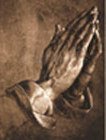
In humble gratitude to Hans for his years of sacrifice, the artist, the great Albrecht Dürer, painted a portrait of the hands that had labored so faithfully in order that he might develop his talent. He presented this painting of praying hands to his devoted friend. It has since become familiar to millions of people --- and perhaps, you have seen it.

When you have seen this painting of praying hands, remember the story behind it. When Jesus said that He is the bread for the life of the world, he meant that His sacrifice will nourish us all. We are like Albrecht, and Jesus is like Hans. Behind our lives is someone who labors for our salvation.

There is, however, a pressing problem: Have we been bread of life to others?


Note: I found this story in a book called, Bits and Pieces. However the internet has given me more information which I found while waiting to upload this homily. The internet story tells us that they were brothers, and the name of "Hans" in our story, is Albert. And Albert worked at the mines, because their father, Albrecht Durer the Elder, was a goldsmith. Albrecht studied in Nuremberg. Whatever the story, the essence still remains the same.

St. Lawrence and Deacons

11 August 2006: Friday of the 18th Year in Ordinary Time
St. Lawrence, Deacon and Martyr

St. Lawrence is one of the most famous Roman martyrs, was a deacon. Killed four days after Pope Sixtus, Lawrence became famous because of his youth, evangelical love for the poor, courage before his torturers, and sense of humor while dying. Tradition holds it that he was roasted to death on a grid iron. A beautiful basilica in honor of St. Lawrence stands in Rome.

In the feast of St. Lawrence, and in the presence of our deacon, Rev. William Garcia, I find it appropriate to talk about the diaconate. What is a deacon? Is he the first runner up of the priest? Almost thirty-seven years ago Pope Paul VI set in motion the restoration of the permanent diaconate with his apostolic letter of June 18, 1967, Sacram Diaconatus Ordinem, and shortly after, the US Bishops began restoring the permanent diaconate in the country. However, even with this promulgation, there is much misinterpretation and confusion concerning this ordained ministry. Case in point: In occasions when Rev. William gives communion beside me, many would rather line up in my line rather than his. There is a superstitious belief in an intellectual community in UP, that those who receive communion from a priest, will receive more blessings from the Lord. Hopefully no one believes that salvation is assured when they come to me.

Most Catholics are familiar with hearing about what sounds as two different kinds of deacons: the transitional deacons, who are ordained deacons as an interim step towards the priesthood like Rev. William, and the permanent deacons, who are single or married, well-known in the community for their exemplary lives and are active in their parishes. Vatican II, initiated the restoration of the order of deacons, and should be seen as a full, permanent, and stable order in its own right. There is only one order of deacons, as the praenotanda to the Rite of Ordination of Deacons makes clear. It is one of the ranks within the three-fold ministry of holy orders: episcopacy (bishops), presbyterate (priests), and diaconate (deacons). Vatican II recovered the ancient notion of the church as servant to the world, the Body of Christ that ministers to the world in order to help bring about its sanctification and redemption. This is the sacramental identity of the deacon, ordained to diakonia, or service.

Historically, a deacon was admitted to service at the Eucharistic table because he served at the table of the poor. In Paul’s letter to the Philippians, he addresses his letter to all the bishops and deacons at Philippi (Phil 1, 1); the services of deacons in (Rom. 12, 7). That is why, the deacon is one to announce petitions of the prayers of the faithful (General Intercessions). As one who worked directly with the sick, the poor, and the needy in the community, the deacon intimately knew their needs and brought these needs to the attention of the praying community as a whole. Thus the General Intercession of the Roman Missal sees the deacon, as holding “first place among those who minister in the Eucharistic celebration” (94). The deacon is thus called to bring the ministry of the church --- its mission of charity and justice --- to the workplace, to the community, to the neighborhood, and to all the places in which he lives and interacts with others daily.

The functions specifically assigned to the deacon in liturgy, at mass, are proclaiming the Gospel, preaching God’s word (homily), announcing the intentions of the Prayers of the Faithful, preparing the altar, serving the celebration of the Sacrifice, distributing the Eucharist to the faithful, especially the Precious Blood, and sometimes giving directions to the people for their proper gestures and posture.

One of the qualities being asked of candidates for those who will be ordained to be deacons is their love for the church. Many of them are sent where they are most needed. Love for the church means getting to know the Church and its servants better. And with a correct understanding of different services and servants, we may accord the same respect as we would of each other.

The Potter and the Dragnet

3 August 2006: Thursday of the 17th Week in Ordinary Time
Jeremiah 18, 1-6; Matthew 13, 47-53 The Potter and the Dragnet

Before we explain Jeremiah in the first reading, we first ask how a prophet knows the word of Yahweh since a prophet has to bear the word of Yahweh, and pass on the Yahweh’s word (dabar Yahweh) to others. A prophecy is not a quiet insight or a simple act of perception as when we are inspired by song or a beautiful sunrise. But the prophet suddenly becomes overwhelmed by a tremendous arrival. The prophet has an experience of grace, the word of Yahweh comes to him. The prophet receives the revelation in a psychic state and is experienced as a) visions, in which under divine influence, the prophet with his inner eye sees things and occurrences which an ordinary person does not see such as Ezekiel when he saw a valley full of bones (Ez 37, 1-2, 7-10); b) auditions or auditory experiences from the inner ear as in Isaiah 5,9; c) inspiration as when an overwhelming insight began as a reflection. The prophets were very much involved in the history of their day, and in the problems of their environment. The words of Yahweh came in the course of his encounter with his contemporary situation and his reflection; and finally, d) symbolic perception in which an insight comes in a reality or event in ordinary life. The most common and ordinary event becomes a symbol of a deeper meaning occurring in a people’s faith. The allegory of the potter in the first reading today, is an example of symbolic perception. The prophet Jeremiah watched a potter shaping clay in the southern section of Jerusalem, and gets the insight that God too molds and shapes his people.

How does God mold us into who we are today? The parable of the dragnet helps us see. A dragnet was used by Galilean fishermen. It is the sagēnē which is dragged on the shallow bottom of a lake and spread out on a rather considerable area so as to imprison indistinctly all the fish in the area. It involves the use of two or three boats with their crews. Afterwards, they begin to select or sort from the catch, keeping the worthy fish in a container with water, and throwing away litter, algae, shells, fish declared impure by Leviticus because they do not have scale or fin, or the inedible species (an eel for example was considered impure and inedible).

We will operate on two levels. First, it has to be said that we accept life as containing both the bad and the good. Our lives contain all sorts of people: the sinners and the saints; the drug addicts, the habitual criminals, the alcoholics, the social misfits, the destitute, the shameful, and the mediocre Christians. Such a mixture is inevitable. Entrance into the Church is for any body who is interested and, in a sense, even for those who are not interested, since newly-born babies are admitted on the faith of their parents. In Baptism, entrance into the Church is a starting-point, not a finishing line. Leave the sorting out to the Last Judgment.

But we can also talk on another level when sorting is done. Our lives are like dragnets that gather all sorts of things combined. We have both good and bad experiences. We have all sorts of things that we do --- desirable or undesirable. We meet all sorts of people who say all sorts of things that disturb us, inspire us, encourage us, disappoint us, or confuse us. And thus, part of growing up is to be able to make decisions including deciding values, virtues and principles that will become the foundation of our lives, our personalities, our identity and our view of life. These various experiences are used by God to mold us into whom we are today and who we will be in the future. Like clay to the potter: God continues to form us into better Christians.

Blessed Peter Favre

2 August 2006: Wednesday of the 17th Week in Ordinary Time
Memorial of Blessed Peter Favre
from Praying with the First Companions, for private use of Jesuits

We are familiar with religious debates on radio and television conducted not in a single program for purposes of enlightenment but in separate programs hosted by respective leaders of two different churches or religious sects. One pastor would say something derogatory to the pastor of another Christian denomination. If you watch their programs by accident and listened to them, didn’t you get frustrated or even scandalized? Is this really a proclamation of God’s words?

Our saint for today is not familiar to many of us. He is not as popular as St. Francis or Augustine or Dominic. He is Blessed Peter Favre, who is a companion of Sts. Ignatius and Xavier, founders of the Jesuits. The Society of Jesus, or the Jesuits, including Peter Favre, lived through what we know today as the age of the Reformation or the birth of Protestantism. At that time, Catholic princes would hunt down and destroy Lutherans, Calvinists and other dissenters and heretics. On the other hand, rulers favoring the Reformers proved adept at persecuting and slaying the Catholics. Statesmen and politicians, intent of removing opponents, were to find it convenient to do so in the name of religion, often came to persuade themselves that by such deeds of violence they were doing service to God.

When Pope Paul III sent Peter Favre to Germany in 1540, he had him attend the conferences that Catholic Emperor Charles V was conducting with Protestant leaders. The first of these conferences or “diets” was held at Worms. A second was held in the following year at Regensburg, formerly Ratisbon. The Emperor had the idea that discussions would be sufficient to bring back the Protestants who were attracting more and more followers through erroneous preaching and political pressures. But Favre was an ecumenist born four centuries early. An ecumenist is a new term describing someone who longs to restore the unity among Christians. He was a humanist who pleaded for calm instead of fury, conciliation instead of condemnation, and concentration on moral reform rather than on theological controversy. In other words, Peter Faver was saying, what Pope John XXIII said in 1960: “Stress what brings men together, not what divides them.” Before the 16th century, the Church preached to pagans with the policy that we have to bring them first to belief, and afterwards, a moral life. But Faver taught after post-Rennaissance Europe, that the correct procedure is the reform of the clergy and the faithful, both individual and collective. And then being renewed and purified, she might endeavor to win back by example and kindness the faithful who have left the fold. This is Favre’s words:

  1. Remember that if we want to be of help to them, we must be careful to regard them with love, to love them in deed and in truth, and to banish from our own souls any thought that might lessen our love and esteem for them.
  2. We have to win their good will so they will love us and readily confide in us by speaking familiarly on subjects about which we agree, and by avoiding points of discussion that might give rise to arguments... neither should we act towards them as though they were pagans, but rather to address ourselves to a person’s will, to their heart, as a means of approaching with prudence matters of faith.
  3. In preaching, avoid referring to the differences between Protestants and Catholics. Content yourselves with getting people to foster virtues, stir them so that they come to a true knowledge of themselves and increase in the knowledge and love of God our Lord.

Today, the door is wide open to dialogues between the Christian churches. The desire to recover the unity of all Christians is a gift of Christ and a call by the Holy Spirit, as articulated by the Decree on Ecumenism, in Vatican II in 1965. So, we ask ourselves. Recall times when you were in disagreement on religious issues with co-workers, fellow students, members of the family. How did you behave in such situations? When in the company of someone of a different religion, how do you feel towards them? When in the company of someone who does not practice Catholicism as piously as you, do you harbor thoughts that lessen your love and esteem for them or do you thank the Lord that you are far better than them? When you do, perhaps, Blessed Peter Favre might offer a great help.

The Weeds and Wheat of the Human Heart

1 August 2006: Tuesday of the 17th Week in Ordinary Time
Jeremiah 14, 17-22; Matthew 13, 35-43: St. Alphonsus M. d’Ligouri

The first reading from Jeremiah tells us about Israel’s unfaithfulness. Israel continuously worshipped idols and false gods. Each time, the people of Israel realize that false gods can do them no good, they turn back to Yahweh. The Gospel talks about the Parable of the Weeds and the Wheat. It was meant for those, like the Pharisees, claim that they could see the righteous from the evil ones. These righteous people are inclined to form exclusive circles of ‘respectable’ people. Jesus cautions them from such attitude. Fr. Nil Guillemette SJ, tells us that the Pharisees’ name for example, suggests that they are the ‘separated’ ones ---- and so they wanted to create a society of ‘pure’ believers. In the first century, an apocryphal book called the Psalms of Solomon claimed that in the coming of the Messiah, He would eliminate all weeds, all sinners from Israel so that the Chosen Race will be composed of perfect persons.

However, we run to risk of eliminating the saints in wanting to eliminate the so-called sinners from society. Many saints are non-conformist and their criteria of action always run counter to the accepted norms of society. Take for example Augustine, Ignatius and Charles de Foucauld who all started as sinners. Even Jesus was like a poisonous weed: he appeared so scandalous to the pious and ‘religious’ men and women of his time.

I guess we can translate the thought of the parable from the field of the world to the field of the human heart. In reality, there is no human heart that is pure enough, totally good, or totally evil. It is sown with the wheat and the weeds in varying proportions and intensities. In the secrecy of our hearts, we easily discern the weeds from the wheat, the good from the bad intentions, the “false idols and gods” that have determined our lives --- as the first reading tells us. Similarly with our neighbor’s hearts, which we do not have total access. We can morally evaluate their actions: when they help us in our studies, we say that is a good action; when they gossip about us, we say that it is a bad action. But we know that sometimes our helping others can be for selfish reasons, like those who would like to be popular would help the star of the campus in order to belong to the popular group.

Thus, if God has shown himself infinitely patient with Israel, sending rain to both the good and the bad, and He has shown Himself infinitely patient with us, then we should show infinite patience with our neighbors, who like us, are struggling to eliminate what they do not like about themselves. And as in our struggles, they too need the support God gives to the human heart whose fields include even the poisonous weeds.

Having Eyes But Cannot See

27 July 2006: Thursday of the 16th Week in Ordinary Time
Matthew 13, 10-17: Having eyes but do not see

The truth is simple in the Gospel today: Jesus came to reveal the Truth, but people failed to understand it. I have three points as experienced by prophets, by Jesus, and all those whose role is to teach.

First, Jesus and the prophets brought a message to people. The messages are clear to them, but they are puzzled because people cannot understand it. The experiences of many of us who preach, teach, or discuss things to our children, students or parishioners are that we try to tell them something which to us is relevant, interesting or important, but our listeners seem to lack interest and understanding. They even shrugged away urgent notices. Often, what means something to us, means nothing to them.

Second, many prophets such as Isaiah felt like talking to the hand as the expression goes. Many parents and teachers and leaders occasionally feel that they are talking to people with a closed mind and heart, and as far as we can see, they seemed to be getting worse than getting better. Many parents or even elder siblings are exasperated and frustrated with their children or loved one. Despite their advice and prodding, their loved ones do not listen and seemingly heading for ruin. Our words get from one ear and exits to the other.

Finally, a little consolation: The Jews believe that there is nothing outside of God’s will. That means, everything including all our frustrations and mistakes are somehow incorporated by God in His ultimate plan that it still ends up good. For example, St. Paul is clear when he said that the Jews rejected Jesus and the Gospel and because of this, the Gentiles were able to have access to them. Eventually, the Gentiles will bring the Jews together again.

Sowing Seeds

26 July 2006: Wednesday of the 16th Week in Ordinary Time
Memorial of Joachim and Anne, Parents of the BVM
Matthew 13, 1-9: The Sower

The Gospel today tells us about a man who sows seeds in his field. A person who sows must not look for quick results. There is no rush in nature’s process of growth. It takes a long time before a mango seed becomes a full-grown tree; as life’s lessons germinates in the heart of persons. But often a word, a gesture, a value or a life principle sowed in a child’s heart lies dormant until someday it awakens like a seed in contact with water. Often, the awakening happens in time to save a person from going down the drain or from ruin itself. I once came across a sound advice for parents: “Sound travels slowly. Sometimes the things you say when your kids are teenagers don’t reach them till they’re in their forties.”

And like seeds, there is a process of growth that one respects. In a time of instants and quick results, we often end up impatient over kids and adolescents, doing things photo-finished or submitting projects half-baked. I remember the butterfly story from Zorba, the Greek by Nikos Kazantzakis.

“I remember one morning when I discovered a cocoon in the back of a tree just as a butterfly was making a hole in its case and preparing to come out. I waited awhile, but it was too long appearing and I was impatient. I bent over it and breathed on it to warm it. I warmed it as quickly as I could and the miracle began to happen before my eyes, faster than life. The case opened; the butterfly started slowly crawling out, and I shall never forget my horror when I saw how its wings were folded back and crumpled; the wretched butterfly tried with its whole trembling body to unfold them. Bending over it, I tried to help it with my breath, in vain. It needed to be hatched out patiently and the unfolding of the wings should be a gradual process in the sun. Now it was too late. My breath had forced the butterfly to appear all crumpled, before its time. It struggled desperately and, a few seconds later, died in the palm of my hand. That little body is, I do believe, the greatest weight I have on my conscience. For I realize today that it is a mortal sin to violate the great laws of nature. We should not hurry, we should not be impatient, but we should confidently obey the external rhythm.”

As we celebrate the Sts. Joachim and Anne, parents of the Blessed Virgin Mary, we remember what it means to be parents or for to be in the business of parenting --- caring for students for example. Often parenting means to give work to children in order for them to know what life is all about. I remember a story of a father who made his boys to work in the rice fields while the other boys went swimming. His sister finally scolded the father saying, “Why do you make those boys work so hard? You don’t need all those rice.” The wise father replied, “Ate, I’m not raising rice. I’m raising boys.”

Joachim and Anne


26 July 2006: Memorial of Joachim and Anne, Parents of the Blessed Virgin Mary
Jer 1, 1.4-10; Psalm 71; Matthew 13, 1-9

Ancient tradition has recorded in the Proto-Gospel of St. James, an apocryphal work dating from 130-150 AD that identifies Mary's parents as Joachim and Anne. There is only one thing that I would like to say today as we remember Sts. Joachim and Anne, the parents of Mary: who Mary is reflects Joachim and Anne. Kung ano ang puno, siya rin ang bunga! The ability to obey the Lord at all cost must been learned from Joachim and Anne. The way Mary took care of Jesus must be the way she learned from her parents. The Gospel describes people like Joachim and Anne like the good soil on which the seeds of the Kingdom grow.

The Nephew

There’s a short story of a childless couple who had raised their orphaned nephew named David. He is now leaving them for college, and they’re at the railroad station. David looked at his aunt and uncle. She, with hands cupped and hard from selling fruit and vegetables outdoors in all kinds of weather, face ruddy and round and invariably smiling, the heavy body more accustomed to a half dozen sweaters at one time than a single coat, her hair the color of moonlight now, but the dark eyes still bright. He, with his slight, wiry body, strong and bent from lifting too many fruit and vegetable crates for too many years, the wind-burned skin, the swarthy face, the wry mouth; the childless couple who had taken the orphan David into their home, rearing him since the age of seven yet refusing to be called Mama and Papa for fear he would forget his real parents.

David grabbed their rough peddlers’ hands in his smooth student ones. “How can I ever repay you two for what you’ve done for me?” His uncle spoke gently, “David, there’s a saying, ‘The love of parents goes to their children, but the love of these children goes to their children.’” “That’s not so,” protested David, “I’ll always be trying to…” His aunt interrupted. “David,” she said, “what your uncle means is that a parent’s love isn’t to be paid back. It can only be passed on.”

Mary passed on the love of Joachim and Anne, her parents, to Jesus and to us. Mary passed on the love of God to us. That is why we call her our Mother. Do we feel blessed and privileged by this? Do you pass on the love of your parents to others? Or have we remained ungrateful to them? My final story which I got from a text message.

A Birthday Gift

A 21-year old son asked his parents for a car on his birthday. Unfortunately, his father handed him a bible. Instead of receiving it, he threw it, went mad and never returned home. He has raised his own family and years have passed.

Then his parents died in a plane crash. He went to the funeral and surprisingly found the bible he refused to receive when his parents gave it on his birthday. As he went on to the pages of the bible, he noticed an envelope with a car key and a letter that read, “Happy Birthday! We love you. Ma and Pa. The car is still in the garage.”

At Wit's End, Never at Hope's End


25 July 2006. Feast of St. James, the Apostle
2 Cor 4, 7-15; Psalm 126; Matthew 20, 20-28

St. Paul, in his second letter to the Corinthians tells us what Christian life is. First, he said, “We are persecuted by men, but never abandoned by God.” In other words, whatever happens to us, whoever abandons us, God will always stand by us. The loyalty of God is illustrated by our martyrs. To them, their sweetest moments with Christ are the times when they were at their most painful.

Today, we celebrate the Feast of St. James, the Apostle. He was born at Bethsaida, Galilee. He was a son of Zebedee, as the Gospel tells us, and he was the brother of John, the Evangelist. We know that he was the first apostle to die, martyred by Herod Agrippa I in 43-44 AD (Acts 12, 1-3). For St. James, his martyrdom is the closest he can get to approximate Christ’s suffering. It is when Christ’s suffering and his are one. St. Joan of Arc affirmed when she was abandoned, “It is better to be alone with God. His friendship will not fail me, nor his counsel, nor his love. In his strength, I will dare and dare and dare until I die.

Second, Paul tells us that we might be at our wit’s end, but never at our hope’s end. This means that there are times when we do not know what to do, but we never doubt there is something that can be done. There are times when we cannot see where we are going, but we never doubt that we are going somewhere, somehow. Per Jespersen has a story about hope. I have edited the story to make it just right for a homily.
Per tells us about Jack, who had a bad dream one night. The dream was clear to him, so he took out drawing materials from the cupboard and drew his dream. This was his dream.

A man is walking in a street in a town Jack does not know. All the houses are yellow, and there is a tree at each house. All the houses are alike with the same number of windows and doors, equally tall and equally old, with the same number of leaves and the same number of twigs. The man is lost and there is nobody to ask. He shouts, "Where is the hospital? I have to get to the hospital!" One window in each house gets up, and he hear voices shouting, "Go straight ahead. Just go straight ahead!" The man finally finds the hospital. This is the only different house in town --- yellow, and the tree in front of the building is quite unlike the other trees in town. He presses the door bell to get in: the gate opens by itself. A man in a long black robe received him, "What do you want?"

"I am ill,” the man says. It's my heart. It is so hot today and I am very weak. Can you help me?" The man in a black robe says, "Can I see your card?" The man finds a small plastic card and gives it to him. The black man takes the card and puts it into a computer; the man's gene-card is seen very clearly on a huge screen. Each pair of gene is examined, until all of a sudden the picture stops. A small green arrow shows up on the screen - pointing towards a pair of genes which seems to be different. "We can't help," the black man says. "You have no future.” The gene-card showed that the man was different from the rest.

"Sir, couldn't you make an exception?" “No,” the man in dark robes said. He gets up, pointing towards the door. As he leaves, the man shouts, "Why are there no exceptions? It is almost dark, and the man lies down to sleep.

A small boy comes running down the street. He runs directly up to the man; wakes him, but couldn’t. So, using his finger, he draws in the dust of the street - a pattern. And then the boy leaves. When the man opens his eyes, he is surprised. In the pattern are blossoming flowers--- and each flower is different. Not one is the same. The man, then said, to himself, “there is still hope.” For Paul, hope is built in the very love of God.

Gathering Around Jesus


23 July 2006: 16th Sunday in Ordinary Time
Jer 23, 1-6; Psalm 23; Eph 2; Mark 6, 30-34

The Gospel today tells us of Jesus’ time management. First, about work. Mark tells us that Jesus and his disciples are overworked that they have no leisure to eat. We also know that the disciples have been gone to preach the Good News. There are many demands. People follow him everywhere like sheep without a shepherd. Out of compassion for them, Jesus and his disciples tirelessly work for them.

In the life of a Christian, there are tasks to accomplish, responsibilities to do, and plans to be completed. There is work in the office, in school, and at home. There are people to care for --- the clients and customers, the academic and non-academic personnel, and members of our household. There are added demands for those who are involved in church and civic activities. A friend of mine told me, work would always be there; but not our loved ones.

Second, about gathering. The disciples come back and gather around Jesus, reporting what they have done and taught. They retreat to a deserted placed all by themselves to rest awhile. This is important. While we all move away from our home to work, who matters in our lives are those to whom we come back to. As the disciples come back to gather around Jesus, we too come home to gather around the family’s table to share what happened during the day. Unfortunately, families gather less these days. Captain Barbel, Majica, Bituing Walang Ningning or even our work have snatched precious family time from us. In the past, we did what the disciples did: at family table we reported what we had done, what happened during the day and who were the people we encountered. We used to treat meal times or at least, dinner as a holy hour --- we prioritized family time more than television programs and gimmicks.

Moreover, we gather to unwind for coffee or a late night movie with those we care about --- we do not unwind with people who cause us stress! Furthermore, just as the disciples gather around Jesus, we too gather around Jesus when we attend mass. We feel this gathering of disciples around Jesus especially when we come to Sunday mass.

But there is something more in the gathering and resting. Scientific study tells us that physical growth happens when we are at rest. It is the time when muscles, tendons and ligaments repair themselves. Muscle mass, for bodybuilders, are formed during downtime. Our brains develop new connections when we sleep especially on the 7th and 8th hour (Rapid Eye Movement or REM sleep). That is why, when we lack sleep, our performance is impaired. The same thing happens in our relationships. During mealtimes, family relationships are strengthened and enriched. During coffee breaks and movies, the muscles of friendships develop mass and tenacity. During Sunday masses, ligaments that connect our lives to God and God to us grow stronger.

Let us look at how we manage our time. If Jesus had time for his disciples, we too must have time for those we love. As we flex our muscles in work, we must also allow our heart to expand.

*The UP Filipiniana Dance Group, choreographed by Van Manalo, at the 11 AM Sunday Student Mass, Parish of the Holy Sacrifice, University of the Philippines.

Mercy Not Sacrifice

21 July 2006. Friday of the 15th Week in Ordinary Time
Isaiah 38. 1-6.21-22. 7-8; Psalm is Isaiah 38, 10-12.16; Matthew 12, 1-8

The readings today affirm one basic truth about God’s priority. Over and above any law, mercy stands at its highest. In the first reading, we hear about Hezekiah’s recovery from his sickness. Out of God’s compassion, Hezekiah was cured: God has heard his prayers and his tears. In the Gospel today, Jesus reiterated that God desires mercy and not sacrifice. The Sabbath is a time of worship in which believers sacrifice animals as atonement for their sins or as peace offerings. Jesus tells the Pharisees that the Sabbath is best kept by practicing mercy and compassion, in imitation of God’s saving work of love.

Let me tell a story: Banana Fritters

Nine-year-old Pepe decided one Sunday morning to make banana fritters for his parents. He found a big bowl and spoon, pulled a chair to the counter, opened the cupboard and pulled out the heavy rice flour canister, spilling it on the floor. He scooped some of the flour into the bowl with his hands, mixed in most of a cup of milk and added some sugar, leaving a floury trail on the floor which by now had a few tracks left by his puppy.

Pepe was covered with flour and getting frustrated. He wanted this to be something very good for Nanay and Tatay, but it was getting very bad. He didn’t know what to do next, whether to put it all into the stove, (and he didn’t know how the stove worked)! Suddenly he saw his puppy licking from the bowl of mix and reached to push her away, knocking the eggs, bananas and oil to the floor. Frantically he tried to clean up this monumental mess but slipped on the eggs, bananas and oil, getting his t-shirt dirty.

And just then he saw Tatay standing at the door. Big crocodile tears welled up in Pepe’s eyes. All he wanted to do was something good, but he’d made a terrible mess. He was sure a scolding was coming, maybe even a spanking. But his father just watched him. Then, walking through the mess, he picked up his crying son, hugged him and loved him, getting his own shirt dirty in the process.

This is how God deals with our human weaknesses and mistakes. We insult a friend or we can’t stand our officemates or our health goes bad or our relationships are on the rocks or our desire to pray is marred by too many distractions. We try to do everything right, but all the methods we do becomes a mess. Often, we stand before God in tears because we feel helpless and we believe we have tried everything. This is the time when God picks us up, loves us and forgives us, even though some of our mess gets all over Him. But just because we might mess up, we can’t stop trying to make ‘banana fritters’ for God or for others. Sooner it is in our trying that we will finally get it right. Often, we forget that the process of growing entails a lot of mistakes. If a father understands the process of growth, how much more will our Father in heaven do as much.

An Invitation to Rest

20 July 2006: Thursday of the 15th Week in Ordinary Time
Isaiah 26, 7-9.12.16-19; Psalm 102; Matthew 11, 28-30

The first reading is a lamentation psalm in which the psalmist looks back at all his past and sees all his fruitless labor and longs for God’s comfort. In the Gospel today, Jesus invites us, “Come to me, all you who are weary and find burdensome, and I will give you rest.” The Gospel is both an invitation and a promise: an invitation that whoever is burdened will find comfort in Him just as the psalmist in the first reading desired for God’s consoling embrace; and a promise of rest.

Many of us think that if a three-day work is good, then a six-day work is even better. Or if a five-day study is good, then a seven-days of study is even better. To those who exercise, if a three-day workout is good, then daily workout is even better. However, scientific study tells us that high-intensity work done every single day will eventually lead to burnouts and injury. One of the benefits of resting is that we allow our muscles, tendons and ligaments the time to repair themselves. To the body builder, the principle that muscle mass increases during down time --- that is, during rest --- is true. But it is not just muscles. Research shows that getting sufficient sleep is greatly beneficial. James Maas, Cornell psychology professor, tells us that if we get less than eight hours of sleep at night, working or studying is impaired. There is less alertness, productivity, creativity and generally health is affected. The reason is that in the 7th to 8th hour, we get an hour of REM (rapid eye movement) sleep, the time when the mind repairs itself and grows new connections.

What science tells us now, God has agreed since the beginning of time. One of the primary reasons for the 3rd commandment to keep holy the Sabbath day is rest. Just as the muscles, tendons and ligaments needed time to repair themselves, Sunday is used to repair or enrich our relationships with our family and friends. Just as muscle mass increases during down time, the muscles of our relationships are strengthened by restful activity such as eating together, watching movies together, having coffee with a good friend, coming to mass with those you love, and praying. Just as God rested in the story of creation, Psalm 127 says, “It is useless for you to work so hard from early morning until late at night, anxiously working for food to eat; for God gives rest to his loved ones."

But rest is not just for us. It is also for everything in creation. Exodus 23 tells us, "Work for six days, and rest on the seventh. This will give your ox and your donkey a chance to rest. It will also allow the people of your household, including your slaves and visitors, to be refreshed." Today’s interpretation is this: our computer also needs some rest.

In other words, when Jesus invites us to rest, he is saying that to pause --- as people say, smell the flowers --- is a necessity. We give time for growth. Resting, relaxation, sleeping, playing, taking private time for ourselves is part of our faith. Our faith is not just a faith of action; it is also a faith of being.

The Experience of Power


19 July 2006: Wednesday of the 15th Week in Ordinary Time
Isaiah 10, 5-7.13-16; Matthew 11, 25-27: In the Experience of Power

In the first reading, we hear Yahweh choosing Assyria as His instrument against an “impious nation.” The Gospel tells us of the disciples being chosen as Jesus’ instruments to those who have not heard the Good News. And by baptism, we are all chosen by God as His representatives in the present time. The power of the Spirit helps us read the events of the present times and see how God works in the world today.

There are however two pervading attitudes of those who were sent by God. First, is the path of the proud. Assyria boasts, “By my own power, I have done it!” Second, is the path of the humble. Jesus responds, “All things have been handed over to me by the Father.” In other words, Jesus acknowledges that his power comes from his Father who sent Him. God’s revelation has been given to infants, and not on the wise and intelligent.

We do have experiences of power. To those who have been educated in universities and centers of knowledge and skills, an achievement in a particular field is an experience of power. We know what we can do. To those who have been given responsibilities to direct teams, leadership positions are experiences of power. To those who have develop their skills excellently in the arts and in sports, a brilliant performance is an experience of power --- especially if one gets a standing ovation or the team gets the championship. The tendency of many of us brought in a rat-race culture is believe that this sense of supremacy and authority originates from our abilities alone. As Assyria would say, “By by own power, I have done it!” This is the path of the wise and the intelligent.

But Jesus gives us the opposite response. All things come from God --- even the sense of our own power--- as He would later tell Pilate. To acknowledge that our talents and abilities are gifts of God and does not originate from us is the attitude of the humble. However, to acknowledge that they are gifts includes using them at the service of God and neighbor. This is the path of infants --- those who recognizes their dependence on God. This is also the attitude of the saints.

A Firm Faith

18 July 2006: Tuesday of the 15th Week in Ordinary Time
Isaiah 7, 1-9; Matthew 11, 20-24: A Firm Faith

In the first reading, the prophet Isaiah urges Ahaz to be courageous despite the fear of the joint forces of Syria and Ephraim. The people too were afraid. Isaiah tells them to have faith in God. He says, “unless your faith is firm, you shall not be firm.”

In the Gospel today, Jesus tells the Jews that they have a privilege. They are able to witness miracles. And to witness miracles are helps to make faith in God firm and solid. Not all people will have such privilege.

In our prayers today, we end with the word, “Amen.” The root of the word, Amen, is the Hebrew verb, “Aman”, meaning, “to be firm.” It was often used to refer to the house of David, which God promised to “stand firm forever.”

Often, our prayers determine what we are at the time of when we pray. If we are discouraged, the content of our prayer is a yearning for hope. If we are lonely, the content of our prayer is a desire for companionship. If we are in the midst of crisis, the content of our prayer is a plea for strength. If we are confused, the content of our prayer is a search for clarity.

Nevertheless, there are two things that come out of our prayer. First, our hearts searches for past experiences that awaken courage, hope, love, clarity, or joy that would enable us to continue to trust and have faith in God. And second, the end of our prayer is both a reminder and commitment. Amen reminds us to stand firm. Amen commits us to continue to have faith as Mary, in midst of anxiety and faith, said yes to God. As ICTUS, who sings to day, has it as their motto, “Nothing without faith.”

Instructions for the Twelve

16 July 2006: Fifteenth Sunday in Ordinary Time
Mark 6, 7-13 Instructions for the Twelve

The episode in the Gospel today presents the sending of the Twelve on a mission to heal and to preach the Good News. The mission of the Twelve apostles was already prepared by the fact they Jesus specifically called them. Jesus gave them two primary instructions. First, that they take nothing for their journey. This means that a missionary must be poor, simple, frugal and trusting in God’s care. This is an old instruction to the present, “Travel light”. Traveling light facilitates mobility, availability and purity of testimony. Second, that they anticipate opposition: in the eventuality that people will not welcome you, shake off the dust that is on your feet. This needs explanation. To shake the dust off your feet is an act of rupture known in the ancient world. The person doing this signifies that he wants to take absolutely nothing of what belongs to the city or country judged unworthy --- not even its dust. Kung sa Pilipino, “wala akong kinalaman sa inyo.”

And Jesus sent them two by two. There is something important here: Jesus sent his disciples in pairs. Why two and not just one? First, this is to ensure mutual support amidst difficulties. The quality of our service also depends on feedback from a co-worker. A husband-and-wife team is able to rear a family better. A rector and scholastic is able to help each other grow in religious life. Second, it also means that the mission given to us is, in a sense, a community or ecclesial undertaking. When we are sent to speak and to act, we are speaking and acting in behalf of Christ and the Church, not only on our own. Here is a story when all of these points are placed together:

Breakfast at McDonald's

I am a mother of three (ages 14, 12, 3) and have recently completed my college degree. The last class I had to take was Sociology. The teacher was absolutely inspiring with the qualities that I wish every human being had been graced with. Her last project of the term was called "Smile." The class was asked to go out and smile at three people and document their reactions.

Soon after we were assigned the project, my husband, youngest son, and I went out to McDonald's one crisp March morning. It was just our way of sharing special playtime with our son. We were standing in line, waiting to be served, when all of a sudden everyone around us began to back away, and then even my husband did. I did not move an inch... an overwhelming feeling of panic welled up inside of me as I turned to see why they had moved.

As I turned around I smelled a horrible "dirty body" smell, and there standing behind me were two poor homeless men.

As I looked down at the short blue-eyed gentleman, close to me, he was "smiling". He said, "Good day" as he counted the few coins he had been clutching. The second man fumbled with his hands as he stood behind his friend. I realized the second man was mentally challenged and the blue-eyed gentleman was his salvation. I held my tears as I stood there with them.

The young lady at the counter asked him what they wanted. He said, "Coffee is all Miss" because that was all they could afford. (If they wanted to sit in the restaurant and warm up, they had to buy something. He just wanted to be warm). Then I really felt it: I smiled and asked the young lady behind the counter to give me two more breakfast meals on a separate tray. I then walked around the corner to the table that the men had chosen as a resting spot. I put the tray on the table and laid my hand on the blue-eyed gentleman's cold hand. He looked up at me, with tears in his eyes, and said, "Thank you.” I leaned over, began to pat his hand.

When I sat down, my husband smiled at me and said, "That is why God gave you to me, Honey: to give me hope.” My husband and I held hands for a moment. We are not church goers, but we are believers. I believe every good deed is always done in to benefit another, in behalf of God and the community.

I returned to college, on the last evening of class, with this story in hand. I turned in "my project" and the instructor read it. Then she looked up at me and said, "Can I share this?" I slowly nodded as she got the attention of the class. She began to read and that is when I knew that we, as human beings, as being part of God, share this need to heal people and to be healed. In my own way, I had touched the people at McDonald's, my husband, son, instructor, and every soul that shared the classroom on the last night I spent as a college student.

Any Christian then is by vocation or call, a healer. While not all have the gift to perform physical healing, nevertheless we all have the gift and the mission to heal hearts and souls just as the mother who has given hope to the two homeless gentlemen, her family, and the class she shared her experience. And finally, when we do all this, we do not do it by ourselves. People experience God by our single acts of love even when it is as simple as a “smile”.

Challenges for Disciples Like Us


12 July 2006: Wednesday of the 14th Week in Ordinary Time
Matthew 10, 1-7: Sending of the Disciples

Once there was a farmer who pleaded with God saying, “Lord, would you let me have control of the weather for one year? I think that I could raise a good quality of wheat.” The Lord agreed. “Just tell me what you want,” he said. The farmer said, “I want sun,” and the sun came out. After sometime he said, “Let there be rain,” and rain fell. For a whole year, the farmer had sun and rain whenever he wanted it.

When the wheat was tall and ready for the harvest, the farmer beamed with satisfaction, but when he cut the first stalks of wheat, his heart sank. The wheat stalks were practically empty. “What did I do wrong?” he asked the Lord.

The Lord said, “You never asked me for strong winds and fierce storms --- these are the things that make tall wheat strong and sturdy. You asked only for what was pleasant, that was your mistake.”

There are some people, when they do their Morning Prayer say this to God, “O Lord, don’t send me challenges today, no surprises, no hurts.”

While others say, “What are the challenges you are going to send me today?” These are the people who welcome opportunities to grow, the way a good wheat crop needs strong winds.

The Gospel tells us that Jesus called the disciple by name and sent them out to the lost sheep and to proclaim the Gospel. However, serving the Lord needs courage and strength. A good doctor underwent rigorous training. Our faith deepens in the midst of temptation. We can’t get pure gold unless it is tried in intense fire; or diamonds unless carbon is subject to great friction and polishing.

From The Very Depths


11 July 2006: Tuesday of the 14th Week in Ordinary Time
Matthew 9. 32-26: Compassion from the Depths

Have you ever been so moved to your very depths, that your heart sank and bled as those whom you feel deeply for? When we saw the victims of natural calamities such as the past floods, earthquakes and tidal waves, we find ourselves scrounging for food, clothing and medicines. We join the thousand of donors contributing to relief operations and disaster programs. When we see sick children flashed on television needing funds for a special surgery, we find ourselves jotting down the contact number and giving them a portion of our wealth. When we see an acquaintance, a friend, or a dorm-mate who always eats alone, we naturally feel the need to talk to them, no matter how shy we are. We all do feel a little pinch in our hearts when we see people alone. Moreover, our hearts become terribly affected when those who suffer are those we love. When their heart groans with sorrow and pain, we too feel their pain. Then we are moved from the depths of our being. This is what Jesus felt --- perhaps more intense than us.

The Gospel tells us that when Jesus saw the people who were bewildered and dejected like sheep without a shepherd, Jesus was moved with compassion from the depths of his being. The Greek word used for moved with compassion was splagchnistheis, which is the strongest word for pity. It comes from the word splagchna, from the bowels, and it describes the compassion of a person moved from the deepest core of his being.

The ministry of compassion remains a challenge in the Church. As the Church begins to be more institutionalized, the leaders of the Church or even its personnel may become inaccessible. For example, a mother needing immediate medicine for her sick child may find it strenuous to follow several steps before given money. Thus, we are able to help, but the bureaucracy shields us from involving our hearts, shielding us from further emotional investment. Thus, we can be compassionate at a shallow level, without being moved from the depths of our being.

However, the ministry of personal care (cura personalis) is a ministry of the Consoling Christ whose heart is affected from its depths by people who are in dire need. When our devotions bring us to the two hearts of Mary and Jesus, we are asked to pray that our hearts may be molded according to the two hearts that bleeds out of love for us. Blessed Peter Favre SJ wrote about this ministry of the consoling Christ. Peter Favre wished to be the one “who helps, delivers, heals, frees, enriches and strengthens” in order to bring to others “not only in spiritual matters, but also --- if such daring and hope are permitted by God --- in a material fashion, with all that charity can do for the soul and body of any of our brothers and sisters” (Memorial, 26.10.1542).

What Makes a Person

9 July 2006: 14th Sunday in Ordinary Time
Mark 6, 1-6 What makes a person?

When Jesus came to Nazareth, he was returning as a teacher, not a carpenter. He was coming, now as a Rabbi, who carried with him his own disciples. He taught in the synagogue, where people gather to listen to teachers. Ordinarily, Rabbis are given honor, but the people of Nazareth knew Jesus from boyhood, and they knew he was a tektōn. A tektōn was not merely an ordinary carpenter; he was a craftsman who could build anything from a simple table to a house. Homer said that tektōns in the ancient world built ships and houses and temples. And thus, because Jesus --- like his father, Joseph--- was a tektōn they refuse to believe him.

The Gospel speaks about a cultural attitude that looks down on blue-collared jobs, on people whose work does not find him in the tall buildings of Makati or Ortigas, but on the streets of Quiapo and the iskinitas of urban poor communities. It is an attitude that does not regard as honorable work by the sidewalks, vendors of fishballs, corn and isaw. We might have loved the famous products from the streets --- and UP is famous for its fishball and isaw --- but when it comes to the real thing, this attitude comes to the fore. When it comes to relationships, for example, we hear parents ask, “Kaninong anak ‘yan? Baka taga-diyan lang” (Whose child is he/she?). The culture of the present generation has it that certain things are “pogi points” --- you become more attractive if you have the following things: a car, a big house, or a glamorous career. It is not surprising that basketball and movie stars can move from one relationship to the other, while those who are from the backstage struggle to enter or keep relationships. Family background, pedigree and fortune still count to many as matters of great worth.

But what makes a person great? David Aikman, in his book, “Great Souls” said that he has always been inspired by the lives of great people, how they have risen from adversity and maintained a kind of purity in the midst of great temptation. If we follow David Aikman’s thought, then the fishball, corn and isaw vendors, the maintenance crew and the canteen staff count as great people. If you come to get to know them, they struggle to rise from great adversity and maintained a faith in God, stronger than death or a financial crisis. The Gospel tells us that the people of Nazareth referred to Jesus as “Mary’s son” meaning Joseph had been dead and Jesus who took over Joseph’s craft, took care of his family till he was thirty. Their souls and their hearts --- like Jesus --- are stronger than many of us. It is no wonder that Jesus preferred to be an ordinary and simple tektōn --- not a king or a political leader. It is to make the statement that greatness does not lie in how rich or popular you are, what position you have or who your friends are, or how beautiful or handsome you are. Greatness lies in character. Character forged by great adversity; strength tested in fire. This is what makes heroes and saints. This is what makes a person unforgettable.

A final word. To those of you who study: remember that when you leave the university, think who have saved you from great adversity. Get to know at least one of them. The photocopier who hurriedly copied your handouts and reviewers, the isaw and fishball vendors who provided instant food that fits your meager allowance or the meal vendor who with their small capital allowed you to give you a meal on credit, or the janitor who kept your rooms clean and liveable --- these are the people to whom you owe survival in a huge university as UP. To them you owe valuable service. Consider: a tektōn --- not a king or a president --- has saved the world.

The Importance of Friends


6 July 2006: Thursday of the 13th Week in Ordinary Time
Matthew 9, 1-8: Cure of the Paralytic

From Mark 2,1 we learn that this incident took place in Capernaum; and it is interesting to note that by this time Jesus had become so identified with Capernaum that it could be called his own town. At this stage in his ministry, Capernaum was the center of his work. The Gospel tells us that a paralyzed man was brought to him, carried on a bed by some friends. Here is a wonderful picture of a man who was saved by the faith of his friends. Decree 8 of the 34th General Congregation of the Society of Jesus says that friendships can "support a life of dedicated chastity" and "deepen the affective relationship with God." Let us learn from our saints.

St. John Chrysostom said that "a friend is dearer to us than the light of heaven for it would be better for us that the sun was extinguished than that we should be without friends”. One of my favorite passages in Scripture is found in St Paul's Second Letter to the Corinthians. Here the real Paul speaks so openly about his pain: "When we came to Macedonia, our flesh had no rest, but we were troubled in every way, with conflicts without, fears within. Nevertheless God who comforts the downcast, comforted us by the arrival of Titus (2 Cor 7:5-6).” When I first read this passage I had expected something different. I thought St Paul was going to say that perhaps in prayer God had directly comforted him in his difficulties. Or that perhaps God had graciously taken away his troubles, and delivered him from the conflicts and fears. To my surprise and delight Paul simply says that God Himself comforted him----through the arrival and presence of a friend!

Another favorite passage of mine from St Augustine is similar in its message and tone. Augustine says: "I confess that I give myself entirely to the love of my friends, tired as I am of the troubles of this world. In this I am perfectly at ease, for in this common love I experience God in whom I trust and in whom I take my rest in peace."

Both Paul and Augustine know something of the profound joy of friendship. They knew, by experience, what Scripture says about a good friend: "A faithful friend is a sturdy shelter; he who finds one finds a treasure. A faithful friend is beyond price....." (Sirach 6:14-15).

Life is better with friends! In fact, The Imitation of Christ puts it quite bluntly when it says: "Without a friend thou mayest not long endure." And I find it fascinating that even as Jesus, in His farewell discourse, speaks about giving us a share in His own joy, almost immediately He calls His disciples His "friends". Friendship is indeed one of the deepest joys of life.

Probably not too many would qualify for one definition of a friend given by Stuart Miller in his book Men and Friendship: "As much as anything else, friendship is the inner habit of holding someone who is neither spouse, nor relative, nor teacher, nor lover, in your heart." We can lose sight of the specialness of those whom God has given us to be genuine and real friends: persons who have become a vital part of our lives. Persons we can laugh with, cry with, enjoy with, fight with. Nevertheless, we know they are interested in me as a person, concerned about my well-being, willing to do what they can to make my life happier and for whom I have the same interests at heart. Persons whom we could say, as did St Paul when he sent Onesimus back to Philemon: "I am sending you my own heart." (Philemon v.12).

One great Christian, rich in numerous friendships, wrote these words as he grew older and wiser: “The Scriptures and the history of the Church are filled with stories of great and beautiful friendships; it seems that God has done some of His best work through friends.” St Gregory the Theologian spoke of his incomparable friendship with St Basil: "It seemed as though we two had but one soul; and though we must not hold that all things are in all things, yet you must believe that we were two in one and each in the other, having the one aim: to practice virtue and to center our life on eternity, thus passing beyond this mortal life while still in the world."

My experience confirms that our friends come "at the right time”. They come most often when I am hardly aware of needing a friend. I'm sure each friendship has its own unique "unfolding", just as each relationship is different and unique. Yet it has been helpful to me to realize that friendships, the real and lasting ones, come as a result of looking outside myself and being involved in living life and in the objective world outside my inner self.

One helpful insight (so simple and yet so profound---and that flashed on me after many years of living and "learning!") has been the realization that we are all made of the same stuff. I have tried to identify those things that have made me feel good and try my best to bring these into my own friendships. For example, I like to be affirmed as a person. I notice that whenever anyone compliments me (be it about work well done or about the color of my eyes!) I delight in this. So I do try to notice whatever I find attractive about my friends and, at the right moment, let them know this. They seem to delight in this as much as I do! It seems to me that we miss countless opportunities to do this, as we take so, so much for granted. Love is creative and finds ways to affirm and compliment and thank and to appreciate---even if in the midst of mostly routine and ordinary exchanges and chores. Love will find a way, and a right time and without overmuch protestations and self-consciousness.

Friendship is different than sexual love and attraction, which is mostly about two who gaze into each other's eyes and hearts; friendship is mostly about two or more who look together in the same direction. But even friends need the occasional and well-timed word of affirmation and gratitude if it is to abide and grow. Friends can be truthful with one another. Even if, at times, it hurts. An honest sharing of some negative feeling or some concern and even criticism has a place in any relationship that is alive, and grounded in reality. But if the negative word comes from the heart of a friend, even that honesty can make us, deep down, feel good and blessed: to have someone who cares enough and trusts me enough: another "affirmation" of my full personhood. William Blake says it well:

I was angry with my friend;

I told my wrath,

My wrath did end.

I was angry with my foe;

I told it not, My wrath did grow.

The Three-in-One God communicates His Love to us through human persons. That's why St Paul could say, so boldly, that God Himself comforted him through the visit of a friend. That's why St Augustine could say that in his friendships he experienced the God in whom he finds his rest. That's why St Gregory could say that in his friendship with St Basil he already had a foretaste of eternity. The friends we have are a precious treasure in which we learn and taste something of God's Trinitarian love for us and communicate something of our love for Him. Passing from Christ to friend, and from friend to Christ: a sign of a true spiritual friendship and a foretaste of heaven where God will be all in all! Our journey to this homeland may be long and hard. Most of us are pretty wounded people, and have more than our share of "conflicts without, and fears within." But the journey, both difficult and exciting, is surely made a lot easier with friends accompanying us along the way. A shoulder to cry on is one of friendship's offerings. As well as helping us to laugh (often at ourselves!) as only friends can do. So let's not take these treasures for granted. To our friends, our own "Tituses", let's say, from the bottom of our grateful hearts: Life is better with you! To Christ, who calls us astonishingly, "friends" (Jn 15:15), be all glory and all the love of our hearts!

*my friends from Canto Cinco (C5).

Demons in Our Lives


5 July 2006: Wednesday of the 13th Week in Ordinary Time
Matthew 8, 28-34: The Demons in Our Lives

The ancient world believed in demons. It is said that they were descendants of the fallen angels in Genesis 6, 1-8 who seduced mortal women. The ancient world believed that the world was filled with demons that lived in unclean places such as tombs, deserts where their howling can be heard. These demons are dangerous to many especially those who are pregnant, to the newly-weds, to children and those who were out at night. To them, the ancient world ascribed all illnesses. The Jews believed that in the coming of the Messiah, these demons will be defeated. And to the demon-possessed, Jesus cured them by sending the demons into the herd of pigs and drowned them at sea.

Nevertheless, we talk about different kinds of evil spirits, different demons that control us like pride, jealousy, envy, and insecurity. John Milton (Al Pacino) in the film, The Devil’s Advocate (1997), says, “vanity is my favorite sin.” We can talk about external demons that destroy our health and our relationships like food, alcohol, drugs, wealth, and other people whom we are obsessed with. They control us and influence our decisions powerfully.

Furthermore, it can be our selfishness as seen in the last lines of the Gospel. When the caretakers of the herd of pigs ran to the town to tell the story, the townsfolk wanted Jesus to leave the town. They did not care about the two men who were cured of their illness. They cared for the herd of pigs that perish. They cared for their own concerns but did not care for others --- or even rejoiced with fortune of being ‘sane’ again.

Most of us live our lives focused on our immediate needs and our immediate problems. If we thing beyond these, it is usually in terms of our immediate relationships. Our lives are shaped by our past. Often, we carry that past with us, as if we were houses haunted by ghosts, spirits and demons that refuse to leave. These are the traumatic moments that have stunted our growth and made us closed, grumpy, cautious, insecure, and wounded. Unless we become aware of these traumas and we experience being transformed by love, these demons continue to pester us. And it may even kill us spirituality. Some have stopped praying or coming to mass because they do not believe in a God who loves them. Their experience of abandonment and loneliness and frustration made them believe that God has forsaken them --- or He does not exist altogether.

Today, we must ask the Lord to search our hearts for the demons that hide in it. We can sing with the Psalmist in Psalm 139, 1-3:

O Lord, you have searched me and known me,

You know when I sit and when I stand.

You discern my thoughts,

You search out my path

And are acquainted with all my ways.

And after that we ask God what St. Ignatius urges those who do the Spiritual Exercises: for an understanding of our demons that filled with horror of them, we may amend our lives and put it in order. (Spiritual Exercises #62)

*a view from Mirador, Baguio City where I had my retreat last May 2006, doing the Spiritual Exercises of St. Ignatius.

Stand By Me


13 July 2006: Tuesday of the 13th Week in Ordinary Time
Matthew 8, 23-27: The Calming of the Storm


The Gospel today reminds me of "Stand By Me" a movie in 1986. The death of a friend, causes a writer --- Gordie --- to recall a boyhood journey he took in the summer of 1959 with three friends--- Chris, Teddy and Vern --- to find the dead body of a missing boy. Each of these boys carries the past with them, their storms in their lives: Gordie, the death of his brother; Chris, his reputation; Teddy, his abusive father, and Vern, his image as a fat kid. There were all wounded, cautious and insecure. In one scene, Chris tells Gordie not to give up being a writer, a gift that God gave him. Chris feels he has to say this --- in place of it being said by Gordie’s father because, “Kids lose everything unless someone is there to make sure they don’t.” In the end, Gordie, the writer says this, referring to Chris, “Although I hadn't seen him in more than 10 years, I know I'll miss him forever.” The presence of friends calms the most terrible of tempests. An excerpt of the original song by Jerry Lieber expresses this theme:

If the sky that we look upon
Should tumble and fall
Or the mountain
Should crumble to the sea
I won't cry, I won't cry
No, I won't shed a tear
Just as long as you stand
Stand by me.

Whenever you're in trouble
Won't you stand by me, oh stand by me.

And this is precisely the meaning of the Gospel today. When the storms of life shake us, Jesus’ presence turns them to peace. Jesus stands by us: He makes sure that we don’t lose our lives.

Another song became a soundtrack in the video of the death of a friend who died protecting a student in Cambodia. Richie Fernando SJ was my batchmate in regency. The refrain of “Far Greater Love” says:

The storms of life may shake our ground; a greater peace still dwells in our hearts.
The dreams we build may fall apart; a deeper hope still runs in our hearts.
Fear no harm we are ruled by a far greater love.
We’re never alone, all else may go wrong.
Still will there be, a love far greater than our hearts.

The reason why Jesus stands by us, present in the same boat as us, is this: His love is far greater than ours.

*Will Wheaton (Gordie), River Phoenix (Chris), Corey Fieldman (Teddy), and Jerry O'Connell (Vern). from IMDb.