Jesus Begins His Ministry


9 January 2007: Tuesday of the 1st Week in Ordinary Time
Mark 1, 21-28: The Beginning of Jesus’ Public Ministry

The story of Jesus according to Mark presents some natural steps for someone who embarks on an important career. Jesus is recognized in John’s proclamation that his role was only to prepare the way for someone greater than he. Jesus is then baptized, and then receives the blessing and recognition from God. With the Holy Spirit descending on him, Jesus is now equipped for his ministry. Then his principles are tested by the devil in the desert. From then on, he chooses his disciples to whom he would pass on his message. With all of these in place, Jesus launches his career in the synagogue.

The synagogue is a logical place for a launch. You see, when we launch our CD albums, we go where our market is. Jesus went to the synagogue. First, the synagogue is like a school: the faith is taught there. Jewish law has it that synagogues can be put up wherever there are at least ten Jewish families. A synagogue session consists of a prayer, the reading of Scripture, and then the explanation of the Scripture. Second, since people gather there, it is the perfect place for someone with a religious message.

The people who heard Jesus teach were spellbound. No one teaches with authority and power. And not just that: Jesus supported his teaching with his deeds: What he says, he does. Jesus was an excellent teacher. He profoundly affected those who listen to him and thus built a foundation for values and beliefs, our society and our way of life.

Today, we look at the teaching aspect of being Christians. We preach with our words. But only when our words are products of accumulated lessons taught, learned and lived over a lifetime, the impact of what we say is stronger and influential. Sometimes it is a phrase or a word spoken, deliberately or mindlessly, in a critical moment of vulnerability, that begins an action, adds an encouragement or the beginning of wisdom. It is what we remember and affect us in timeless ways. Someone once said that we can accelerate learning for all students, especially the problematic ones, by building relationships. Using powerful, positive words is a great way to begin a trustworthy relationship. I have a story.

A group of frogs were traveling through the woods, and two of them fell into a deep pit. All the other frogs gathered around the pit. When they say how deep the pit was, they told the two frogs that they were as good as dead.

The two frogs ignored the comments and tried to jump up out of the pit with all their might. The other frogs kept telling them to stop. Finally, one of the frogs took heed to what the other frogs were saying and gave up. He fell down and died.

The other frog continued to jump as hard as he could. Once again, the crowd of frogs yelled at him to stop the pain and just die. He jumped even harder and finally made it out.

When he got out, the other frogs said, “Did you not hear us?” The frog explained to them that he was deaf. He thought they were encouraging him to entire time.

The words we speak are powerful. Just as Jesus’ words affect us, we too are invited to use words that will build up, not tear down, someone so that behaviors are positive. A wise teacher said that if you want to save and inspire students, you don’t have to tear down their house, but merely suggest or show them a better house in which to live. Henri Amiel once said of what teachers are: “The highest function of the teacher consists, not so much in imparting knowledge as in stimulating the pupil in its love and pursuit. To know how to suggest is the art of teaching.” Jesus has given us a better alternative to just living.

It is no wonder why he healed a demon-possessed. Demons in those days are called mazzikin, one who does harm. Teaching allows us to fight against the demons of ignorance and limitations. In order to be a good ‘teacher’, whether as a parent or a friend, we help people discover their greatness and possibilities within themselves. I guess that is what we need today. We are in a world that discourages people than encouraging them. In a highly competitive world, the Christian preaches with powerful words of affirmation and compassion. And thus, we ask this question for reflection today: Do I build up people, or do I destroy them? Give concrete examples when you build up people, and when you destroy them. With words that give importance to people, all of us Christians will help build the Kingdom of God which Jesus first launched in a synagogue.

*xavier university high school 4A 1997, my moderating class. Dondino, Brent, Niku and Kenneth were just four among the all-boys 49-member class. They were 15/16 years old when I taught them Christian Humanism and English. Their class was my inspiration during my two years of Jesuit regency. Their lives aided me to finally pursue priesthood.

No Three Kings!

7 January 2007. Feast of the Epiphany
Matthew 2, 1-12: The Magi

Today, people greet me with the traditional, “Happy Three Kings, Father!” Let me first say this for its shock value: THERE ARE NO THREE KINGS! Now that I have your attention, let me explain.

Matthew’s Gospel tells us that when Jesus was born, there came to give him homage wise men from the East (Matthew 2, 1). Those who came to visit Jesus were called the magi (magus in Greek). Herodotus, a famous historian, wrote that the magus were from the Median tribe who were suppose to overthrow the Persian government, but their influence was curtailed by Cyrus the Great and his son. Media was then absorbed into the Persian Empire around 550 BC. Shunning all political activities, they became priests whose activities included funerary services. Later, they accepted the Zoroastrian religion, but keeping many of their former practices. They were to the Persians, what the Levites were to the Jews. In Persia, no sacrifice can be made without the presence of the magi.

The magi were good men who were known for their expertise in the natural sciences, philosophy and medicine. During their time, people were very much interested in astrology. They believed that they could foretell the future by reading the stars and the destiny of human beings were already determined by the star on which the person was born. The Gospel of Matthew tells us that these wise magi followed a star, commonly referred to as “The Star of Bethlehem”. Whether it was a star or an astronomical event such as the conjunction of the planets Jupiter and Saturn (7 BC) or a heliacal event (as translated from the Greek, anatole, “rising from the morning”) meaning a star above the horizon but hidden because of the brightness of the sun. In ancient astrology, the appearance of a ‘star’ means the birth of royalty. Thus it was not surprising that the wise men from the East, who paid particular attention to the stars, came to follow that bright star to Jerusalem (Matthew 2, 1) to pay homage to the future king.

During that time, there was a growing expectation of a king. Both historians, Seutonius in his book, Life of Vespasian, and Tacitus, in his book Histories, tell us that during those days an old belief was gaining popularity. They believed that a great king will be born in Judea, and he will be great, gaining universal empire. The scriptural basis of this belief is from the Masoretic text of the prophet Micah 5, 1-3, as quoted by the chief priests of Herod, “But you, Bethlehem Ephrathah, though you are little among the thousands of Judah, out of you will come for me one who will be ruler over Israel, whose origins are from of old, from ancient times.”

Matthew tells us that these wise men gave Jesus three highly symbolic gifts: gold, frankincense and myrrh. Gold is given to kings; frankincense is given to priests; and myrrh, an embalming oil, is given to the dying. These items became emblems of Jesus’ life: Jesus is King; Jesus is Priest; and Jesus’ death is our salvation. One can still hear its medieval significance in John Henry Hopkins’ song, “We, three Kings” composed around 1857. Thus the three wise men were indeed ‘wise’ because they have given the appropriate gifts to Jesus, and at the same time, was able to recognize the true identity of Jesus.

Thus, it is widely accepted that there is nothing in scripture that tells us that they were kings, and that they were only three people from the East who came to seek Jesus. And thus, the religious significance of this homage to Jesus shifts from the “three kings” to the epiphany: the wise men of the East were witnesses that God has indeed become one of us. Epiphany, when translated from Greek, means “the manifestation of God” as man, with a definite name (Jesus) --- ang pagpapakita ng Diyos sa atin bilang tao; may hugis, may pangalan (Hesus) at taong-tao (dyumi-dyingle, dumu-dumi, nagkaka-amoy-pawis tulad nating lahat.

As we celebrate the first Epiphany of Our Lord on the first Sunday after January 1st, let us reflect on our lives and see how God had manifested Himself to us. Be sure that we are able to concretely identify the event: what, when, where, who were the instruments of His presence, what were you feeling, etc. And when we are able to concretely see the times when we greatly experience these manifestations of God in our lives, then we ask ourselves too: What appropriate gift should I give to God?

Happy Epiphany to all!

Why Do You Believe


5 January 2007. Friday Before Epiphany
John 1, 43-51: The Call of Nathanael

The Gospel today presents to us a pattern of discipleship. Andrew brings his brother Simon Peter and said, “We have found the Messiah.” Philip founds Nathanael, and said, “We have found him”. The role of disciples is defined by the pattern of each one bringing another to Jesus. Therefore, a disciple is one who brings another to Jesus.

This is the first point for us to reflect on: Who brought us to Jesus? Our faith grows because of many disciples of Jesus. When we were baptized, our parents and godparents promised to rear us in the faith. I remember my parents bringing us all to church every Sunday at 8 AM. As we grow older, our teachers and friends contribute to the growth --- or reduction --- of our faith. In later life, someone or an organization may have brought you to a deeper understanding and love of Jesus.

The Gospel tells us that Philip identifies Jesus as the Messiah, who comes from Nazareth. And Nathanael replied, “Can anything good come out of Nazareth?” (May mabuti bang pwedeng manggaling sa Nazareth?). Why is the response of Nathanael very skeptical, hindi naniwala at may pagkamataray? You see, Nathanael was an Israelite: he knew the Old Testament, and there is nothing in the Old Testament that refers to God’s Messiah as coming from Nazareth. Nazareth was a quite undistinguished place, and God’s chosen One cannot come from such a small town. At that time, there was rivalry and jealousy between towns and villages. Philip did not argue, he just said, “Come and see.” Who were the “Philips” or the significant disciples in your life who brought you to a deeper understanding of Jesus?

When Nathanael finally meets Jesus, he was surprised that Jesus can see who he was. Jesus remarked, “A man who is really an Israelite! A man whom there is no guile. (Isang totoong Israelitang walang pagkukunwari!)” And Nathanael demanded how Jesus could know him in so short an acquaintance. Jesus told him that He saw him under the fig tree. What is the significance of the fig tree? The fig tree is a symbol of peace, and no one can be disturbed when under it (1 Kgs 4, 25; Micah 4, 4; Zech 3,10). Moreover, studies of the Torah were usually done under a fig tree. In Hosea 9,10, God said, “Like grapes in the wilderness, I found Israel. Like the first fruit on the fig tree... I saw your ancestors?” For Nathanael, Jesus’ remark about him meant two things: Jesus complimented Nathanael as a true Israelite, and Jesus had some divine knowledge.

With that, Nathanael believed. But Jesus poses an important question, “Do you believe because I told you that I saw you under a fig tree? You will see greater things than these.” It probes into the source and authenticity of the faith of Nathanael, and raises the second question for us: What therefore constitutes faith? Ano ba ang tunay na pananampalataya? Do you believe because you are afraid of hell or the punishment of God? Do you believe because of parental or peer pressure? Do you believe because you feel guilty if you do not fulfill your obligations? Do you believe because you want to see miracles? Or, who is a better believer: the one who attends mass but treats her househelp unjustly, or the one who cares for the rights of workers but declares he doesn’t believe in God?

St. Francis Xavier SJ, has a prayer, O God, I Love You (O Deus Ego Amo Te) that illustrates why he believed:

O God, I love You, I love You ---

Not out of hope of heaven for me

Nor fearing not to love and be in the everlasting burning.

You, You, my Jesus, after me did reach your arms out dying,

For my sake You suffered nails and lance,

mocked and marred countenance,

Sorrows passing number,

Sweat and care and cumber,

Yes and death, and this for me,

And You could see me sinning.

Then I, why should not I love You,

Jesus, so much in love with me?

Not for heaven’s sake; not to be out of hell by loving You;

Not for any gains I see;

But just the way that You did for me

I do love and I will love Thee:

What must I love Thee, Lord, for then?

For being my king and God. Amen.

There are two points raised today: Who brought you to Jesus and what constitutes your faith? We can do a little twist to these questions: With what you say and what you do, how do you bring others to Jesus? How do you help others deepen their understanding of Jesus?

Discerning our Vocations


4 January 2007. Thursday before Epiphany
1 John 3, 7-10; John 1, 35-42: Discerning our vocations

Everyone has a vocation. We are all called to be Christ’s disciples like Peter and Andrew whom Christ invited to follow him. The word ‘vocation’ --- a call or an invitation --- does not only mean the priesthood or the religious life. It is a term for everybody. Fr. Thomas Green S.J. defined a vocation as “a call from God to follow Him in a particular form of life (lay, priestly, religious), which may then be further specified.” For example, if you are considering the priesthood, would you want to be a diocesan (like Fr. Raymond Arre, who is our parish priest) or a religious (like me)? And if religious, what congregation or order do you want to be: Jesuit, Dominican, Franciscan, Benedictine, Blessed Sacrament, Paulines, etc.)? In addition, if you want to be a lay person, would you want to be married or single? And in what way would you want to live your life? In other words, the call of the Lord for us is simply to be his disciple or to be truly children of God. But how to be his disciple is left for us to discern. Our personal way to the Lord has to be discerned properly.

There are many students and young professionals who have asked me about vocation. And perhaps today, we shall see certain steps to be able to discern our place in the greater scheme of things. Discernment (as distinguished from decision-making) is a prayer: it is discovering in prayer how God wishes us to act in a particular vocation (Luke 9, 57-62). Let see some steps and prerequisites.

First, ask yourself about the state of life the Lord is calling you. Is God calling you to be a lay person, a priest or a religious? If religious, what congregation or order? If lay, married or single?

In discerning the state of life, there are natural prerequisites, since ‘grace builds on nature’ (Thomas Aquinas) and the God gives particular graces in order for us to fulfill His call. A specific vocation needs sufficient intelligence for the life in question, mental health, sound common sense, and the strength of will to follow practical judgments. If you are married, it needs some manageable neurosis and transcendence of self: one cannot live with another if he or she is too self-centered to consider the needs of others other than himself. Or, as a lay person, you want to become an engineer, perhaps you must have a higher mathematical-logical intelligence to become one; and a sound common sense, or else, you may cause a bridge to break.

Second, there is an interior grace of vocation. It is not just the natural prerequisites that are needed; there are others who possess all them but may not be called to that particular state of life unless he or she considers his personal call from God. It's the "ok lang, pero hindi ko siya feel." You find where you fit and feel 'at home'. And this is done gradually over a length of time. The whole college life is a good time to discern.

A valid motivation is very much required. Why do you want to be a doctor? If your motivation is just to earn money, and nothing else, perhaps, you better consider other professions or else, you might endanger people’s lives. If your motivation is clear, that you love your neighbor and this is the best service you can give them, and that this is your response to God’s love, then perhaps, you are in the right path.

However, our motives may be mixed (part valid, part invalid such as prestige and security), our core motivation can become clearer only by prayer and the ability to face oneself squarely. The spiritual results can be discerned by concrete manifestations. If you want to be a priest, do you find yourself attending mass, not as a requirement, but you just love attending mass; do you pray often; can you live a celibate life? If you want to be married, are you able to maintain your relationships well? If you have a steady relationship (a boyfriend or girlfriend), are you faithful to him or her? What is the level of honesty and communication between both of you? And in preparing for marriage, have you tried to be financially stable so that you can actually raise your family especially your children?

Finally, we discern our vocation gradually. No one experiences what St. Paul had by a blinding light and Jesus telling him what to do. For most of us, we do it in prayer and with a sufficient self-knowledge and acceptance. Some people go through transitional vocations. I have a friend who was a successful bank manager. After a few years, she said she was becoming restless and unhappy. She came for a discernment retreat, and finally, decided to try what she wanted to do all her life. She now runs a restaurant, and her vegetables are products of her own organic farm. She said she is very happy and less stressed.

There is a tendency for us to be sigurista --- we want to be perfectly certain. But experience tells us that things don’t get perfectly certain. Even science: certitude is determined by the same result from numerous tests. Thus, a large part of it is the leap of faith, to trust God at each step. And when our heart reaches a certain clarity, then decide --- that’s the last natural requirement. We need to decide and follow that decision headlong. If not, then perhaps be resigned to grow old asking the dreaded question, "What if?"

*someone who discerns --- a retreatant --- at Sacred Heart Novitiate in Novaliches, Quezon City.

The Johns of our lives


3 January 2007: Wednesday before the Epiphany
1 John 2, 29- 3,6 & John 1, 29-34: The ‘Johns’ in our lives

In the public life of Jesus, many people did not recognize who Jesus truly was. Thus when the evangelists wrote the Gospels, they introduced Jesus to the people. The writers of the Gospels, especially John, presented Jesus at the beginning of their stories. The Gospel today from John tells us about John the Baptist who identified Jesus as the “Lamb of God who takes away the sin of the world.” And at the end of the passage, John would testify to the truth that “Jesus is the Son of God.”

In the first letter of John, the first reading today, he reminds us that we are truly ‘children of God.’ And that what and who we are. This disciple of Jesus was also the first one to recognize and believed in the resurrection. And at the Resurrection accounts on the Lake of Tiberias, John would tell Peter, “It is the Lord!” as they followed Jesus’ instruction to throw the nets into the sea for a great catch.

Both Johns --- John the Baptist, and John, the beloved disciple --- identified Jesus and helped others recognize Him at moments of darkness. Today, we shall identify who our “Johns” are in our lives. The “Johns” in our lives play pivotal roles when we experience darkness or hopelessness.

Chris Daniel M. Losa was a prenovice in Arvisu House when I was there. His article about the year 2006 in the Philippine Daily Inquirer (Young Blood, January 2, 2007) caught my attention. His article was a rewind of tragedies: it began with December 2006 when much of Albay was without electricity (and that included my family); November was tragic with typhoon ‘Reming’ and Albay was in shabbles. The article ended with January when he and his brother Bryan celebrated the New Year watching the fireworks display at midnight. Two months after, Bryan met an accident on his way to Ash Wednesday mass. In his article, Chris becomes cynical with New Year celebrations and much, much, more. Is there really reason to celebrate when what is ahead are disappointments and tragedies?

The experience of Chris happens to us in varying degrees and intensities. There are those who are terminally-ill (Is believing in God the better way because one is left without a choice?), those who experienced loss (like some of my students whose parents died this year); those with financial difficulties like my family and many others in Albay. It would be difficult to identify and recognize Jesus when we are directly involved in a crisis. All the platitudes people say, like “everything happens for a reason” and “God might be communicating something to you,” are rendered useless and overly pious.

In the darkness, we grope for the light. The Johns of our lives --- a best friend, a family member, a counselor, etc --- come to you, not to give unwarranted and unsolicited advice, but to tell you where the light is, who Jesus is. Karl Rahner, SJ, once wrote about who Jesus is to us. He said that Christians know the definitive name of God, Jesus, “who is our helper.” These Johns do not just give comfort, but direct our gaze on the sole savior for those in greatest need.

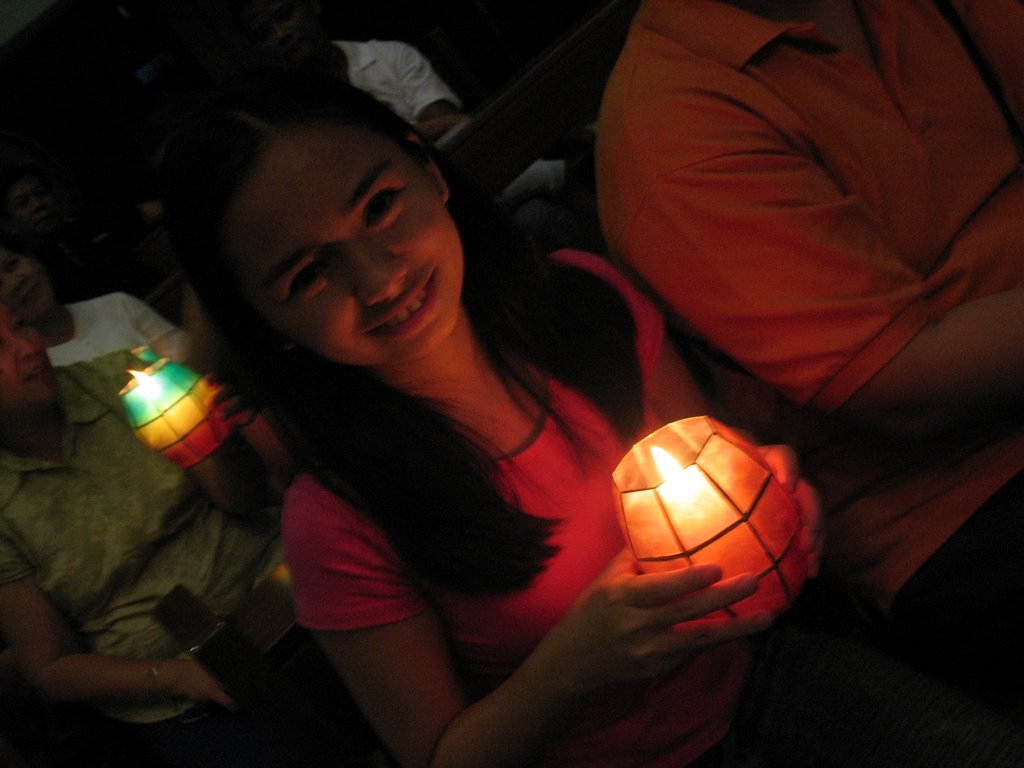
*During the Christmas concert of our choir, Canto Cinco Music Ministry, they gave candles to their "Johns". This is Herbie's girlfriend. Some gave their candles to their families.

A Suggestion at the End of the Year!


The Consciousness Examen: A Practical Exercise as we end the year 2006 and open our hearts to the next.

There is a practice which many religious people are encouraged to do daily: the Consciousness Examen. I would like to suggest this exercise as we close the year 2006, and open with hopeful hearts the coming year. The Consciousness Examen is different from the Examination of Conscience which many of us do to prepare for confession. The Examination of Conscience has a moral quality to it: the primary concern is what good or bad actions we have done in our lives.

But the Consciousness Examen is a discerning prayer: the primary concern is how God is affecting and moving us spontaneously in our affective consciousness! In other words, the Consciousness Examen helps us see how God relates to us, how does He show His love for us in our lives and how He touches our hearts. It is like seeing how a friend shows his care to us, how he touches our hearts, how he moves us in his own ways, according to our unique personalities and gifts. Thus the Consciousness Examen draws our attention not on our own self --- it begins by seeing how another loves us, and how we respond in return. It is not one of those self-indulgent reflections, or unhealthy self-centered reflections we are all prone to. Its basic objective is to form or “develop the heart with a discerning vision to be active not only for half-an-hour” or during prayer time, “but continually” (George Aschenbrenner SJ).

There are steps. The first is to pray for enlightenment. The Consciousness Examen is not a matter of our own personal ability to reflect and look back at our experiences and be able to analyze them, as many blogs, journals and diaries are prone to do. It is a Spirit-guided insight into our life and sees how we are growing in sensitivity to God’s movements. In other words, it is about seeing our life as God sees it; and seeing whether our hearts are able to detect the stirrings of God when He makes Himself felt to us in our daily lives. So, we ask for the grace (because to do this needs God’s grace!) that we may see our lives as God sees it.

The second is to pray for gratitude or thanksgiving. The attitude of Christians in this world is the attitude of a poor person, “Blessed are they who are poor in spirit.” At the heart of this attitude is the realization that everything is gift; that all that we have or are comes from God; and yet in our poverty, the Lord has gifted us through everything. In the prayer of gratitude, we look back at the year and ask, “What are the gifts that the Lord has given us? I suggest not focusing on the large, grand gifts we received, because obviously we are aware of them, but scour and glean through your life and locate the tiniest, smallest gifts that we have been unaware of. Our faith should help boost our sense of poverty and humility as we center on the concrete, unique and personal gifts that each of us are blessed with. Of course, do count the large ones: but don’t end there.

The third is to survey our actions. But before we do that, we remember that the objective of the examen is not an effort to make a list of all our sins and vices, as in one by one (as the Examination of Conscience does with a list of sins, categorized under the 10 commandments). But, we are challenged to see -- in the background of God’s love for us and in the attitude of gratitude – what areas in our life that are deficient, and needs change. However, the Lord does not want us to handle all of them at once. Usually there is an area in our hearts that he is calling for conversion: these are the issues that suddenly nudges or assertively vie for your attention. Sometimes, the area that needs conversion might be very challenging, but we do not want the pain that comes with it, so we would rather go to a safer, lighter area that also, undeniably, needs attention. For example, the issue of the growing coldness between you and your wife: it needs painful attention, but you would rather talk about the children or business. Ito yung mga iniiwasan niyong issues na umiipon nang umiipon.

Fourth, if the gratitude is taken from the realization of all gifts; the next step is the feeling or attitude that comes from the realization of our sinful tendencies and deficiencies. When the Christian praises the Lord, the adoration becomes more genuine and deep if it rises from the fact of our sinfulness, and yet, despite it, we are still being loved. In other words, the adequate feeling of one who sees this constant love despite one’s sinfulness and deficiency is sorrow and shame --- not guilt that condemns; but sorrow and shame that exposes our real nakedness before God and at the same time, draws us closer to Him: yung damdaming nahihiya ka sa kabila ng kanyang pagmamahal.

Finally, a hopeful resolution for the future. If the Consciousness Examen flows from an attitude of thanksgiving to the gifts given to us who are poor; then sorrow for our sinful tendencies; then see in the deepest part of your heart how you now face the future. Are you discouraged or fearful about the future? Or are you acquiring more hopeful vision of the future?

I guess with the steps given above: enlightenment, gratitude, the survey of actions, sorrow & contrition and the hopeful resolution for the future, we may face the coming year with courage and assurance; that just as God had been with us in the past, He will accompany us, and not abandon us, in the future.

Note: The Consciousness Examen is done by every Jesuit, every day, usually 15 minutes before half of the day is over; and 15 minutes before retiring. Fr. George A. Achenbrenner SJ wrote an article on the Consciousness Examen in which this homily is based. The article, written in the Review for Religious, Vol. 31, 1972, is given to novices who are beginning their life as Jesuits. (In fact, a first-year novice, Sherwin – a UP Engineering graduate – lent me his article.) This is one of the first things we learn in Jesuit prayer. In the Constitutions of the Society of Jesus, the Consciousness Examen is a non-negotiable: cannot substitute or forego even if one is super-duper busy. Personally, it is in the Consciousness Examen that I often ask myself what would be the Jesuit way of proceeding or responding when confronted by challenges and difficulties especially in UP and the Jesuit Music Ministry. Thus, through this exercise, the Lord subtly deepens and develops my religious identity.

*I took this photograph in Mirador as a proof of a growing sensitivity to the work of the Lord in nature.

The Flight to Egypt


28 December 2006: The Holy Innocents
Matthew 2, 13-18 The Flight to Egypt

Throughout history, the Jews often fled to Egypt when their life was being threatened. Many colonies of Jews were found in cities like Alexandria, the capital city of the Graeco-Roman Egypt, where millions of Jews had made permanent residency. The city of Alexandria was built by Alexander the Great in 331 BC. And therefore, when Mary, Joseph and Jesus fled to Egypt because their lives --- and countless children --- were in danger from King Herod, Egypt was a logical place. They will not be strangers there, because there were Jews.

The flight to Egypt is also recorded in the Quran, Islam’s holy book. It says that Mary rests on a palm tree and heard a voice saying “Grieve not! The Lord has placed a rivulet thee, and shake the trunk of the palm tree toward thee, thou will cause ripe dates to fall upon thee. So, eat and drink and be consoled…” Tradition has it (especially in the Coptic Church) that the Holy Family stayed in Egypt for three and a half years before they returned to Nazareth.

William Barclay tells two legends about the flight to Egypt. The first story is about the penitent thief on Calvary. Legend has named him, Dismas. And legend also has it that that was the second time they met. On their way to Egypt, Mary, Joseph and Jesus were met on the road by robbers who would like to kill them and steal whatever they have. Dismas was one of the robbers, and he saw something in the baby that went to his heart. So he refused anything that would harm the baby or his parents. Then he said to the baby, “O most blessed of children, if ever there come a time for having mercy on me, then remember me, and forget not this hour.” And so Dismas indeed found forgiveness and mercy on the cross.

The second is about a spider. When the Holy Family was fleeing, they came to a cave on their way to Egypt. The cave was very, very cold that the ground was covered with hoar frost. A little spider saw the baby Jesus, and he wished so much that he could do something to keep him warm in the cold night. So the spider decided to spin a web on the entrance of the cave. A detachment of Herod’s soldiers seeking children to kill upon orders from the king came to the cave. But the captain noticed the spider’s web, covered with hoar frost and stretched towards the whole entrance. The captain said, “Look at the spider’s web. It is unbroken and there cannot possibly be someone in that cave, for anyone who enters will surely break the web.” And so the legend continues that the soldiers left the cave and the little spider spared the Holy Family that night.

As Pope Benedict XVI appealed for abused children around the world in his Christmas message, and as we remember the Holy Innocents who died that day, we remember to keep children in our prayers. The stories in legends make us remember that all the little things we do for Jesus does not pass the loving gaze of Jesus. Benedict urges us to “not forget the true gift: to give each other something of ourselves, to give each other something of our time, to open our time to God.”

Painting with the Heart

27 December 2006. Feast of St. John the Evangelist
John 20, 2-8: Painting from the Heart

It was customary in Palestine that family and friends visit the tomb of their loved ones for three days after they had buried the body. They believed that the spirit of the dead hovered around the tomb for three days because they still could recognize their bodies --- until the fourth day when decay began. The spirit departed thereafter. In the Gospel, those who loved Jesus came to the tomb the first thing after the Sabbath (which is Saturday to us). They could not visit it after they buried the body on a Friday: or else, they break the Sabbath law. So, very early (prōi – technical word of the last four watches which the night was divided) on Sunday morning, Mary came to the tomb. When she arrived and discovered that the stone that barred the tomb was removed, she returned to the city to seek out Peter and John. And we knew that both ran towards the tomb, but it was John who made it first.

Today is the feast of St. John, the evangelist. And thus we will focus on John. John must have been younger than Peter, he came to the tomb first, but Peter, as impulsive as he was, went in and found the clothes they wrapped Jesus on. The grave clothes were not in disarray or disarranged. It was still in their folds --- in Greek words says that the grave clothes did not appear to have been folded or taken or removed: it was there as if the body of Jesus just evaporated. The sight convinced John and he believed: he believed that Jesus had risen.

There is a wonderful thing here. You see, those who came to the tomb are those who loved Jesus very much. Mary, Peter and John, all have the same and intense love for him. Mary who loved Jesus so much, was the first in the tomb. John, who loved Jesus, and whom Jesus also loved, was the first to believe. In another instance after the Resurrection, Jesus appeared on the shore instructing Peter and the disciples to fish. It was John who first recognized Jesus, and said to Peter, “It is the Lord!”

You see, when we love someone, we are able to read his mind and his heart. When our hearts are totally one with our beloved, we are able to interpret events according to them. When the mother of one of my students passed away, I happen to join the family for dinner. The brother of my student did not finish his food, and my student remarked, “If mom were here, she would have scolded you.” St. Ignatius writes in the Constitution of the Jesuits how to think with the Church, and how to be one heart and one mind as Jesuits: you can only do this when you genuinely love the Church and the Society of Jesus.

Second, we are able to recognize the person we love even if the person is at a distance: by their walk or how they stand. Love can interpret events and recognize persons which another who doesn’t care cannot. A fine arts student once told me how she chose her boyfriend. She had two suitors --- both from the Fine Arts Department; both painters; both, interesting to her. She made them paint her. When they presented their paintings to her, she noticed one remarkable thing: one of her suitors was able to paint her face with its minute details: the fold of her cheeks when she blushes. She said, “I chose him because he clearly loved and understood me.”

As we celebrate Christmas and the feast of St. John who loved Jesus, let us reflect on the way we understand and love Jesus. If Jesus asked you to paint Him --- without borrowing or copying from all the paintings of Him in the world --- how are you going to paint Jesus?

Meaningful Name-Giving

23 December 2006. Simbanggabi
Malachi 3, 1-4, 23-24; Luke 1, 57-66


When Zechariah and Elizabeth had to name their son, they have to make the occasion very special. It was the custom in Palestine that the naming of a boy should be eight days after childbirth, and usually the son is named after his father or some ancestor in the family. Naturally, the neighbors expected Zechariah, but Zechariah and Elizabeth defied convention in obedience to God, and so named their son, John meaning “God’s graciousness”. The name John also described who and what John was for them: having been childless, God has given them a son out of his graciousness to them in their old age. Naming is a serious matter.

What’s in a name? In the Old Testament, we find that names of individuals are meaningful. Adam is named after the earth (Adama) from which he was created. The primary purpose of giving something a name is identity: when it’s not around for you to point at, you can refer to it by name. For example, even if you don’t know what a pencil sharpener looks like, you can still figure out what that this does. The beginning of knowledge is to call things by their right names. Giving a name to a person, a module, a thing, a class or a process is a sign that you truly understand the concept and what it’s supposed to do. Elza Dinwiddie-Boyd said that a name is not all that you are, but it is certainly what you are first known by. And parents should take into consideration that historically kids have been teased when they had very unusual, different and odd names. I baptized a baby once in Bukidnon whose name was Sixbam, a contraction of Sixto and Bambi who are her parents.

Certain given names now are being changed for the same reason: their names give them identity, and so if their names mean something indecent and shameful in another tongue, they might as well change it. In Philippine history, many Filipino names have been Hispanized on November 21, 1849 when Governor General Narciso Claveria ordered a systematic distribution of family names for the native Filipinos to use. In the Catalogo Alfabetico de Apellidos are the names distributed to families in towns: these names are still evident in the Provinces of Iloilo, Albay or Bohol. However, there were names that were retained such as Maglaban, Magtanggol, Mangahas among others. They were perhaps members of the warrior class or the ruling class. But some names are unfortunate.

GMA 7’s I-Witness once featured a documentary called, “Sa Ngalan ng Pangalan” with Howie Severino featuring two clans. (Now, I have reservations printing them here, but I guess we can be mature readers and these names are facts.) The first clan is the Pecpec clan of Ilocos Norte. The story tells us of James Pecpec who cannot have a girlfriend; and his sister, Erica, who doesn’t want to go to college. In the Ilocos, the name “pecpec” means full as in a basket brimming with fruit. In addition, one of their ancestors was a revolutionary who fought with General Artemio Ricarte of Batac, Ilocos Norte. The older members of the clan did not want their names changed, except the younger ones who need to go to Manila to study. James sought GMA 7’s help to change his surname.

The second clan is the Bagongahasa clan of Paete, Laguna. Mr. Bagongahasa was a retired US Navy man who placed his name all over his house, while his cousin, a Barangay Captain and the ladies of the Bagongahasa clan desperately want their surname changed: so they are so eager to marry anyone just to shed their name. (One of our Vocation Workshop participants is a relative of the Bagongahasa. His family name is now Bhasa.)

If these two clans desperately want their names changed, then names matter. The Babylonian Talmud maintains that names exert an influence over their bearers.

Second, the change of name marks a change of identity, status and lifestyle. Here is a short list of Biblical personages who changed their names: Abram to Abraham (‘Father of a Multitude’); Jacob to Israel (‘God’s strong one’), the apostle of Elijah called himself Elisha (‘The small Elijah’), Simon to Peter (The Rock) and Saul of Tarsus to Paul (from persecutor to disciple of Christ).

Hector Santos writes in his blog, “As we planted our roots in the US, we started calling ourselves by more popular American names. Pedring is now Peter; Carlos or Carling is now Charles or Chuck; German is now Gerry but not Germs or Marcelina is now Marsha. I do not fault these names changing, perhaps, it’s their way of discarding the old ways and announcing their new found life by making their names more adaptive to the people they will be living with from hereon.” Here is some funny renames: Gregorio Talahib becomes George Bush; Esteban Magtaka becomes Stevie Wonder; Remigio Batungbacal becomes Remington Steel; Leo Mangubat becomes Tiger Woods; Ligaya Anonuevo becomes Happy New Year!

Those who enter religious life like nuns, priests and brothers change their names or add a name to their given names. The practice depends on the congregation one joins. For example, Ms. Joy dela Cruz is now Sr. Annunciata Cruz, FGH (the name of the congregation). Many Jesuits have vow names added. Mine is Ignacio Maria. I took it when I had my perpetual vows on 31st May 1991. It symbolizes a change of status. This is the reason why many of us add a Christian name when we were baptized. The name of a saint or an episode in the life of Jesus gives a boy or a girl a certain guide to emulate.

In the Philippines, we would have seen social history in the preferences in names and the slow change from Spanish names to Catholic saints to English names. We have the first list compiled in 1905 (with 1,000 names) and 1915 (with 2,700 names). We can see the whole life of Christ through these names: Conception, Annunciation, Visitacion, Presentation, Natividad, Purificacion, Epifania, Transfiguracion and Resurrection. No one however used Circumcision or Crucifixion as their names.

Let me end: If names give identity and tell us about our life and history; and if a change of name is necessary for a change in lifestyle; then perhaps we can ask this question to reflect on: If I am given a second chance to change my name into something meaningful and that describes my relationship with God (as John is “God is gracious”), what would I call myself? Or, we are all Christians and the name of Christ is sealed in our names, how have I contributed to its dignity or shame?

The Yes-No Face!


20 December 2006: Wednesday, Simbanggabi in UP Parish
Isaiah 7, 10-14 and Luke 1, 26-38: The Annunciation

The internet uses emoticons as substitute for facial expressions we usually get in face-to-face conversations. There are different facial expressions. But no emoticons can draw a “Yes” face or a “No” face.

What’s a “NO” face? In the time of the prophet Isaiah in the Old Testament, God argued with Ahaz practically begging Ahaz to accept the promise he wished to offer through the prophet Isaiah. The Lord told Ahaz, “The Virgin shall be with child, and bear a son and shall name him Emmanuel.” But Ahaz said, “No”.

Perhaps, Ahaz is typical of many of us. God plans great things for us, but we resist and argue with him. Take for example opportunities to serve others. What is our common answer? Paki-hugas ng pinggan, anak? May gagawin pa ako e! Makisuyo po, pwede bang makigamit ng computer? Di pwede! Linis naman tayo ng ating tambayan? Ay, di ako pwede. May tatapusin pa kasi ako.

Kapag puro ka, “NO” --- you have a “NO-FACE!”

What’s a “Yes” face?

During his days as president, Thomas Jefferson and a group of companions were traveling across the country on horseback. They came to a river which had left its banks because of a recent downpour. The swollen river had washed the bridge away. Each rider was forced to ford the river on horseback, fighting for his life against the rapid currents.

The very real possibility of death threatened each rider, which caused the traveler who was not part of their group to step aside and watch. After several had plunged in and made it to the other side, the traveler asked President Jefferson if he would ferry him across the river. The president agreed without hesitation.

The man climbed on and shortly thereafter, the two of them made it safely to the other side. As the stranger slid off the back of the saddle into dry ground, one in the group asked him, “Tell me, why did you select the president to ask this favor of?” The man was shocked, admitting he had no idea it was the president who had helped him. “All I know,” he said, “is that on some of your faces was written the answer, “No” and on some of them was the answer “Yes”. His was a “Yes” face!

When God asked Mary to be the mother of His Son, Mary readily agreed and made herself available. She said, “I am the handmaid of the Lord!” Mary had a “Yes-face!”

So, kapag puro ka: “Ok po, pwede po akong tumulong. Sige po, volunteer po ako sa paghahakot ng relief goods. Ako na po ang maghuhugas ng pinggan. Ipapaxerox ko na po ito mamya.” Ikaw ay may “YES-FACE!”

God cannot enter into our hearts unless we become more hospitable to him. Having a Yes-face is about being available for someone, other than our selfish self. Thus, we pray that we open ourselves up, to soften our resistance to God’s blessings, to free ourselves from the obstacles that hinder Christ’s entrance in our hearts, to make ourselves more welcoming to Him and others. Only if say yes to God, “Let your will be done” as Mary said, will we be able to be ready for his promise: “He shall receive blessing from the Lord.”

So, how about you? Do you have a NO-Face or a YES-face? Kung ang pagmumukha mo ay NO; baka pwede mo nang palitan.

* Julius, a member of our choir, making faces!

The Genealogy of Jesus


24 December 2006: Mass of the Vigil, Solemnity of the Birth of Our Lord Matthew 1, 1-25: The Genealogy of Jesus

The genealogy or family tree for the Jews is very important. It tells us who he is and what is his worth. The reason for this interest in genealogies or pedigrees was that the Jews set the greatest possible store on the purity of lineage. If in any man, there was a slightest admixture of foreign blood, he lost his right to be called a Jew, and a member of the people of God. Thus, Matthew first presented the lineage of Jesus. Matthew established that Jesus was a descendant of Abraham and of King David. To trace the lineage of Jesus to Abraham, he proved that He was indeed a Jew; and to trace his lineage to King David, Matthew established that Jesus indeed is the Messiah, fulfilling the prophecy that the Messiah is to come from the line of David.

But the most amazing of Matthew's genealogy of Jesus are the names of the women who appear in it. It is not normal to find the names of women in Jewish family trees. The woman had no legal rights; she was not regarded as a person. She was regarded as a thing. She was merely the possession of her father or of her husband, and she is in his disposal to do as he liked. In fact, the regular morning prayer of a Jew is to thank God that he had not made him a Gentile, a woman or a slave. Jesus will radically change all these as illustrated by his lineage.

But when we look at who these women are, the genealogy of Jesus becomes interesting and more amazing. Rahab, was a prostitute of Jericho (Joshua 2:1-7). Ruth was not a Jewess, but a Moabitess (Ruth 1:4). And as a foreigner, she was not allowed to enter the assembly of the Lord. To make things worse, the Jews hated the Moabites. Tamar was a seducer and adulteress (Genesis 38). And finally, Bathsheba, the mother of Solomon, was the woman whom David seduced from Uriah, her husband (Samuel 11 & 12). These are the women in Jesus' genealogy.

And what does it say to us?

First, the barrier between Jew and Gentile is down. Rahab, the prostitute of Jericho and Ruth, the woman of Moab, find their place in the lineage of Jesus. Thus, in Christ there is no Jew nor Greek. God's love includes everybody. God's love is universal. It goes beyond color and race; beyond rich or poor.

In a communion line, a rich woman with her sparkling jewelry wanted to insert. The poor woman at the line motioned to her that she should line up like the rest. The rich woman was annoyed. She asked sternly, "Whose daughter are you?" The poor woman answered, "I am a child of God. How about you?"

Second, the barrier between male and female is down. The old contempt for women is gone. Men and women stand equally dear to God, and equally important to His purposes.

An English professor on the blackboard wrote these words, "Woman without her man is nothing," and directed the students to punctuate it correctly.

The men wrote: "Woman, without her man, is nothing."

The women wrote: "Woman! Without her, man is nothing."

There is another saying that "A woman is like a tea bag, you never know how strong it is, until it's in hot water."

Finally, the barrier between the sinner and saint is down. Somehow God uses anyone, sinner or saint, for his purposes. The greatest saints like Mary Magdalene, Augustine and Ignatius were the greatest sinners before their conversion. Sinner or saint, we all fit in the scheme of God. We, sinners, have a place in God's plan. "I came," Jesus said, "not to call the righteous, but sinners" (Matthew 9:13). Jesus frees us from slavery from sin.

One day Satan and Jesus were having a conversation. Satan had just come from the Garden of Eden, and he was gloating and boasting. "Yes sir, I just caught the world full of people down there. I set a trap, used bait I knew they couldn't resist. Got 'em all!"

"What are you going to do with them?" Jesus asked.

Satan replied, "Oh, I'm gonna have fun! I'm gonna teach them how to marry and divorce each other, how to hate and abuse each other, how to drink and smoke and curse. I'm gonna teach them how to invent guns and bombs and kill each other. I'm really gonna have fun!"

"And what will you do when you get done with them?" Jesus asked.

"Oh, I'll kill 'em," Satan glared proudly.

"How much do you want for them?" Jesus asked.

"Oh, you don't want those people. They ain't no good. Why, you take them and they'll just hate you. They'll spit on you, curse you and kill you!! You don't want those people!!"

"How much?" He asked again. Satan looked at Jesus and sneered, "All your tears, and all your blood."

Jesus said, "DONE!" Then He paid the price for the sinners by dying on the Cross.

And thus to save us from our slavery, he came down to earth and gave us himself. And so we pray with Gerald Manley Hopkins' "Now Begin on Christmas Day."

"Moonless darkness stands between,

Past, O Past, no more be seen!

But the Bethlehem star may lead me

To the sight of Him who freed me

From the self that I have been.

Make me pure, Lord; Thou art holy;

Make me meek, Lord; Thou wert lowly;

Now beginning, and always;

Now begin on Christmas Day!"

The Naming of John


23 December 2006: Saturday, Simbanggabi
Luke 1: 57-66: The Naming of John the Baptist

In Palestine, the birth of a boy was an occasion of great joy. At the time of birth, friends and musicians gathered at the house of the parents. When the child was a boy, the people sang with jubilation: they believed that a boy causes universal joy! If the child was a girl, the people and the musicians just left silently. For Elizabeth, her joy was doubled. She had a child at last, and she had a son!

The Gospel unfolds during the eighth day since childbirth. The eighth day was the day designated for circumcision and the naming of the boy (a girl’s naming happens within 30 days). During the time of Jesus, the naming of a boy was an important occasion where friends and families meet. The naming of a child is descriptive. It can be by circumstance attending the child’s birth (Esau and Jacob), a description of the child (Laban means white or blond), a parental name (Saul/Samuel), what one asked for, and historical significance (e.g. Elijah: “Jehovah is my God” a testimony when Elijah’s parents asserted their faith in the time of Baal worship).

In the past, names are given with meaning, not just because it was a popular name, or it was nice to hear. A child was named according to a saint such as Antonio, Juan, Santiago, Francisco, Ignacio, Maria, Barbara: together dedicating their child to the care of the saints. Often the names become a guide to moral life: their names are reminders on how they live their lives. For example, Gerard was derived from the Germanic element ger "spear" combined with hard "brave, hardy". The Normans introduced this name to Britain. Gonzales is from the medieval name Gundisalvus, which was the Latin form of a Germanic name composed of the elements gund "war" and salv which sounds like salvation. Jesus is the English form of Iesous, which was the Greek form of the Aramaic name Yeshua. Yeshua is itself a contracted form of Yehoshua. Yeshua ben Yoseph (after his father Joseph) is the name of Jesus Christ. It might be helpful for us to regain the meaning of our names, and see whether its meaning may provide a motto or a guide for us to live by.

When Zechariah named his son, John, he meant several things. First, John means Jehovah’s gift or God is gracious, an acknowledgement of the truth surrounding John’s birth. Second, it is a discreet way of showing gratitude to God. Finally, it is obedience to God: it is the name which God asked Zechariah to name his child. Despite the people’s expectation to name the child after his father or ancestors, Zechariah defied convention if it was God’s will. Zechariah then proved his trust in God’s word, and finally regained his voice. Because of this, people began to wonder what the child will turn out to be.

A child is a bundle of possibilities. You will never know who they will turn out to be. For parents, a child is reason enough to thank God for. On the other hand, a child is his parents’ supreme responsibility. Often it depends on parents and those who stand in their place such as teachers, family members, friends how these possibilities will or will not be realized.

For many of us, we therefore look back on how we have contributed or not contributed to another person’s realization of their growth and possibilities. We first take into consideration ourselves, and see how others contributed or not contributed to our growth as persons. We look at our relationships in the family, with our friends, at our school or workplace and see how they are helping you grow and realize your possibilities. Finally, we look at ourselves: how do we contribute or stifle another person’s growth and the realization of their possibilities.

*my photograph of flora in Mirador, Baguio City.

God's Preference


21 December 2006: Thursday, Simbanggabi

Luke 1, 39-45: The Visitation

We remember that the message of Gabriel in the Annunciation was that both Mary and Elizabeth would become pregnant. Thus the visitation of Mary to her cousin Elizabeth is proof that God kept His word. And Elizabeth, on the other hand, confirms Mary’s pregnancy. Elizabeth knew about it, and thus greets her, “Blessed are you among women, and blessed is the fruit of your womb.” Both women are full of joy as they share their pregnancies. James A. Wallace in his book, Preaching to the Hungers of the Heart, tells us that “Mary is a model of responding to God’s grace and the Spirit’s counsel as she goes forth to be with Elizabeth and to utter the prophetic song that proclaims the agenda of God and her willing part in it.”

Mary sings the prophetic song, the Magnificat. She sees the strangeness of God: He reverses all plans and designs, defies human conventions, chooses the weak instead of the strong, and lifts up the lowly like Elizabeth and her. She sings with great joy and gladness because the Lord has favored the weak. She knew she didn’t deserve it, but God chose to make her deserving of it! Even Elizabeth knew that God also willed that she bore a son in her old age. In their being ordinary, God broke into their lives.

The reaction of both Mary and Elizabeth is not surprising for common folks: they are the easiest to please. I gave a Jesuit Music Ministry CD to Aling Toyang, one of the ladies in Payatas, and the same CD to a wealthy lady. They both acknowledged the gift, but Aling Toyang kept thanking me for remembering her --- until now. Indeed, for someone who has less, a little gift means a lot!

Such is the feeling of Mary and Elizabeth. God has favored the poor. God’s attention means a lot to them. And if God prefers the simple, insignificant, lonely, lowly, poor and ordinary people like us, then, like Mary, we could have said to whatever God wills, “I am the handmaid (a servant, a slave girl) of the Lord!”

The world’s standard has it that kings are born of queenly rich women. God’s standard is reverse. We are all unworthy of the presence of God, but God graciously became present to us. God visited us and intervened in our life stories.

Today, the Gospel encourages us to be like Mary and Elizabeth. We develop the habit to share not just our personal problems and opinions, our ideas and daily routines, but include in our conversations, the stories of how God has visited our lives. We prepare for the visit of the Lord in our ordinary lives by preparing our hearts as we prepare our homes to our visitors, and opening our doors to God’s graceful entry into our lives.

*Canto Cinco or C5, who regularly sings at the 11oo am Sunday mass in UP, at the Jesuit Music Ministry Christmas Concert, Child: Emmanuel, at Shangrila EDSA on 15 December 2006. They are singing the Magnificat in this picture.

Unadorned Prayer


20 December 2006: Misa de Gallo
Luke 1, 26-38: The Response of Faith

Mary's obedience to the will of the Father is lovely. Mary forgets the most common prayer--- "Let your will be changed" or "Let my will be done" ---- and prays the greatest prayer "Let Your will be done." Her Son, Jesus will pray the same thing at the Agony in the Garden: "Not my will, but Your will be done." Maybe, He learned the prayer from His mom. And it stuck that he taught it to his friends. And his friends in turn taught it to us: the "Our Father."

First, the greatest prayer is simple and unadorned. Even if it is a cry of the heart in the midst of a scandal. You see, just as the family tree of Jesus contains saints and sinners, Jesus' birth is also surrounded by scandal. Mary is found to be pregnant before she has lived with Joseph. Joseph, who is a just man, decides to divorce her quietly. In other words, he will put her out of his life. Joseph is not open to scandal. The angel who appears to him entreats him not to fear scandal. Joseph should take Mary into his home. And thus, this story drives home the proper attitude toward the strange and scandalous: do not be afraid to take it into your home.

A disciple came to his Master at midnight. He was distraught.

"Master, I need to talk to you immediately. I am filled with anxiety and fear."

"Right this way," said the Master. The master opened a door that led down a long corridor. It was unlit, but the master had a candle in his hand.

"You go first," said the master.

As the disciple moved down the corridor, the master blew out the light.

Mary's prayer was simple. She said yes, though she was anxious of the scandal that that consent might bring her. Her attitude towards scandal was to bring it home. Her attitude towards fear is to enter into the darkness. They say "There is no other way to face fear, than to face it."

Finally, a warning before we end. Most of our Christmases are empty because we busy ourselves with the externals: buying gifts, fixing our rooms. We forget what is essential. And when we do remember the essence of the celebration, we are too late. Let us not live the folktale of Befana:


Befana, the Housewife, scrubbing her pane,

Saw three old sages ride down the lane,

Saw three grey travellers pass her door---

Gaspar, Balthazar, Melchior.

"Where journey you, sirs?" she asked of them.

Balthazar answered, "To Bethlehem,

For we have news of a marvelous thing.

Born in a stable is Christ the King."

"Give Him my welcome!"

Then Gaspar smiled,

"Come with us, mistress, to greet the Child."

"Oh, happily, happily would I fare,

Were my dusting through and I'd polished the stair."

Old Melchoir leaned on his saddlehorn.

"Then send but a gift to the small Newborn."

"Oh, gladly, gladly I'd send Him one,

Were the hearthstone swept and my weaving done.

As soon as ever I've baked my bread,

I'll fetch Him a pillow for His head,

And a coverlet too," Befana said.

"When the rooms are aired and the linen dry,

I'll look at the Babe."

But the Three rode by.

She worked for a day and a night and a day,

Then, gifts in her hands, took up her way.

But she never found where the Christ Child lay.

And still she wanders at Christmastide,

Houseless, whose house was all her pride.

As we go on Christmas break, I pray: May we NOT be late. May we find the Christ Child in a stable we all call "Home."

The Joy in Our Faith


17 December 2006: 3rd Sunday of Advent
Zephaniah 3, 14-18; Philippians 4, 4-7; Luke 3, 10-18: The Joy in our Faith

John the Baptist lived in the desert that is dry and covered with brushwood. Often this image is used to describe many Christians. There is a type of Christianity that is gloomy and dark. The type that thinks that our faith is a faith of seriousness and rigidity, marked by the strict following of rules that begins with “Do not...” The celebration of the 3rd Sunday of Advent is a celebration of joy where we light the rose or pink candle that symbolize joy. It breaks that misconception of Christianity as a religion of seriousness. Joy is at the very core of our faith. Paul set before the Philippians in the second reading the quality of joy: he stressed, “Rejoice!” When he was writing his letter to the Philippians, he was in prison almost certain of his death. But still, he said, “Rejoice!” The prophet Zephaniah also said, “Shout for joy!” You see, Christian joy is independent of all things on earth because its source is the continual presence of Christ no matter what situation we may find ourselves in. Take for example two sweethearts. They are always happy when they are together, no matter where they are. As long as they are together, whether they are in middle of the smelly fish market of Balintawak or the scented ambiance of cafés, they are happy. Their joy is not dampened by their human situation. The source of their joy is beyond their life situation. They said, “kahit saging, basta loving.”

The message of John lays down important principles of joy. First, John stressed our social responsibility. He tells us that we should share what we have with one another. There is a certain deep fulfillment that we feel when we are able to help others. We find joy in giving, not in hording.

Second, there is joy in our daily, routine work. John said that our salvation is worked out in our daily work. John ordered that a person should not have to leave his job to work for his salvation. For example, many of us compartmentalize faith --- we do our daily routine as if they are separated from faith, and we go to mass to fulfill our duties to God. But John tells us that our daily menial work is part of faith. If one is a tax collector, be a good one; if one is a soldier, be a good soldier. Do not take advantage of one’s position. In our present situation: if you are a teacher, you will be saved by becoming a good teacher. If you are a student, you will be saved by becoming a good student. If you are church or civil official, you don’t have to leave your work to be saved, but do your job excellently and you will be saved. Our faith teaches us that nowhere can a person serve God fully well than in one’s daily work.

Finally, there is joy in prayer because we meet the very source of our joy: God who loves us. When we pray we remember the love of God, and only desires what is best for us. He the joy lies in the very quality of God’s love for us: He loves us for whatever and whoever we are.

A few weeks ago, a husband said to me: “My wife had a mudpack, and she looked great for two days. Then, the mud fell off.” (joke!) With or without the mudpack, God loves us. Isn’t this a real source of joy? It is not surprising then, that when Jesus described to us what the Kingdom of God is, he said, “a banquet” --- a celebration, a party, a gathering to celebrate. Because Christianity is about joy: we know when a person has Christ in his heart, because the person lives and exudes a certain joy in his heart. Perhaps a practical exercise: look at yourself in the mirror. Is your face exuding the dryness and lifelessness of the desert, or is joy emanating from it?

*the unique wedding of my friends, Dyu and Joy.

To Prepare the Heart


10 December 2006: Second Sunday of Advent
Luke 3, 1-6: To prepare the heart

The emergence of John the Baptist was the point in which history turned. So Luke gave us different ways to see how it changed. First, he began with the political situation telling us the Roman governors at that time. Tiberius was the successor of Augustus, thus the 2nd of the Roman emperors. He began his reign in AD 14. So, the fifteenth year of his reign would be AD 28-29. In Palestine, we see its local governors. After Herod the Great died in AD 4, after reigning for 40 years, he divided his kingdom among his sons, who were tetrachs. A tetrach is a governor of any part of the kingdom (just imagine the governors in each province). Herod Antipas reigned from AD 4-39; therefore Jesus’ life was practically lived under him, especially Galilee. Herod Philip, AD 4-33; thus, Caesarea Philippi was built and named after him. Archelaus was not a good tetrach in Judaea, so the people petitioned his removal. Rome changed him, and made Pontius Pilate governor.

Second, Luke leads us to the religious situation at that time. In the old days, the office of the high-priest was lifetime and he acted as the religious and the civil leader of his community. Usually, there was only one high priest. But with the Romans intervening in the life of the Jews, they appointed many high priests as a result of intrigues. Remember China today: there are bishops appointed by Rome and there are Catholic bishops appointed by the government.

Luke mentions two high-priests: Annas and Caiaphas whom we will meet again at the Passion of Jesus. Annas was high priest in AD 7- 14. Thus, he was out of office at the time of Jesus’ public ministry. Caiaphas was his son-in-law. But Annas was the power behind the throne. So when Jesus was arrested, he was brought first to Annas and then to Caiaphas (John 18, 13).

How is this related to Advent. If Luke tells us of the political and religious situation during the emergence of John the Baptist so that we may see the difficulties of their lives, then the context of Advent is a people in adversity. The time of darkness before Christ. Advent is very much part of our daily lives. When priorities are lopsided: Leaders are power-hungry that they spend millions in electoral campaigns or corruptive measures to perpetuate their tenure of office, when they could instead funnel those resources to those in need. In the midst of the prevailing state of calamity, many are still apathetic. For several decades, UP was known for people who actively advocate for political, economic and cultural change; for students whose social conscience moves them to entirely give themselves to the service of their country; now the problem is more apathy and a consumerist lifestyle. Our family and personal lives get complicated and confused. When people are in transition and struggle to accept certain realities and truths in their lives, then this is the season of Advent.

In the midst of all these, the voice of John the Baptist cries out to us: “Prepare the way of the Lord!” Luke suggests that John the Baptist’s role, in the time of political and religious upheaval, was to prepare the way for Jesus. In verses 4-6, Luke quotes Isaiah 40, 3-5. When a king proposes a tour of his kingdom, the king sends emissaries or messengers to tell the leaders of the place to prepare the roads for the king is coming. And admonished everyone that the change is not about roads, but about one’s heart. But the arrival of the king is always met with joy and hope. Let me end with a story.

President Abraham Lincoln often visited hospitals to talk with wounded soldiers. Once, doctors pointed out a young soldier who was near death and Lincoln went over to his bedside.

“Is there anything I can do for you?” asked the President.

The soldier didn’t recognize Lincoln, and with some effort he was able to whisper, “Would you please write a letter to my mother?” A pen and paper were provided and the President carefully began to write down what the young man was able to say: “My dearest mother, I was badly hurt while doing my duty. I’m afraid I’m not going to recover. Don’t grieve too much for me, please. Kiss Mary and John for me. May God bless you and father.”

The soldier was too weak to continue, so Lincoln signed the letter for him and added, “Written for your son by Abraham Lincoln.”

The young man asked to see the note and was astonished when he discovered who had written it. “Are you really the President?” he asked. “Yes I am,” Lincoln replied quietly. Then he asked if there was anything else he could do.

“Would you please hold my hand?” the soldier asked. “It will help to see me through to the end.” In the hushed room, the tall, gaunt President tool the boy’s hand in his and spoke quiet words of encouragement until death came.

I think to prepare the way of the Lord is be like Abraham Lincoln. Advent and Christmas is indeed making Jesus come in our lives. To prepare the heart as John said is to be compassionate to the poor. As the dying soldier requested for Abraham’s hand, may we too may lend a hand to those in dire need. Incidentally, today is Human Rights Day.

*relief goods in UPSCA tambayan bound for Catanduanes. Relief goods were personally delivered Dec 16, Saturday by UP Catandungan.

The Immaculate Conception


8 December 2006: The Immaculate Conception
Gen 3, 9-15.20; Eph 1, 3-6.11-12; Luke 1, 26-38

Let me first clarify a point because there is always a misunderstanding. In the description of the upcoming movie recommended by the Vatican and major church leaders called, “The Nativity”, one writer described it as the story of the “immaculate conception of Jesus” --- referring the feast of the Immaculate Conception with the birth of Jesus. However, the Immaculate Conception refers to the birth of Mary. It means that Mary's birth, by the grace of God, is free her whole life long of every personal sin because she will be the Mother of Jesus --- the Mother of God.

Why do we celebrate the Immaculate Conception of the Blessed Virgin Mary? First, the Immaculate Conception is the Principal Patroness of the Philippines. A patron is someone who supports, guides, and protects a group, the arts, a social or a charitable event. For example, if one is putting up a gallery, one contacts an art patron who can finance it. That art patron is someone who believes in the preservation and appreciation of art. Thus, if the Blessed Virgin Mary is the principal patroness of our country, then it is she who supports, guides and protects us. Many of us have a very deep affection for our Mother, because we run to her for our needs and protection. In the event of the catastrophe in Bicol, I heard people praying the rosary. The Wednesday mass is always well-attended because of the Mother of Perpetual Help. Thus, we celebrate the Immaculate Conception as a way of honoring Mary for being mother to us.

Second, I believe that there is something to the Immaculate Conception that makes us want her to be our model of living a Christian life. Mary is a model of holiness. But what is holiness? John Brown defines holiness as “thinking as God thinks and willing as God wills.” That means holiness is about having the mind, the heart and arms of God. It is not about having mystic visions, almost austere lifestyle, cloistered halls of the monastery, or organ music, long prayers, religious-sounding chants. Holiness is the everyday business of every Christian. It evidences and manifests itself in the decisions we make and things we do, hour by hour, day by day. Mary was doing her everyday chores, but she was holy. She was a simple, pure woman --- not a queen, a celebrity or a rich girl.

The Immaculate Conception, whose feast we celebrate today, illustrates God's strange way of choosing people to become the instruments of his plans. And yet the angel Gabriel at the moment of the Annunciation salutes her as "full of grace." To become the mother of the Savior, Mary "was enriched by God with gifts appropriate to such a role." At the Announcement that she would give birth to "the Son of the Most High" without knowing man, by the power of the Holy Spirit, Mary responded with the obedience of faith, certain that "with God nothing will be impossible": "Behold, I am the handmaid of the Lord, let it be done according to Your word." Thus, giving her consent to God's word, Mary becomes the mother of Jesus.

In other words, we celebrate the Immaculate Conception because we celebrate a possibility: that any ordinary human being such as Mary and all of us, can be holy. It celebrates the possibility that we can think as God, feel as God, and live as God’s children. Thus, there is a holy studying; a holy taking a bath; a holy washing one’s clothes; a holy walking to the next building for class; a holy talking to one’s friends; a holy combing of one’s hair. There is even a holiness when you sit on the john. Our excretory system gets rid of all the toxins in our bodies. And if our body removes what is unhealthy, then if we think as God thinks, then sitting on the john is how God preserves our life. See how good God is to us! Holiness is about every single moment of every day.

Perhaps a good thing if we ask: How can I be holy? Suggestion: Resolve never to do anything that you would be afraid to do, if it is your last hour in your life. Huwag mong gawin ang matatakot kang gawin kung ika’y malapit nang mamatay.

An Appeal for Bicol


Note: My apology for all the homilies this week. Since typhoon Reming hit Bicol, my province, I have focused my energies on relief operations. This is one of the letters we distributed to seek further support. I am from Camalig in the Province of Albay, the area with the largest death toll.


SIMBAHANG LINGKOD NG BAYAN (SLB), ADMU Disaster Response and Management (DREAM) Team and the UP Diliman Catholic Chaplaincy, University of the Philippines

AGAP BIKOL and Tabang sa Kabikolan (UP-Diliman) extended.

Reports from Civil Defense Officials as of December 6, 2006
- 526 dead mostly around Mayon volcano and another 740 missing
- 1.54 million people affected nearly 83,000 of whom sought refuge at evacuation centers
- More than 250,000 damaged houses and damage to buildings, infrastructure and agriculture placed at P1.6 billion
- Power facilities in Albay valued at about P200 million destroyed and power restoration may take more than six (6) months (Albay Electric Coop)

Relief and Rehabilitation Program
- P100,000.00 relief fund personally released to Fr. Jovic Lobrigo (Diocese of Legaspi Social Action Center Director) who visited SLB Office last December 4
- P50,000.00 rehabilitation fund released through Ateneo de Naga University’s Center for Community Development headed by Mr. Nono Sto. Domingo
- Initial construction materials purchased to be shuttled to Naga December 6 evening due to reports of shortage in construction supplies
- SLB-ADMU Dream Team Batch 1 leaving December 6 evening for Naga operations. Batch 2 leaving December 7 evening for Albay operations.
- Team of Professional Psychologists from various institutions (ADMU, DLSU, UGAT Foundation and CLC, among others) formed for Psycho-Social interventions as per request of the Diocese of Legaspi. Program will start December 7.
- Various goods being collected to be shuttled to Albay.

NEEDED:
- Volunteers for goods repacking. Details, as follows:
o December 8 (Friday) 8:00 p.m.
o Cervini Function Room (ADMU Male Residence Hall) back of Church of the Gesu
o Contact Person: Franco Soberano (0917-6442626) or Cervini Director Tim Gabuna (Tel. 426-6001 local 5900)
- Trucks for shuttling goods and construction materials
- Construction materials (G.I. Sheets, Plywood, Nails and other basics)
- Medicines for cough, colds and fever and surgical mask
- More food, preferably canned goods and noodles
- More funds


DONATION MECHANISM
=====================
GOODS
----------
You may directly donate the goods to the Cervini (Male Residence Hall) Function Room at the back of Church of the Gesu. Temporary AGAP BIKOL Relief Operation center can accept donation from 9:00 a.m. to 12:00 midnight. Contact person is Residence Hall Director Tim Gabuna. You may communicate with him through 426-6001 local 5900.

Priority: Food (Canned Goods, Noodles and other kinds with long shelf life) and Water

CASH/CHECK
-------------------
Direct deposits (online from any of the BPI branches) may be made to:

SIMBAHANG LINGKOD NG BAYAN (Account Name/Payee)
Bank of the Philippine Islands (Loyola-Katipunan Branch)
BPI Peso Checking Account Number 3081-1111-61
BPI Dollar Savings Account Number 3084-0420-12

For proper acknowledgment:
- Please fax a copy of the validated deposit slip to SLB through telefax 426-5968
- Kindly indicate contact information: Name, Address, Email, Mobile
- Those who wish to remain anonymous may skip this procedure

Or you may send it to

Loyola House of Studies (LHS)
Ateneo de Manila University
Loyola Heights, Quezon City
Telephone Number 426-6101
Time: 6:00 a.m. to 10:00 p.m.

Official Receipts will be immediately issued to you by the LHS Lobby Porter.

For dollar remittances:
- You may purchase a Manager’s Check and send it via any courier to SLB’s address OR
- Course it via telegraphic transfer to BPI Dollar Account

Should there be any concerns, please contact:

MS. MARJORIE TEJADA
Telephone Number 426-6101 local 3440 (Office Hours)
Telefax 426-5968
Email: slb@slb.ph

MR. RC BATAC
SLB Project Officer for Socio-Economic Development
Mobile 0921-3509565
Email: rc2_adnu@atenista.net

UP DILIMAN MECHANISM

Relief Operations:
Send all goods to the UPSCA Tambayan, Parish of the Holy Sacrifice, Diliman, Quezon City
Call the Parish at 9269496, contact Fr. Jboy Gonzales SJ, UP Chaplain.

All the relief goods will be brought to the Cervini Dormitory, Ateneo de Manila University. (see above).

Cash can done through Simbahang Lingkod ng Bayan (SLB) [see above.]

*picture from CNN