Experiencing the Transfiguration


4 March 2007. The 2nd Sunday of Lent
Luke 9, 28-36 Experiencing the Transfiguration

There is one big fact in the Gospel story today: after the Transfiguration experience, Jesus set out to Jerusalem and to the Cross. Jesus knew that the consummation of His whole life, the step towards the final destiny of all of His principles and His work, was in Jerusalem. So before He set His eyes and took His final step, Jesus prayed and then had this tremendous experience with God. I believe there was something significant that happened in the mountain of the Transfiguration. It was in that experience that Jesus was assured that the direction He was about to take was correct. He was assured by the great law-giver himself, Moses, and the greatest prophet of Israel, Elijah and finally, God who said, “This is my Beloved Son.”

So today, in the 2nd Sunday of Lent, we are asked to look at our transfiguration experiences. Let me first illustrate with examples what I call our own transfiguration experiences.

I remember a conversation I had with my Dad --- who incidentally celebrated his first day in heaven yesterday (March 3). When I was very young, my mom who is a pharmacist had all of us vaccinated. I never liked needles, and I was afraid of them. I would ask Dad to stay beside me, and he would assure me that vaccination was indeed necessary for my well-being and my health. With his comforting words, I would just hold on my Dad’s arms and then I was ready for that inevitable pain that a needle prick would give me. Therefore, when one is assured that the darkness and pain to be faced is a necessary step for growth, and then one experiences a transfiguration. This kind of darkness is something we should not fear.

On the other hand, there are dangerous experiences of pain and darkness. These kinds of darkness we definitely need to fear to protect ourselves from anything that would wound, destroy, abuse, torture, or kill us. Wherever there is an intimidation or a brutal death in any form, there is a dangerous darkness.

But there is holy darkness or a holy pain: this darkness is a kind of darkness we just don’t want to have, but which is essential for our growth. It stands in the way of our comfortableness (such as vaccination) or convenience (such as taking the long queue to the jeepney bay as part of our college days), our familiarity (such as being with people whom we have to be nice, but we don’t personally know, like our clients), our security (taking the dark road to the dormitory), our desire to control (such as when we are not anymore in control like the decisions that our children make), or our need to “have it all”. The emotions associated with this holy pain are the ones we often experience in times of grief because such darkness means losing a part of ourselves. But in the face of this fear, we have to let go and embrace the fear, the pain, and the darkness.

But it takes a great leap, like the great Transfiguration experience of Jesus. It does become easier to live in the darkness the more we can see that this phase of our lives, is just that, a phase, a necessary part of our humanity, and that eventually it will pass --- but we have pass through it and go through it. A friend of mine once asked me if the pain and turmoil he was experiencing ever ceased when his father died a year ago. A few months ago, after he had been through the darkness, he told me: “The one thing that I kept clinging to and which gave me hope was when you answered my question, “Does it get better?” with “Yes, it does. It may take awhile but it does get better. I have been there. My dad died years ago.”

But we must also believe that we will never be exactly the same as we were before the darkness. When one leaves, whether in a goodbye, a break-up, or death, we are never the same again. This life event or situation will affect our life. Thus this is another reason for opening up to change --- to finally take the leap, to finally risk, to finally face your Jerusalem, to finally carry the cross just as Jesus did after the Transfiguration. It is in these crucial Transfiguration moments that we have the courage, like a confessed drug dependent, finally saying, “I need rehab. I am sick. I am going to go through it.” In the Lord of Rings trilogy, it is what Gandalf called, “The sigh before the storm.” But the storm is necessary. Because at the end, there is a surprising positive development. There is the Resurrection.

We have a proof in UP. Years ago, former UP President Noel Soriano had a stroke and was paralyzed. He faced his paralysis but did not give up. He went through art therapy. He went through the physical and psychological pain. Today, at the Delaney Hall, he had produced beautiful watercolor paintings. His life is a testimony that our transfiguration experiences leads to another world.

Let us reflect on our lives: What are our experiences of the transfiguration. What part of our lives that needs our attention, but giving it our focus will cause us pain? For example when we experience the break-up of a relationship and we need to face the reality of being alone and lonely; the experience of goodbyes whether death or a temporary separation; having failed and owning up to one's accountability.

Would the Father Mock our Prayers?


1 March 2007. Thursday of the 1st Week of Lent
Matthew 7, 7-11 On Prayer

There is a part of this Gospel that is puzzling to us. When Jesus reasoned to the Jewish Rabbis, he means that God will not refuse the requests of his children just as a father cannot refuse the needs of his children. Jesus thus gives us two examples as Matthew relates it. Luke, adds a third (If a son asks for an egg, will he give him a scorpion?). Let us just tackle Matthew’s examples.

First, Jesus said, if his son asks for bread, will his father give him a stone. Remember they were living near the shore. The stones on the shore, like the river stones we use for Zen fountains and gardens, look like loaves of bread. Thus, if a son asks for a loaf of bread, will a father mock him by giving him a stone to eat --- or something impossible to eat?

Second, Jesus said, if a son asks for a fish, will his father give him a serpent. In the old days, the eel was a forbidden animal to eat because they consider it as unclean. Leviticus (11: 12) says that anything in the water that do not have scales or fins is an abomination. Thus, if a son asks for a fish, will a father mock him by giving him something forbidden to be eaten? Would a father make a joke of his son’s hunger?

Thus, God will not mock our supplications and our pleas when we pray. So, how do we pray? When we ask, and ask, and ask repeatedly. When we seek for answers, we pray repeatedly about what we are searching. When we knock at God’s door, we knock repeatedly, perhaps a little insistently, and God will open the doors for us. It is said that our sincerity and the intensity of our need is seen at our insistence and perseverance.

And how does God answer our prayers? The prayers that we have need answers, whether it is a yes or a no. A refusal is also an answer: Jesus’ plea at the Garden of Gethsemane was a refusal, an answer to His prayers. You see, God’s answers are never mocking: He gives what is good for us, even waiting for the right time to give it.

This is entirely different from the Greeks. When the Greek gods answers the prayer, there is sometimes a bait. When Aurora, the goddess of the dawn, fell in love with a mortal youth named Tithonus, Zeus, the king of the gods, offered her any gift that she would give Tithonus. Aurora asks that Tithonus live forever, but forgot to ask that he retain his youth. So Tithonus grew older and older and older but could not die. Eventually, the gift became a curse.

Not so with God.

Believing in those God Sends


28 February 2007. Wednesday of the 1st Week of Lent
Luke 11, 29-32 Receiving the Word of God

Jesus tells us that when the Queen of Sheba heard of the wisdom of Solomon, she traveled a great distance to hear his words. When Jonah preached repentance to the Ninevites, the pagans listened to him and did penance. Jesus reminded the people that the pagans such as the Queen of Sheba and the Ninevites, accepted the word of God through Solomon and Jonah. But Jesus, who is greater than Solomon and Jonah, they did not listen or believe.

I have two points.

First whom do we first believe? If we look into our lives, we would rather believe the words of our friends, family, teachers, than Jesus himself. We think that their opinion is far better than what Jesus says to us. Were there instances in your life that you followed other people’s word, than follow the call of Jesus?

Second, God acted like a close friend to the pagans by sending someone to tell them their weaknesses and their sins --- including the manner of repentance. God told Jonah to tell the Ninevites. God told Solomon to share his wisdom to the Queen of Sheba. God sent Jesus to tell us of our sins and ask of us to return to God who loves us.

In our lives, who are the people who tell us of our wrongdoings? Usually our friends tell us of their opinion about ourselves. They give us feedback so that we will turn out to be better by beginning from self-awareness. There are things which our friends see, that we don’t see. However, our notion of friendship oftentimes is eschewed. We think that friends should tell us what we would like to hear. If they say something about us, we usually withdraw from them or give them a dose of our anger. A true friend is someone who rejoices in the truth, and thus would tell us the unadulterated truth.

So, we can ask ourselves today: Do we listen to the people whom God sends to convince us and to make us aware of our weaknesses, our sins or the wrong we have committed?

The Bread in the Our Father


27 February 2007. Tuesday of the 1st Week of Lent
Matthew 6, 7-15: The Our Father

I would like to talk about one of the simplest and well-loved phrases in the Our Father: Give us this day our daily bread. What do we mean by the word “bread” in the Our Father?

First, bread has been identified with the bread at the Lord’s Supper. Since the beginning, the Lord’s Prayer has been closely related to the Lord’s Table. In the very first orders of service in the early Christian communities, it has been instructed that the Lord’s Prayer should be prayed at the celebration of the Lord’s Table --- which is today’s mass. Thus, when we pray the phrase, “Give us this day our daily bread” we are saying that the Lord grant us the privilege of being at the Lord’s Table daily. Since we experience the Lord’s table also at our daily meals, then perhaps, the Our Father can be a substitute for the Prayer Before Meals.

Second, bread has been identified with the spiritual food that is the word of God. So, when we say the phrase, “Give us our daily bread” we are saying that the Lord grant us the essential truth and teaching of our faith. That knowing and taking this spiritual food, it would nourish our daily lives as Christians.

Third, the symbol of bread is Jesus Himself, as John would call Jesus as the Bread of Life. And the bread we take at communion is indeed partaking of Jesus. Thus, when we utter this phrase, we say that the Lord may grant us the grace of being joyful, nourished and strengthened by Jesus, Himself, the Bread of Life.

Finally, the bread can also mean our physical bodies. That God is also concerned for our health. Jesus’ healing miracles is first of all, a healing of the body --- whether it was of disease, hunger, etc. For Jesus, bodily healing is also healing for the soul and the mind. Thus, we are also praying that the Lord provide us with the basic necessities we need to keep our bodies healthy.

Having said all these, we hope that when we begin to pray the Lord’s Prayer, we will now have a deeper appreciation of its meaning.

Note on the First Sunday of Lent

25 February 2007: First Sunday of Lent
Luke 4, 1-13: The Temptations of Jesus


Note: Sorry for the absence the past week until today. We were so busy organizing our rock concert, Paglaum: A united hope for Bicol," for the benefit of the typhoon victims last November 30, 2006. We are contributing to the rehabilitation of the Bicol Region. Last week, most of my homilies have been done in bullet points. I still have to write them in paragraph form.

This sunday, 25 February, I have not prepared anything yet, but I do have homilies about the Temptations of Jesus. Kindly search the blog for the homilies (yes, I have two) last year about temptations. You can search for the "first sunday of Lent" or "Temptations" or "5 March 2006".

Thank you very much for your understanding. Will post the new homilies soon.

Reflecting God, our Father


17 February 2007. The 7th Sunday in Ordinary Time
Luke 6, 27-38 Going the Extra Mile

In the previous homilies about this passage from Luke’s Gospel, we have talked about what kind of love Jesus is asking us to have for our foes. We have said that Jesus used agape, the Greek word for love; thus it means whatever another person does to us (even if it is painful, hurtful, insulting, etc.), we do not allow ourselves to desire evil against them; but always their good. Agape does not mean we love them as we love our brothers or sisters (philia) or our lovers (eros), because it would be almost impossible for us to have the same affectionate feeling for an enemy. But to desire their good is possible, because love that is agape, involves not only the heart, but the will.

There are two things I want to share today. First, the commandment of Jesus differs from others such as Confucius, the Mahabharata 5, 1517 (Brahmanism), Udana-Varga 5:18 (Buddhism), Shayast-na-Shayast 13:29 (Zoroastrianism) or figures such as Epictetus, Socrates and Seneca. Jesus’ commandment is said in the positive: “Love your enemies;” and “Do unto others what you want them to do unto you.” You see, there is a difference. Christianity is not so much about avoiding bad things, but in actively doing good things. Let me explain. Supposing in an organization, there are two members who are not in speaking terms. Mark said that he does not want to involve himself in the rift between them, so he just avoided getting into their path. Patti wanted to bring both together to talk about their differences, by having both of them talk to each other. Unfortunately in the dialogue, the quarrel between them worsened. Who is the better Christian, Mark or Patti?

The second tells us that Christianity is about going the extra mile. Jesus said that if we love those who love us; if we do good to those who do good to us; if we lend to those whom repayment is expected; what credit is these to us? Even sinners do them. We are therefore no different from anyone at all. Here we see that Jesus is expecting us to be better than the ordinary person. It is not about accumulating a lot of work. It is not about the quantity of activities but quality of action. St. Ignatius of Loyola calls this the magis, the more. St. Francis Xavier said, “Do the little things excellently.” Thus the extra mile, the magis, the more, will make the Christian different from the rest. If the ordinary person loves those who love them, then the Christian will do more than just that: he or she will love his/her enemies. If the ordinary person does what is good to those who are good to them, then the Christian will still desire what is good even to the person who has hurt and insulted them. If the ordinary person lends to the person whom he knows can repay them, then the Christian will lend to those who may not be able to pay them back.

Let us then stretch this lesson. Thus, ideally, we expect more from a Christian. If the ordinary person is asked to clean the dishes, then the Christian would wash the dishes until they are squeaky clean; if the ordinary person is asked to clean the room, then the Christian would clean it better. If we do service to others, we do not therefore do it half-heartedly, but whole-heartedly. The Christian is not at home with mediocrity. The Christian is always on the look-out for the better way to serve God.

Thus, to love one’s enemies is going the extra mile. The Christian acts on it, putting all of his will to treat his or her foe with respect. Moreover, the desire to be better is not about competition especially when we compare our achievements with others. But the key is in the phrases, “Be merciful, just as your Father is merciful” and in the second reading, “we bear the image of the heavenly one.” Thus, we work better because we would like to mirror the love and mercy of God. Just as God sends rain to both the wheat and the weeds, to the good and the bad person, so should we. After all, this is precisely what it means to be children of God. A child reflects one’s parents.

Dios Mabalos!


13 February 2007: Tuesday of the 6th Week in Ordinary Time
Mark 8, 14-21: Diyos Mabalos!
Homily at the Ateneo de Manila High School for all their Social Involvement Programs.

Magandang umaga sa inyong lahat.

Tingnan muna natin ang ebanghelio. Nangamba ang mga alagad ni Hesus dahil wala silang maibibigay sa mga taong nakikinig sa kanila. Nang sinabi nila kay Hesus, pinapaalalahanan niya sila. Pinakain niya ang limang libong tao (5,000) at labingdalawang (12) kaing ang natira ; nang pinakain niya ang apat na libo, pitong kaing ang natira. Pinapahiwatig ni Hesus sa kanila na huwag dapat silang mangambang magugutom ang mga tao. Ito rin ang sinasabi ni Hesus sa atin. Hindi niya tayo pababayaan ano mang mangyari, matindi man ang ating pangangailangan.

Ngunit, tayo rin ang pinapangako ng Diyos sa lahat ng mga taong nangangailangan.

Magsisimula ako sa isang kuwento. Papauwi na si Mr. Nestor Villanueva nang nasira ang kanyang sasakyan sa daan patungong Legaspi sa Bicol. Narinig niya ang nangyari sa kanyang pamilya sa Albay nang umagos ang lahar galing sa Mayon Volcano, kaya nagmadali siyang umuwi dala ang isang KIA Pride. Umuulan noon dahil kakatapos lang dumaan ng bagyong Reming. Sa kasawing-palad, hindi niya alam kung papaanong aayusin niya ang kanyang sasakyan.

May isang lalaking tumigil at nilapitan siya. Unang sumagi sa kanyang isip na ang hitsura ng lalaki ay mukhang di-mapagkakatiwalaan. Ngunit lumapit sa kanya ang lalaki at tinanong siya kung kailangan niya ng tulong dahil mekaniko siya sa isang talyer. “Ako po si Jayson,” pakilala ng lalaki. Binuksan ni Jayson ang hood ng sasakyan at sinimula na niya ang pag-aayos. Nang umandar na ang KIA Pride ni Mr. Villanueva, nagpaalam na si Jayson.

Sa labis na tuwa ni Mr. Villanueva, inabot niya ang limang daang piso para kay Jayson. Ngunit tinanggihan siya nito. Sabi ni Jayson, ibigay na lang daw niya ang kanyang pera sa nangangailangan. Kusa siyang tumulong na di iniisip na babayaran siya nito. At pagkasabi, umangkas na si Jayson sa kanyang motor at nagpaalam.

Sa di kalayuan, tumigil si Mr. Villanueva sa isang maliit na turo-turo. Nag-order siya ng pagkain at pagkatapos, nahalata niya na buntis ang nagsisilbi sa kanya. Nang matapos siyang kumain, naalala niya ang sinabi ni Jayson. Kaya, nilagay ang limang daan bilang tip sa babaeng buntis.

Nang makita ng babae na sobrang-sobra ang tip na binigay sa kanya, hinabol niya si Mr. Villanueva para ibalik ito. Pero di na niya naabutan. Nilagay niya sa kanyang bulsa ang tip at pagkatapos magsara, umuwi na siya. Naabutan niya ang kanyang asawang nakahiga sa kama. Hinaplos niya ito sa kanyang mukha at ginising. Sabi ng babae, “May pambayad na tayo para sa panganganak ko! May pambayad na tayo, Jayson!”

Ang anumang binibigay natin nang kusa ay napapasa-atin: bumabalik sa iba’t ibang paraan. At kung ano mang tinatago natin ay kusang nawawala din. Marami tayong isinasakripisyo upang tumulong at magmalasakit sa kapwa: mga oras na ginugugol na maaari sanang gamitin sa paglalaro ng Dota o ng basketball; mga bagay na ibinibigay natin para sa mga nasalanta ng bagyo o sa mga matindi ang pangangailangan, ay maaari rin sanang mapakinabangan pa natin.

Ngunit ang sukli ng pagiging bukas-palad ay di mababayaran kailanman: ang mga kaibigan natin mula sa mga institusyon, pamayanan at paaralang katuwang natin sa Dungaw Exposure Program, Damay Christian Service Program, Damay Immersion Program, Gawad Kalinga at Tulong Dunong. Sa palagay ko, mas mahalagang nahubog sa ating paglilingkod at pagbibigay ng sarili ang ating karakter: mula sa pagiging makasarili, nagiging tunay tayong maka-Diyos at maka-kapwa. Sabi ng Gawad Kalinga: Pilipino bagong-bayani. Malay natin: ang tinulungan natin ngayon maaaring siya rin tutulong sa atin sa kinabukasan.

Sa kabilang banda, mas mabuti kung isipin natin ang sinasabi ng isang Bikolano bilang pasasalamat: Diyos mabalos (Diyos na ang bahalang sumukli ng kabutihan mo.).

The Extraordinary in the Ordinary


12 February 2007: Monday of the 6th Week in Ordinary Time
Mark 8, 11-13: The extraordinary in the Ordinary

In Jesus’ time, people looked for God in the extraordinary, in strange and unusual events. For example, the people believed that the coming of the Messiah will be pre-empted by events in the heavens and the stars.

In the readings, the Pharisees demanded from Jesus extraordinary signs or miracles to prove his credibility. But, Jesus refused. He knew that whatever signs He makes, they wouldn’t listen anyways because the Pharisees have already shut off their hearts from the Gospel. Thus, when the Pharisees asked for extraordinary signs, it indicated their lack of faith. There is an atheist society in UP that sponsors debates about faith. They used to invite religious organizations, and I was once asked to join them. But I refused. We choose our battles. Like the Pharisees, they were not there with an attitude of openness.

We are no different from the Pharisees who like extraordinary signs: decades ago, we all rushed to Agoo, La Union, because the Virgin has appeared to Judiel, the visionary. During that time, there were more reports of apparitions all over the country. UP is not spared from this penchant for the unusual. There are those who suddenly fall to the ground when the see a cloud shaped like a face of a divinity.

I guess, when Jesus refused to perform extraordinary signs, he is saying that they do not need them. Jesus is right in front of them; they only have to open their hearts to see the Messiah they are seeking. Thus, the challenge for us is to see God in the ordinary and the normal and the routine. You see much of our lives is routine, regular and often repetitive. But Jesus said that we should open our eyes. St. Ignatius said, “See God in all Things” --- the God in the blade of grass, the God in the early morning, the experience of God in the joy of eating with family or cleaning the house.

Only when we see God in the ordinary, that the ordinary becomes extraordinary.

The Valentines Mass in UP


11 February 2007: The 6th Sunday in Ordinary Time
Luke 6, 17, 20-26: Beatitudes and Love
The Homily for the Student’s Valentines Mass

Let us make some statements. First, the beatitudes were exclamatory sentences: The beatitudes were written in Greek, but spoken in Aramaic. And in Aramaic, they have a common expression, which is exclamatory. For example, Psalm 1, 1: “O the blessedness of the man that walketh not in the counsel of the ungodly.” There is no verb: no is, no are. Like the exclamations we say to a graduate: Congratulations! Why is this important: because it tells us of a time element, the present moment, the present form. Thus, the beatitudes is not about a future happiness, a pious hope of what shall be. They are a congratulations of what is present, here and now! Thus, the fulfillment of the beatitudes is in the present time. Thus, it is attainable today.

Second, the word blessed is a special word. In Greek, it is makarios, and it is used to describe the gods. Let see how makarios is used. The Greeks called Cyprus, hē makaria (feminine form of the adjective), meaning, the Happy Isle. The Greeks like Cyprus, because it was so lovely, so rich, so fertile, full of flowers, trees, fruits, and the climate is just wonderful. All of these were materials for perfect happiness! Thus makarios describes that joy which has its secret within itself, a joy that is untouchable and serene, and self-contained, independent of all the chances and changes in life. This is the Christian joy!

On the other hand, in English, happiness tells us what it is: it has as its root, hap, which means chance. Thus, human happiness is something that is dependent on chances, the changes in life, something which life may give or destroy.

Thus, the Christian joy is the joy that cannot be touched by our pains, sorrow, loss, grief, disappointments, helplessness, anger. It is the joy that is deeper than the ebbs and tides of life: a change is one’s fortune, a collapse in one’s health, the failure of a plan, the disappointment of an ambition, even the change in weather and of feeling. Sometimes, there is no feeling: we are just settled and sure. The Christian blessedness, there is permanent and unchanging. It is what many of us seek.

It is no wonder that couples in marriage vow to each other: Grant us, O Lord, to be one heart and soul, from this day forward, for better or for worse, for richer, for poorer, in sickness and in health, until death. Christian love and joy are the same. It cannot be touched by chance or change: better or worse, in crisis or not, in sickness or in health. This is the love of Christ for the Church, in which, every couple must emulate and mirror. Christ’s love is faithful to us. It is unchangeable and overflowing. It is not withdrawn when we are unfaithful; when we do not pray; when we sin; when we become terrible. Believe it or not, the worse sinner still has Christ’s love.

Thus, each couple, whether mag-asawa o magkasintahan, reminds all of us --- including those who do not have partners, whether by choice or by chance --- that love is still alive. However, it has with it a responsibility. In the marriage rite, the parents and the principal sponsors primarily and the couple’s friends promise: “We express our support and love, vow to counsel them in times of their need and difficulties, remind them of their responsibility of sharing themselves to others, and to mirror to them through our lives, the virtues of responsible marriage.”

I would like to make this bold statement: we cannot prevent our sons and daughters, even how young, from falling in love. But we can help them maintain their relationships, so that they are able to learn. We do not want them to be learning the primary stages of trust when they are already committed. Often, even as high school campus minister, I find myself giving some counseling sessions when they quarrel or when they break-up. At an early stage, we should help and counsel them, so that when they finally tie the knot, they know how to keep the marriage going. We teach them the permanent character of Christian love. I met this woman in a NISMED mass in UP. She told me, that her husband died and that she disagrees with the vow formula in the marriage rite. She said, “Death has no bearing on my love for my husband. I will continue to love him even after death.”

Was Jesus insulting to the Syrophoenician?


8 February 2007: Thursday of the 5th Week in Ordinary Time
Mark 7, 24-23 Was Jesus insulting of the Syrophoenician woman?

The story must be read with insight. The woman came to Jesus asking help for her daughter. His answer was that it was not right to take the children’s bread and give it to the dogs. This is a little shocking and thus it needs an explanation.

What was the status of dogs in ancient times? If one is called a dog, what does it denote or connote? The dog in ancient times was not a person’s best friend. It was a symbol of dishonor. To the Greek, the dog meant a shameless woman, as bitch is today. To the Jew too, it was equally a word of contempt: “Do not give dogs what is holy.” (Matthew 7,6. Philippians 3,2; Revelation 22, 15).

The word, dog, was in fact the Jewish term of contempt for the Gentiles. Rabbi Joshua ben Levi once gave a parable: A king gave a feast, and placed his guests at the door of his palace. The dogs came out with heads of fatted birds and chickens and calves in their mouths. The guests began to say, “If it is thus with the dogs, how much more luxurious will the meal itself be?” (Kung ganito ang binibigay sa mga Hentil, e di mas marami pang ibibigay sa mga pinili.)

So the dog is a word of insult and contempt. What is the explanation for the passage?

Jesus used the diminutive form of the word dog, that describes the small lap-dogs of the house. In Greek the diminutives are characteristically affectionate. There something like this in Filipino culture: in Bicol, we call our closest friends like this: Hoy, pangit kumusta ka na? (Ugly, how are you?) or “Mga bruha, kumusta na?” In English, the word, rascal, can be an affectionate word to another friend.

Jesus did not refuse the woman. First, he said, the children must be fed (Jews). Israel had the first offer of the Gospel, but they did not accept it; so it was offered to the Gentiles and they accepted it. Thus, the Syrophoenician woman became an example of the openness of the Gentile world to the Gospel.

So we ask ourselves: When the Gospel is offered to us, what is our reaction? Do you “switch to another channel” when the scriptures are read at mass? How do we accept the Gospel of Jesus --- for example, love your enemies--- do we just shove it aside?

The Evil in our Hearts


7 February 2007 Wednesday of the 5th Week in Ordinary Time
Mark 7, 14-23 The evil things that comes from the heart

Have you ever wondered why there is no food restriction at least for Catholics? There is no law in the church that prohibits us from eating pork (of course, the rules on abstinence is a different story), or pork blood, etc. By declaring that nothing from the outside can defile a person and that which comes from the heart is what defiles, Jesus changed the laws on ritual food restrictions (we have to distinguish food restrictions for health reasons).

Jesus lists some things that come from the heart of people and thus making a person unclean.

First, evil designs (dialogismoi). Every outward act of sin is preceded by an inward act of choice. In other words, evil actions come from evil thoughts. Fornication, thefts, murders, malicious gossip are examples of these.

Second, covetous deeds (pleonexiai). Pleonexia comes from two Greek words meaning to have more. It has been defined as “the spirit which snatches at that which it is not right to take” and “the baneful appetite for that which belongs to others.” Thus it is the spirit which snatches at things, the appetite or desire for acquire money and things. This includes our addictions to fame, popularity and power.

Third, evil deeds. The Greek word used is poneros. Poneros is a man in whose heart there is the desire to harm. Poneros --- the Evil One --- is the title of Satan. The worst of people, is the person who is doing Satan’s work. It is the man himself, being bad himself, makes others as bad as himself. In common jargon, we call that person BI (Bad Influence). Those that lead others to sin.

Fourth is envy. Envy is literally the evil eye. The eye that looks on the success and happiness of others, in such a way, that it would cast an evil spell upon it if it could. In other words, envy makes it impossible for a person to be happy for the fortunes of others.

Finally, pride (huperephania). The Greek words literally means, “showing oneself above.” It describes the attitude of someone who has a certain contempt for everyone except himself. The interesting things about this word, as the Greeks used it, is that it describes an attitude that may never become public. Thus, a proud people may look humble and simple, but in their heart compare themselves to others; and gloating on how good they are of others. This is, I think, the challenge of the educated. Often we think that our plans alone, our views alone, are always the best, and should therefore be followed.

The Greeks have a story. The Greek giants, the sons of Tartarus and Ge, in their pride sought to storm heavens and were cast down by Hercules. That is pride. It is setting oneself up against God. But it is not just the Greeks, we also have a story of pride. The story of the Tower of Babel is a story of pride. The people in ancient times believe that God resides in the physical heavens. To reach that place, they wanted to build a tower that could reach the heavens. They thought that they could set themselves at par with God. This is pride. Often we act as if we are gods.

Each of us has a “doctorate degree” on any of these things listed by Jesus. We are experts in one or more of these areas --- including myself. Let us therefore reflect on the times when these things operate in our lives, so that we will be able to handle them when its evil head begins to show. We pray that God help us in purifying ourselves.

Evolution and Creation


5 February 2007. Monday of the 5th Week in Ordinary Time
Genesis 1, 1-19: And it was good

The Genesis story is not to be read as a historical narration, as if it happened exactly as it was written. The Creation story in Genesis and the PhilippinesSi Malakas at si Maganda, are called myths in literary form. Myths carry with it a truth: the importance is what is being proclaimed: God is the source of all the creative process. It says that all creative processes such as growth and development are manifestations of the hand of God. If one sees a plant grow, it is God making it grow. If one sees the microscopic cells dividing, it is God working on it. If one witnesses the developmental stages of our sons or daughters, it is God who works on these stages. If species evolve as Charles Darwin puts it in his Theory of Evolution, then it is God continually re-creating His creation. Thus, everything existing is, as God said, “good.”

But among all of God’s creation, human beings comprise the one species God selected to bear His image, and therefore, each of us bears a divine image. Thus, Christians believe that every human person is basically good. This image, however, has been defaced by sin.

And therefore, we are tasked to restore what is divine in us. The Stoics believed this too. Seneca, the great Stoic, believes that each of us possesses a scintilla, a spark of God. And therefore, it is our work to let everyone see this spark of God. When we become good people, faithful and trusting of God, the sin that defaces and covers our beauty is peeled off from us.

A matter of perspective: God saw that it was good. Every tree, every drop of rain, every river, every person speaks to us of God. Gerard Manley Hopkins said: “The world is charged with the grandeur of God.” So, let us reflect on our attitudes: If God saw that all of creation as good, do we see creation the same way? If God Himself has placed His divine image on us, how do we regard people: are we too critical and distrusting of people; are we experts in finding faults in others? If we do, then we are not in the spirit of creation. Christians should see the goodness of others first; if we see the scintilla in others, then we will discover that our sins are just specks compared to the brighter light of God in us.

*my nephews, James and Joshua.

Presentation of the Lord


2 February 2007: Presentation of the Lord

Luke 2, 27-35: The Prophecy of Simeon

The announcement of Simeon came to Mary unexpectedly and it surprised her. Simeon’s announcement was harsh news, like the first time a patient hears that he has cancer. It is the feeling that we will suffer in some way, but though we may feel we don’t deserve it – after all, we fulfill our obligations and we have been good to others – but it comes anyway. These announcements shock, surprise and remove us from our comfort zones and it blazes our lives with sorrow, pain and confusion.

Many of us have somehow experienced this: the diagnosis of a terminal illness, the letter ending a relationship, the memorandum that marks work termination, a family member revealing a dark secret, the child in his teens declaring a decision contrary to a parent’s dream. I have my own: the radio announcement that my father died when I was in the hinterlands of Bukidnon, the phone call that my mom was in the hospital and the exam results that I failed. These experiences come from an external source.

At other times, they come internally too. Our intuition, dreams and consciences are voices that can give us messages of a future sorrow. A friend of mine was uneasy one day, and couldn’t put her mind in the work she was doing. She felt something was wrong and she could not put a finger on it. Later during that day, her boyfriend had an accident. They said that when two people genuinely love each other, they feel what the other is feeling even without a word, even at a distance. In all of these, there is no way for us to prepare.

When we experience these bad news, we become aware that our happiness is fleeting, our security is delicate and fragile, and life can make us vulnerable and weak. We are faced with the truth that life is not within our control, despite the many techniques we employ to get a hold on it. Often, the feeling is a mixture of fear, anger, disbelief, sadness, helplessness and emptiness. Often we are shocked and we could not believe it. When my father died, I did not know what I was feeling. I went through the funeral numb --- as the eldest, I instantly became the “father of the family”. During the entire wake, I was the manager; I was not the “son”. It took me weeks and months, before the reality sank, before I really began to mourn my father’s death.

In the film, Good Will Hunting, the wise therapist says to Bill, the young man who was hurting: “Bad things draw our attention to the good things we’ve overlooked.” When an event predicts future sorrow and confusion to us, suddenly the people who matter to us becomes more precious. An uncle of mine who had a mentally-challenged son once said to me, that it was his son who made the family whole. When we become depressed and empty, we yearn for the joy we have taken for granted. When someone whom we love leaves us, whether in a temporary goodbye, a re-location, a re-assignment or death, we suddenly realize how much we love them, and we regret that we have not spent time with them.

Thus, when an announcement like Simeon’s come to our lives, they are warning calls to attend to it right away. It is a call to appreciate life, because it is fleeting; to affirm and love those who are precious to us, because time passes. Beyond the shocking news and the sorrowful consequence comes the invitation to be grateful and happy for what we already have, and to treasure them. I believe when Mary stood at the foot of the cross sharing in Jesus’ suffering, it is the memory of being together that holds them close, not giving up hope, and standing stronger than ever. Thus the celebration of the Presentation of the Lord is a celebration of the precious things we value: love and life! We give back to the Lord what He himself has given us; but with some improvements on the gift because it contains our contributions to its growth. When we present them to the Lord, we present them with gratitude and surrender. I would like to believe that the candles symbolize the light these gifts offer when we are in darkness; ultimately, the light of these candles are reminders of the greatest Light that could dispel the darkest of all nights.

The Runner in a Race


31 January 2007. Memorial of St. John Bosco
Hebrews 12, 4-7, 11-15

The first reading from the letter to the Hebrews says, “In your struggle against sin, you have not resisted to the point of shedding blood.” Aristotle tells us of an athlete who falls to the ground collapsing after he passes the finish line. The writer also used the same words as Aristotle, and thus he is saying that we can collapse or faint only after we have won the struggle. Therefore, in our struggle against sin, we should not easily give up until we have shed our blood, to the very last drop. Hanggang dumanak ang ating dugo.

The writer gives us the picture of the runner. He wouldn’t win if he slackens and slows down. His challenge is to run as fast as he can, almost as fast as flying. When the race is almost at the end, the runner’s energy is almost exhausted, and it is easy for him to collapse and to faint. The temptation to slow down and to give up becomes stronger.

The Christian is like a runner in a race. There is a verse in the song, Only This I Want, by Dan Schutte, that goes, “I will run the race, I will fight the good fight,” and quoting St. Paul in his letter to the Philippians, “So to win the prize of the kingdom of my Lord.”

We make therefore our first point. In our struggle against sin, how do we know if we can still make it? The letter to the Hebrews tells us that only when we have shed our blood, when we can know that we are at the end of the race. As long as we live, with the aid of God, we can arise victorious over our struggles. Hangga’t buhay ka, kaya mo pa.

Second, this points to our duty as Christians. We are called to be encouragers of our fellow runners. In every congregation and in every Christian society, there are those who are weaker and more likely to go astray and to abandon struggle. There are those who will easily give up. There are those whose vigor suddenly slackens. And when this energy diminishes, the Christian encourages the person.

When the Israelites were in the middle of their journey --- they have left Egypt and the Promise Land is not yet on the horizon --- they began to complain and wished to return to their lives in Egypt. Many of our lives are in the middle of the race: students who already began their college lives, but graduation is still far off; married couples with young children; people in a transition like those into old age; people who are in the middle of their projects. It is therefore our duty to encourage each other to go on struggling, to continue studying, and to persist in their work. Oftentimes, we bail out a few moments before victory.

Let us therefore pray to the Lord that He gives us the strength and vigor needed in the race to His Kingdom.

Heroes


29 January 2007: Monday of the 4th Week in Ordinary Time
Hebrews 11, 32-40 Heroes

For many of us who have seen many glorious years but still wish to inspire the young to be heroic might find the first reading from the letter to the Hebrews inspiring. The writer to the Hebrews lets his mind remember many heroes from Scripture.

The story of Gideon is in Judges 6 & 7. With only 300 men, Gideon won victory from the Ammonites who terrorized Israel for many years. The story of Barak is in Judges 4 & 5. Under the inspiration of the prophetess Deborah, Barak assembled 10,000 young men and faced the Canaanites who had 900 chariots of iron --- and won. The story of Samson is in Judges 13 to 16. Samson fought alone. He fought amazing odds, but was victorious over the Philistines. David was a young shepherd who became king after so many odds against Saul. Samuel was the courageous prophet in the midst of a rebellious people. Amongst all the stories of these heroes, a common thread is visible. They all faced tremendous difficulties, but courageously accepted the risks and tasks given by God to them despite their youth, their small in numbers and their weaknesses. They were never afraid to stand alone to face immense odds for the sake of their loyalty to God.

If the writer of the letter to the Hebrews would have seen our days, perhaps he would be very happy that the list of heroes he gave grew. Our Christian history is not depleted by heroes, saints and martyrs who faced immense odds for the sake of God. And in UP, there are still people who have stories such as these; and many of them unnamed, lived heroic lives. Many of you speak of the miracle in the building of this very church --- stories of brave students who have given up a meal, a snack, a coke, a debut, a party and donated their money for this church.

The list of heroic men and women are witnesses to the immense power of God. God can turn our weakness and limitations into victory. We may be as young as Timothy and Jeremiah; or as old as Abraham; or has succumbed to sin and digressed like Samson, but continues to overturn our weakness and transform it to victory. We might be overpowered by numbers, but heroes like Gideon, Barak, Samson, David, Samuel, our saints and martyrs, our national heroes, our present Bayaning Pilipino, and the many students of UP tell us not to be discouraged.

I guess this is what history is all about, this is how history should be taught: that the stories from the past should inspire the younger generation with a new courage and a sense of responsibility by remembering the stories of old. Now I do not wonder why my parents incessantly talk about their love story at table, or about the stories of our grandparents and our families. These stories contributed to our memory. It is in these treasured stories that we began to appreciate our lineage, gain self-knowledge, and thus to inspire us to live according to the values held dear by the family. But more importantly, these stories that make up our memory as a family, as a people, as members in the Christian faith become our identity.

When we lose heart, when we are frustrated, when we are disappointed, when we are hopeless or helpless by our situation, the first reading then tells all of us that we should not be discouraged. We should take heart. Because what God did in the past, He can still do the same thing for us today and in the future.

Evaluating the Quality of our Love


27 January 2007. 14th Sunday in Ordinary Time
1 Cor 12, 31-13,13 Evaluating the Quality of our Love

Many claim that the 2nd reading from the Letter of Paul to the Corinthians is the most wonderful chapter in the New Testament. It is used very often in weddings and quoted in love notes. It will take a lifetime, however, to fully excavate its meaning. Paul tells us that a person may possess many gifts, but if it is without love, then that gift is useless. For example, one may have the gift of tongues, but does not have love, it is worthless. The gift of tongues is a characteristic of pagan worship of the gods Dionysius and Cybele. It is accompanied by the clanging of cymbals and the sound of trumpets. The gift of tongues was for the Romans a most coveted gift. But Paul tells the Corinthians that even with the most desirable gift, if they do not love, they are worthless. We can interpret it this way: a person may be a good-talker or a cultured conversationalist or even an intellectual, but if he or she does not love, his or her words are empty. Walang laman, walang kagat. Moreover, a person may practice charity, but without love, it is useless. A person may give dole-out goods, as a duty, sometimes with some contempt, like throwing out leftovers to a stray dog, is not genuine charity. It is arrogance, not love. In the end, what makes our talents meaningful are what make them enduring.

Paul lists fifteen characteristics of Christian love. We shall choose a few, but I would not repeat those that I have discussed sometime last year. First, love “does not brood over injury.” In other words, love does not store up the memory of any wrong it has received. The word translated store up (logizeshthai) is an accountant’s word. It is the word used for entering an item in a ledger (to log in) so that it will not be forgotten. That is what many of us do. In Polynesia, the natives are used to fighting and feasting. And it is also customary to keep reminders of one’s anger and wrongdoing. Articles such as a skull are suspended from the roofs of their huts to keep alive the memory of their wrongs --- real or imaginary.” In the same way, nagtatanim tayo ng sama ng loob: we nurse our wrath to keep it warm; we brood over wrongs until it is impossible to forget the. Christian love has learned the great lesson of forgetting. Second, love rejoices with the truth. There are times when we definitely do not want the truth to prevail; and still more times when it is the last thing we wish to hear. Even if the truth is painful. Finally, love never flies into a temper. The real meaning of this passage is that we are never exasperated with people and with circumstances. We are people of hope and therefore, we always hope in people. If we forgive a person who has hurt us, we actually mean that we hope in him or her. Forgiveness is giving another chance for someone whom we believe can also change. If we can master our tempers, then we can control anything.

When we stayed glued to the television series such as Pangako sa ‘Yo, Bakekang, and Sana'y Maulit Muli, we believe in what Paul says, “Love can endure anything.” Love can bear any insult, any injury, any disappointment, any pain, any suffering, and any trial. At the end of the day, what matters is that we love.

And so today, we first name those we love. Who are they? Identify them. And then, look at the quality of our love by evaluating it according to the characteristics given by St. Paul. Do we brood over injury. Nagtatanim ba tayo ng sama ng loob sa ating minamahal? Second, do we hide certain things from our loved ones? Have we told them the whole truth about ourselves? Third, do we hope in them? Only when we continually evaluate the quality of our love, that it is purified, and it endures anything. As Christians, we always believe that today --- and every day for that matter --- is the best time to put some heart into our relationships.

*I took this photograph at Mia and Vir's Wedding. Both UPSCANs.

Timothy and Titus


26 January 2007. Memorial of Sts. Timothy and Titus
2 Timothy 1, 1-8, Psalm 96, Luke 10, 1-9: The Way to Encourage

Paul sent this letter to Timothy, whom he always spoke with affection. Timothy was from Lystra, Galatia, a colony of Rome. There was a Roman garrison in Lystra who controlled the Isaurian mountain tribes. Paul and Barnabas came to Lystra in their first missionary journey (Acts 14, 8-21). Paul and Barnabas lodged at Timothy’s home, because of the faith of Eunice, Timothy’s mother, and Lois, his grandmother (2 Timothy 1, 5). Timothy was a child of mixed marriage. His mother was a Jewess and his father, Greek. Timothy was young, and on Paul’s second journey (Acts 16, 1-3), Paul took Timothy with him. Timothy was significant in the Christian church of Lystra. His youth lent charm, enthusiasm and energy in the community.

From Paul’s second journey, Timothy became his constant companion. He was sent to Macedonia as Paul’s emissary. He was present when the collection from the churches was sent to Jerusalem. When Paul wrote his letter to the Romans in Corinth, Timothy was with him. When there was trouble in Corinth, Paul sent him there. To know how the Thessalonian church was doing, Paul sent Timothy to them. Timothy was with Paul when he was writing to the Corinthian, Colosssian, and Roman churches. When Paul sent him to the Corinthian Church, he writes, “I have sent you Timothy, my beloved and faithful child in the Lord” (1 Corinthians 4, 17). When Paul called Timothy “his true son” he used gnēsios, a Greek word with two meanings for son: legitimate and genuine. For Paul, he was the person to trust and to be sent anywhere. He was the person, though not related by blood, knew his heart and mind, and thus he would be a perfect representative to communities when he cannot go. ‘

The same way for Titus. Titus was also very dear to Paul who also called him “his son.” Both Timothy and Titus were sent by Paul to places that needs leadership. Titus was with Paul in Jerusalem when the Church in Jerusalem mistrusted Paul. Titus was also in Corinth when there was trouble there.

The first reading is taken from Paul’s letter to Timothy. And in the reading we see how Paul encouraged Timothy who was young but was sent to Ephesus to battle against heresies that threatened the Church.

First, Paul reminds Timothy of his own confidence in him. There is no inspiration as great as knowing that someone believes in you and in what you can do. Second, Paul tells him of his family. That what he does will make his family proud of him and give them honor. We, Filipinos, know exactly what this means. Third, Paul tells Timothy of the grace of office. If you are given a responsibility by the Lord, it means you can do it excellently because the Lord gives the grace that you will need to carry out your job.

And finally, a tip in leadership. He tells Timothy that a Christian leader should be courageous, and not to fear any challenges that comes his way because God is with him. He tells Timothy that he has a power coming from the Holy Spirit and not from himself alone. This power will give him strength. And finally reminds him of the primacy of love. Above all, a leader must have a heart. He is able to understand the people he governs, and has genuine concern for their welfare. Any decision he makes must come from his love for them --- even if it means that by his decision, he might hurt others in the process. Parents, for example, have to discipline their children. It may be hurting to them, but it is necessary for their welfare.

All Christians are given some form of leadership and responsibility at any point in their lives --- some, almost at all times. Whether young or old leader, we can learn how to lead people by following Paul’s way of boosting the morale of his constituents.

*Stephen, one of UPSCA's newly inducted members, and hopefully one of the emerging youth leaders. Timothy was a youth leader during his time.

Better than Burnt Offerings

23 January 2007: Tuesday of the 3rd Week in Ordinary Time
Hebrew 10, 1-10, Psalm 40, Mark 3, 31-35 Obedience

The Gospel today tells us that what determines our kinship with Jesus is our obedience to the will of God. Our brotherhood and sisterhood are shown when we all commonly hear the voice of the Lord and follow it.

The writer of the letter to the Hebrews says the same thing when he tells us about sacrifice. Religion for him must bring a person closer to God. And Jesus, with his ultimate sacrifice of himself, has given us direct access to the Lord. Let us understand Hebrew worship.

First, the temple of Jerusalem is divided into different courts. The outer court is the Court of the Gentiles; then the Court of the Women; the Court of the Israelites, then the Court of the Priests. And in the innermost sanctuary that symbolizes the presence of God is the Holy of Holies that contains the Ark of the Covenant. Each court resembles a barrier to the innermost court: until only the high priest enters the inner sanctuary. For the writer of the letter to the Hebrews, Jesus, the High Priest, entered the innermost court with us, thus removing barriers that prevents one to be in the Presence of God.

Second, another barrier that prevents us from being totally in the presence of God is our sinfulness. Thus, Jews offer sacrifices at the Tabernacle especially in the Day of Atonement every year. The sacrifices are supposed to purify people from their sins, and thus make them worthy to enter the holy presence. For the writer of the letter to the Hebrews, Jesus, the High Priest, has made Himself the ultimate sacrifice, more powerful than all the animal sacrifices in the Temple. And the writer quotes Psalm 40: “Sacrifice and burnt offering thou doest not desire...I delight to do Thy will, O my God; thy law is within my heart.” The psalmist tells us that rather offer a formal sacrifice of thanksgiving, he pledges himself to do God’s will.

If we therefore put the whole of our reflection together, we can say that what would provide direct access to God is our obedience to His will. A sacrifice is something that we have, but we are willing to give out of love for someone else. Thus the ultimate sacrifice is when we offer our lives to our friends. Concretely, it does not mean that we can kill ourselves physically; obedience means even the death of our own will. Jesus said, “Let your will be done”. To obey is to sacrifice our whole lives. Let me end with a story.

Many years ago, when I worked as a volunteer at a hospital, I got to know a little girl named Liz who was suffering from a rare and serious disease. Her only chance of recovery appeared to be a blood transfusion from her 5-year old brother, who had miraculously survived the same disease and had developed the antibodies needed to combat the illness. The doctor explained the situation to her little brother, and asked the little boy if he would be willing to give his blood to his sister. I saw him hesitate for only a moment before taking a deep breath and saying, "Yes, I'll do it if it will save her." As the transfusion progressed, he lay in bed next to his sister and smiled, as we all did, seeing the color returning to her cheek. Then his face grew pale and his smile faded. He looked up at the doctor and asked with a trembling voice, "Will I start to die right away?" Being young, the little boy had misunderstood the doctor; he thought he was going to have to give his sister all of his blood in order to save her. You see, after all, understanding and attitude are everything.

Devotions in the Catholic Faith


21 January 2007: Feast of the Sto. Niño
Mark 10, 13-16 Devotions in the Catholic Faith

The Sto. Niño has different looks: the best in sportswear (with a baseball cap and jerseys), the best in gown (with a long gold gown and a scepter), the best in national costume (with camisa de chino and red pants), and the best in skin-wear (the nude Sto. Niño sold in Quiapo Church as featured by ABS-CBN). Are we bordering on the ridiculous, the superstitious, or the plain naive?

So I guess today is one appropriate time to talk about devotions. There are varied reactions to devotions to the Sto. Niño and to others as well.. Many have uncomfortable reactions to devotions. Though expressions of popular piety have long been part of being Catholic, many people especially the educated see these devotions as inconsistent with a mature faith, overly reliant on things --- beads, medals, scapulars --- and even superstitious. For some, devotions are to be avoided, and not embraced. Why would you wipe the whole statue of a saint with a handkerchief when the statue is dusty? Why are there people who actually treat a statue like a person; thus the Sto. Niño is treated like a child? We put candies on the altar; and there are stories of people seeing the Sto. Niño play with children.

On the other hand, devotions did not lose their appeal to older Catholics who remember their youth with affection. For example, the older UPSCANs who have stayed in this church since it was built, fondly remember reciting the Rosary with family and fellow students, attending novenas and singing special songs. Or who would forget wearing the Miraculous Medal on October or receiving a scapular from someone? Present surveys are saying that there is now a renewed rise in devotions from the young who are seeking something “tactile, colorful, exotic,” and “a sense of mystery in their lives.” Thus, in the pockets of the young are rosary beads, a cross, and a small picture of a saint in their wallets. When I was a teacher, we told our students in Ateneo schools to have a rosary in their pocket. Our Catholic faith marks Ateneans.

Vatican II says that though devotions played a very important role in the spread of the faith, devotions should be seen as flowing from and leading back to liturgy, the central form of worship in the Church. Vatican II “warmly commends” the practice of devotions, but it warns against devotions taking the place of the mass. We hear this remark, “nagrosary naman ako, di ko na kailangang mag-simba.” Or we see people not participating at mass because they are too busy flipping their novenas or praying the rosary. The Church tells us that devotions are subordinate to the Mass. The Church does not discourage these practices, but tells us that popular piety and the Liturgy are “two forms of worship which are in mutual and fruitful relationship with each other.” Thus these devotions can move us into prayer and contemplation, comfort us in times of suffering or confusion, encourage us to care for others, bring us to appreciate Scripture more fully, and with the saints, give us good examples of living Christian lives. The most important thing is that devotions lead us to become closer to the very center of our faith: Jesus Christ.

Therefore, the feast of the Sto. Nino is an anniversary and a commemoration of an event. We celebrate the coming of our faith in the Philippines in the 16th century. When it came with the first Spaniards, that faith was still young --- like a child. Genuine regard to the Sto. Niño today should be thud be seen in the light of growth and maturation. Jesus did not remain a child; the Gospel tells us that He has grown in “wisdom, age and favor of God.”

So ask this questions: Does your devotion to the Sto. Niño and to any particular saint help you mature in wisdom, age and favor in the eyes of God and fellow persons? Does it help you know Jesus more closely? Does it make you holier? Does it make you a better person? Does it enrich and increase your appreciation of the liturgy? Has the Christian faith in the Philippines mature since it was first planted? If not, perhaps, you can look at your statue of the Sto. Niño and your collection of costumes, and re-think: Maybe you do not need Jesus. Maybe you actually need a doll.

When Families Oppose God's Call


20 January 2007: Saturday of the 2nd Week in Ordinary Time
Mark 3, 20-21: When Families Oppose God’s Call

Jesus once remarked that if anyone follows him, the person’s greatest enemy becomes one’s family and relatives. In Matthew 10, 35-36, Jesus remarked, “For I have come to set a man against his father, and a daughter against her mother, and a daughter-in-law against her mother-in-law; and a man’s foes will be those of his own household.” I guess this remark was not made without an experience. The Gospel passage today from Mark tells us that Jesus actually experienced this. His family thought that He was crazy when He decided to embark on his ministry; and that they thought that they have to restrain and stop Him. Let us see why.

First, Jesus left home and his carpentry business in Nazareth. Remember, Jesus was around 30 years old when He embarked on His public ministry. Joseph had since died, and Jesus took over the family business. Jesus was a tektōn, a skilled carpenter, a craftsman who can build a simple table to a ship. Homer said that tektōns make huge buildings and temples. Thus, carpentry was a flourishing business. To His family, he was crazy: he left a money-making career, and became a wandering preacher who had no place to lay His head on.

Second, Jesus’ career went into direct collision with the powers of society. No one would have thought to challenge the religious and political leaders of his time: the Pharisees, the Sadducees and the Scribes. To His family, he was indeed crazy. Not only will it bring dishonor to them; but He would become a great shame. For example, who among us would like to be in direct opposition to the present power-holders such as government officials who can kill you and members of your family? You just don’t endanger your life, but also the life of your family.

Third, Jesus started to organize a weird group of disciples. They were fishermen, a tax-collector who is in great animosity with a nationalist. Peter, James and John were fishermen. Matthew was the tax collector who is pro-government, and Simon was a Zealot, a rebel, an ancient NPA. During the time of Jesus, disciples of rabbis did not include men such as them; they included educated men who were people they want to be with that could add to their credibility or worth. They were not particularly the friends ambitious men would like to have.

Jesus therefore abandoned security, safety and risked a lot to follow His Father’s will.

The experience of Jesus is not alien to many. To those who have entered religious life or even those who dared considered it had one or many members of his or her family opposing their decision. To those who have decided to volunteer for church ministry such as being choir members had their family as hindrances to such services. Nagsasayang lang daw sila ng oras. Family members think that to be of service to God is a crazy idea.

And so today we reflect. Have I, at one point in my life, been a hindrance to others’ serving the Lord? Have I dictated to others my will and not God’s? For example, as parents, did you dictate and insist on what you want them to be, not what they actually want for themselves, especially in choosing their life’s career and vocation? Even by action, did you give them a bad example? For instance, by not being participative at mass --- whether one refuses to respond or sing --- did you provide your children the perfect example of un-involvement at worship? If Jesus --- and many of our saints and heroes --- did not take this great risk, do you think we would have been saved? By thinking that serving God and country is crazy, you have just contributed to the fall of humankind.

Our Common Priesthood


18 January 2007: Thursday in the 2nd Week in Ordinary Time
Hebrews 7, 25- 8,6: The Priesthood according to the Melchizedek

We continue our reflection about our common priesthood from the first reading to the Hebrews from yesterday.

In the first reading, the writer of the Hebrews described what the priesthood according to Melchizedek means: it is a priesthood that is forever --- without beginning or end; a priesthood founded on personal greatness, not on any legal appointment or genealogy (as opposed to the Levites who traced their priesthood to Aaron). You see, the priesthood of the Jews is based on genealogy: you have to trace your lineage to Aaron.

But the writer of the letter to the Hebrews asserts that the priesthood of Jesus is from the line of Melchizedek. Melchizedek as the reading yesterday (Hebrews 7, 1-3) says has no “father, mother or ancestry.” Thus his priesthood is not according to genealogy. And that he has “no beginning nor end”; thus forever. So Jesus is legitimately high priest, like Melchizedek, but not according to the Levitical priesthood. And Jesus’ high priesthood is forever.

The writer of the letter to the Hebrews is largely unknown (once it was attributed to Paul), sees religion as access to God; thus the supreme priest opens the way to God; he builds a bridge so that people can go to God’s presence. Alfred Tennyson of the famous, Charge of the Light Brigade (1855) said that God fulfills Himself in many ways; and George William Russell (aka AE) said that there are as numerous ways to the stars as people who climbs to it. And thus, priests presents different ways to go to God.

During the time of the writer of the Hebrews, the Greek understanding of the universe was simple: there were two worlds, the real and the unreal. Our world, the material world was just a pale copy of the real world. Ideas belong to the real world: the idea of the perfect table exists, and all other material tables are imperfect copies of it. Thus, the priest for them brings people to reality. It is not surprising when people ask me when they are hurting after a break-up, “Is love really real?” Priests points to what real love is to people who are groping in the dark. The same way with the ideals of peace and happiness. When temporary peace is achieved, we pattern it according to the perfect peace in heaven.

How do we become priests? The first reading tells us: as mediator, as the mesitēs. Mesitēs comes from mesos, which means middle. He is one who stands in the middle between two people and brings them together. He reconciles them. In Athens, there were a group of 60ish men who were called to act as mediators when there was a dispute between two people. Their role is to reconcile them. In Rome, there was the arbitri: the judge settled point of the law; the arbitri settled matters of equity, bringing disputes to an end. In Greek, the mesitēs also was a sponsor, who posts bail for a friend who was on trial, guarantees that a debt will be paid. He is a man who stands between and brings together two parties in reconciliation.

So, what does this mean for us who shares a common priesthood? Our role therefore as priests is to become mesitēs: to bring people together and bring them to God. We clarify our understanding of mediator. We used to understand it as the middle person: I-tell-him, he-tells-her. Now, to be mediator, is to open the doors for both of them to talk. In addition, our common priesthood is practiced when we decide whether a law helps people become closer to God or bars the doors for others to come closer to God. Do you make it difficult for people to come to God because of your many shoulds and don’ts? Do you put more importance to rules and steps, than that of charity and reconciliation?

And furthermore, we practice our common priesthood at mass. The mass is not just the presider’s show (like Fr. Jboy’s show), and all of you who attends it are spectators. The Church today encourages people to actively participate at mass: singing together, responding together, etc. Because now, we know that when you sing at mass, respond together like talking to each other, then you and I practice our common priesthood genuinely.

The Order of Melchizedek


17 January 2007: Wednesday of the 2nd Week in Ordinary Time
Hebrews 7, 1-3, 15-17: The Order of Melchizedek

When we were baptized, we were given three roles or responsibilities: the roles of priest, prophet and king. The prophet preaches the faith; the king serves his people; and the priest builds bridges to God – pontifex means bridge-builder. Today, we shall understand our common priesthood, the priesthood that all baptized share. We shall all take our reflections from the first reading: the letter to the Hebrews.

The letter to the Hebrews mentions a high priest, Melchizedek whose kingdom is Salem. The name Melchizedek means in Hebrew “King of Righteousness” and the word, Salem, means peace: thus Melchizedek was also the King of Peace. He appeared in scripture from nowhere, no background is given. All that is said about him, especially in the Tanakh, is that he brought bread and wine to Abram (he was not yet renamed Abraham) after Abram had victory over certain kings. And in return, Abram granted him tithes from the spoils of war. It is believed that Salem was ancient Jerusalem.

The order of righteousness and peace is significant and no accident in scripture. Paul writes to the Romans (5,1): “Therefore, since we are justified by faith, we have peace with God.” and Romans 14,17: “The Kingdom of God is righteousness, peace and joy.” The order is always the same: righteousness then peace.

It is said that the ultimate goal in life is peace; and that we have looked for peace in wrong places. We tried to find peace as we retreat from the world through movies, parties, and some through alcohol and drugs. But we all know that the joys found in these things are never lasting. Though to indulge in some recreation is necessary for our well-being, the truth remains: it is a temporary relief, but never a permanent cure.

We may have evaded our problems and denied certain painful truth about ourselves, but we know that by evading them, they become worse. Moreover, many Filipinos compromise our values and principles just to live peacefully with others.

But the way to righteousness is the way of doing God’s will. The way may be painful and entails challenges, but when there is acceptance of the inevitability of being hurt, peace is achieved. Just look at couples who begin raising their families: they suffer for the sake of their children, but they know that they are doing what they should, as following God’s will. Jesus, for example, asked to be spared from the cross, but as His Father refused his prayers, He faced the cross with courage and with peace.

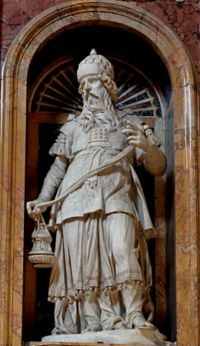
*Melchizedek at the Basilica di Santa Maria Maggiore, Rome.

The Wedding at Cana


14 January 2007: 2nd Sunday in Ordinary Time
John 2, 1-11 The Wedding at Cana

Let us first note where the first miracle happened. Cana in Galilee was probably a village near Nazareth. Today, it is attributed to a place called Kafar Kanna in Israel. In Cana, there was a wedding where Mary held an important responsibility, because she had power enough to command the servants. She was probably one of the wedding ‘coordinators’ of present-day weddings. She was worried about the wine that it was running out.

There are many little details given by other sources than the New Testament --- and some of these are not canonically accepted. But we can let our imagination fly. The writings of Coptic Gospels said that Mary was the sister of the bridegroom’s mother; and in early prefaces to the books in the New Testament called Monarchian* prefaces, they said that the bridegroom was John, the evangelist himself, and his mother was Salome, the sister of Mary.

Second, how important are weddings in ancient Israel? Weddings in Jewish customs are milestones. They give their time and effort in celebrating and marking it in their lives. In Jewish law, the wedding of a virgin takes place on a Wednesday, and it lasts for more than a day. The wedding ceremony itself took place after a big feast and late in the evening, as we see illustrated in the Parable of the Ten Virgins. After the ceremony, the young couple was brought to their new home. They take the longest route so that people may wish them well.

Third, how important are wines? For a Jewish feast, wine was essential. The rabbis said, “Without wine, there is no joy.” It did not say that it was permissible to get drunk --- drunkenness was a great disgrace! They actually drank wine mixed with water. But hospitality was a sacred duty for the Jews that for food and wine --- provisions--- to ran out in a wedding was a great embarrassment and humiliation.

And so Mary went to Jesus to ask for a favor. Mary knew her Son, so she asked Him for help. And Jesus responded. It was not his time, but what moved Jesus was compassion for the bridegroom and his bride: to save them from embarrassment in the community.

Our present lives are also marked by milestones: birth and birthdays, weddings and anniversaries, funerals and family gatherings. When we celebrate days that commemorate an important life-changing event, we gather people to celebrate with us, to share our joys. Many of these families and friends take time to invite us and to make those celebrations special. Jesus and his disciples mark these events and thus took time to celebrate this milestone in their friends’ wedding. Their presence is proof of their love.

This is the time therefore to re-affirm the importance of milestones, and check our attitudes and behavior towards celebrations. What are our motivations in attending these events? Do we catch ourselves dragging our feet to these events? Are we there for the meal --- as ‘eat and run’ guests do? Jesus thus affirms that Christians should not forget the virtue of hospitality and friendship; and thus genuine motivation is ideal when we mark days of our lives.

*Monarchianism holds and emphasizes God as being the one and only ruler --- thus is in conflict with the doctrine on the Trinity and the God becoming human as the Gospel of John emphasizes. Monarchian belief is heretical.

Peter's Mother In Law


January 2007. Wednesday of the First Week in Ordinary Time
Mark 1, 29-35

Yesterday’s Gospel tells us that people were amazed at Jesus’ teaching in the synagogue because he taught with power and authority. After His public appearance, Jesus’ friends brought him to Peter’s house. But upon arrival, Jesus responds to the needs of Peter’s mother-in-law.

The passage might be very simple, but when you meditate on it, and focus your attention to Jesus, you get a glimpse of who He is. Any public performance such as a one-hour variety show, a talk, a class, a seminar, or a mass needs energy. These events are exhausting. But Jesus could have demanded a break and rest, but He didn’t. Let’s see what we learn from Jesus.

First, Jesus still used his power, with or without a crowd. He was just as prepared to heal a large number of sick people as to cure a private person like Peter’s mother-in-law. The need of others took first priority over His desire to rest. How many of us have put our need before other people? Take for example our “take-home” practice during parties. I have witnessed a lot of people stuffing food in plastic or paper containers while the party queue is still on. Nagsisimula pa lang party, nagbabalot na siya. This tenet is good to remember: save the best for the last. Save the best chicken part for the last person.

Second, Jesus used his power in partnership with compassion. The Greek word for power used in the Gospel is exousia: unique knowledge together unique power. In diagnosing a person a doctor listens to his patience with interest, and when he gives the patient the prescription, he judges by understanding his patient’s condition --- done through interested listening and the knowledge he gained from studying. Jesus did not perform his miracles to gain popularity, but to help was his primary motivation. Let us reflect on our motivations: how many of us work when we are recognized: “Masama ang loob ko kasi hindi man lang pinapapansin o pinahahalagahan ang trabaho ko.” or “Ba’t ko gagawin iyan, hindi naman ako officer.”

We also learn something about the disciples of Jesus. They were indeed friends. The disciples have known Jesus for just a short time, but here they already have taken their personal troubles to him. It is intriguing to think of Peter as married, giving his home to his wife’s mother, and probably according to tradition, also was a father to his children. And here we see Peter telling Jesus about his personal life and struggles. The would-be leader of the Church had domestic problems.

Many of us are like Peter: in our service to God and country --- whether in teaching, public office, or even studying --- we are also bombarded by troubles at home. Last month, while presiding at mass and coordinating mall Christmas concerts, I was deeply troubled by my family’s condition in Bicol after the typhoon Reming. Or, many students have to continue preparing for exams while their parents fight. To whom do you talk about your troubles --- honestly and without edit? Do you talk about all your problems with all its gory details openly to Jesus? The Gospel tells us that after Jesus’ work, He goes up to the mountain to pray. It is not difficult to imagine that in this quiet time with His father, Jesus would tell Him everything indeed.