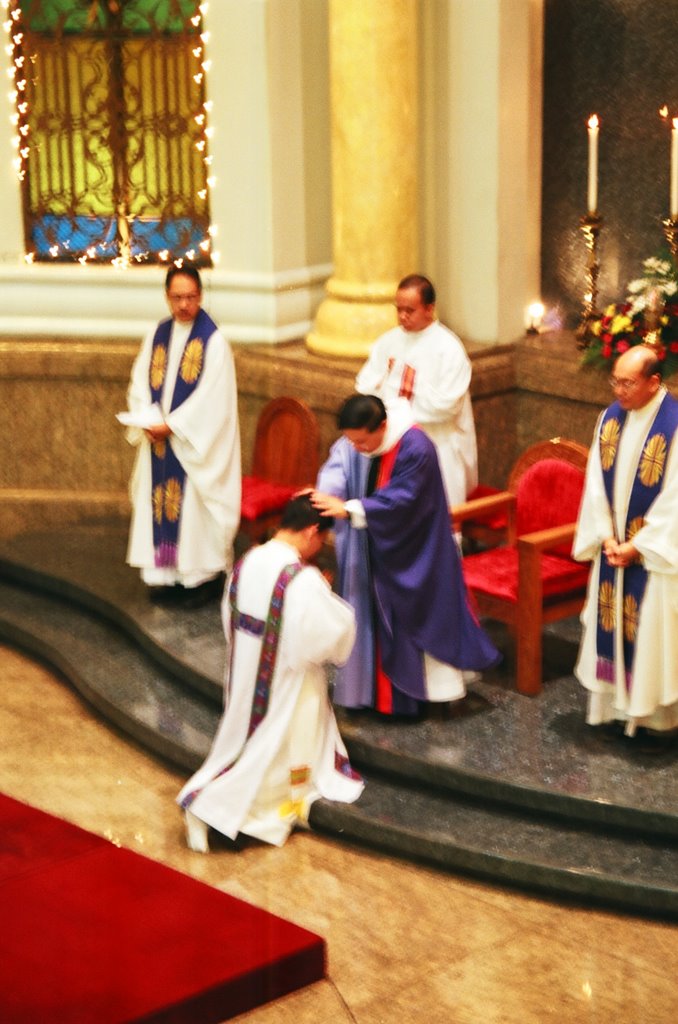
The Sign of the Cross

14 September 2006: The Triumph of the Cross
Num 21, 4-9; Psalm 78; Phil 2, 6-11; John 3, 13-17


The sign of the cross has always marked the Christian, more so the tracing of the sign of the cross marked the Catholic. Who among us make the sign of the cross at every moment in our lives everyday? We make the sign of the cross at the start and beginning of a prayer. We make the sign of the cross when we start and end our meals. We make the sign of the cross when we are afraid. We make the sign of the cross when we mark holy places such as churches and cemeteries. Why do Catholics trace the sign? Protestants have lambasted us. But little do they know that Martin Luther did not abandon the sign of the cross. In fact, he recommended it in his Small Catechism in an appendix on family prayer. It says, “As soon as you get out of bed in the morning, you should bless yourself with the sign of the Holy Cross and say: “May the will of God, the Father, the Son and the Holy Spirit be done! Amen.” (Martin Luther, Luther’s Little Instruction Book, trans. Robert E. Smith at http://www.iclnet.org)
Well, we, Catholics, are doing what the early Christians were doing as early as Paul. It seems it becomes a practice at baptisms. It was a normal, everyday experience of Christians in the first centuries as attested by many Christian writers. Tertullian (160-225 AD) said, “In all our travels and movements, in all our comings and goings, in putting on our shoes, at the bath, at the table, in lighting our candles, in lying down, in sitting down, whatever employment occupies us, we mark our foreheads with the sign of the cross.”
St. John Chrysostom (347-407 AD), the eloquent saint whose memory we celebrated yesterday, was the patriarch of Constantinople (now Baghdad), said, “Never leave your house without making the sign of the cross. It will be to you a staff, a weapon, an impregnable fortress. Neither man nor demon will dare to attack you, seeing you covered with such powerful armor. Let this sign teach you that you are a soldier, ready to combat against the demons, and ready to fight for the crown of justice. Are you ignorant of what the cross has done? It has vanquished death, destroyed sin, emptied hell, dethroned Satan, and restored the universe. Would you then, doubt its power?” Let us see what he meant.

***

There is a story about Alexander Solzhenitsyn found in the internet and circulated through email. Alexander leaned on his shovel and watched the gray clouds drag sullenly across the sky. A merciless wind tore at him through his prison garb. He felt as though it penetrated to his soul. Every one of his bones and muscles ached. Hunger gnawed his stomach. Years of hard labor in the Siberian work camp had ruined his health and stripped him of hope.
Alexander could endure no longer. He dropped his shovel, left the work gang, and sat on a bench nearby. Soon a guard would command him to return to work. When he would ignore the order, the guard would beat him to death with his own shovel. He had seen it happen to others many times. “A quick, bloody death today,” thought Alexander, “would be better than a slow death in a bleak, empty future.”
He stared at the ground, waiting for the inevitable. Soon he heard footsteps and braced himself in anticipation of the guard’s harsh words. But when he raised his eyes, instead of a guard he saw a gaunt, elderly prisoner standing before him. The old man said nothing but knelt in front of him. With a stick he scratched the sign of the cross in the dirt and then hurried back to work.
He looked at the cross, and as he reflected on it, a ray of light penetrated his dark thoughts. In that moment, his perspective changed radically. He realized that he did not have to face the evil of the gulag and the Soviets on his own diminished strength. With the power of the cross, he could withstand the evil of not one but a thousand Soviet empires.

He got up from the bench and returned to work. Although the record does not say so, I think that he must also have traced the ancient sign of the cross on his breast. None of Solzhenitsyn’s external circumstances changed that day, but internally he had experienced a gentle revolution. The sign of the cross had blessed him with the grace of hope.

***

Alexander’s experience is not strange to many of us. The sign of the cross has given us hope. Who among us experienced some assurance when we make the sign of the cross before we hurdle a hard exam? Who among us experience some healing when we ask a priest to make the sign of the cross over our heads, or trace with holy oil on the part afflicted with pain? When we travel and our transportation --- land, water or air --- seem unsteady, didn’t we make the sign of the cross to assure us that the Lord will bring us safe to our destination?

When we make the sign of the cross then, we are not doing an empty gesture. The sign of the cross is an opening to God. It is a prayer itself that engages the Trinity to help us live a true Christian life. It is a renewal of Baptism. When we trace it on our body, it stirs up the new life of the Spirit that we received in Baptism and vitalized our prayer drawing us closer to God. It is a mark of discipleship. Making the sign affirms our decision to follow Christ, allowing Him to assume our burdens and free us to live joyfully. It is an acceptance of suffering. The sign of the cross is a practical tool for dealing with problems. It is a defense against the devil and a victory over self-indulgence. It invites Christ to support us in our pain and suffering and works handily to defuse our worst inclinations and sins and to dispel the temptations of the devil. And the sign is much more, for with a slight motion of the hand and a few simple words, it sums up the truth and power of the Christian life.

In other words, when we trace the sign of the cross, we remind ourselves of our identity and our responsibility: I am a Christian! I am a Catholic! We follow what Paul says in the 2nd reading: Put on the mind of Christ! When we trace the sign of the cross in public, we tell them that we are not ashamed to be branded with the cross of Christ. Just as St. Paul said to the Galatians, “But as for me, it is out of the question that I should boast at all, except of the cross of our Lord Jesus Christ, through whom the world has been crucified to me, and I to the world... After this, let no one trouble me; I carry branded on my body the marks of Jesus.” (Galatians 6, 14 &17).

Offenses

12 September 2006: Tuesday of the 23rd Week in Ordinary Time
1 Cor 6, 1-11; Ps 149; Lk 6, 12-19


With regards to offenses, the culture of the Jews is to settle their dispute among the elders of their village or the synagogue. For the Jews, disagreements are more settled in the spirit of family than of law. The Greeks find litigation entertaining. They would take their disputes to court. When Paul saw that the Corinthian Church was settling disputes the Greek way, he was shocked. Paul wanted the Christian way --- there a way of proceeding. They must settle it among themselves first; then it is settled within the church community. In the first reading, Paul seizes on the great essential principle. To go to law at all, and especially to go to law with a brother, is to fall far below the Christian standard of behavior. Long ago, Plato had laid it down that the good man will always choose to suffer wrong rather than to do wrong. If the Christian has even the remotest tinge of the love of Christ within his heart, he will rather suffer insult and loss and injury than try to inflict them on someone else --- still more so, if that person is a brother or a sister. To take vengeance is always an unchristian thing. A Christian orders his relations by the spirit of love; and the spirit of love will insist that he live at peace with his brother or sister. Ibig sabihin, mas gugustuhin ng Kristiyano ang magtiis sa mga paninirang ginagawa ng mga tao sa kanya, sa mga maling sinasabi ng mga tao sa kanya, kaysa gumawa ng masama sa kanila. The Prayer of Sacrifice that we say after communion every mass puts it aptly, “Teach my mind and direct my will to humbly endure the pain of undeserved suffering even when my intent was good and done what is right.”
The reason is that the Christian believes in the power of Christ to change people --- as St. paul enumerated the great sins, but it also includes those who accuse us wrongly, those who inflict pain on us. The power of Christ is still the same. No person can change oneself, but Christ can change him. A contemporary of St. Paul, Seneca declared, “men love their vices, and hate them at one and the same time.” He called himself, homo non tolerabilis, a man not to be tolerated. Since we love and hate our sins at the same time, our sins should not be tolerated. Into this world, conscious of a tide of decadence, sinfulness and darkness --- nowadays they call it, the culture of death --- nothing could stop, the radiant power of Christianity, which was triumphantly able to make all things new.
In other words, when Jesus chose his disciples, it is to make things new. We are his disciples, how do we make things new. Do we hope in people that they can change with God’s power? Or have we inflicted pain in vengeance? Would we rather get even or would we rather talk to them so that we may live in peace?

Discipline

11 September 2006: Monday of the 23rd Week in Ordinary Time
1 Cor 5, 1-8; Luke 6, 6-11 Discipline


In Jewish literature, leaven stands for an evil influence. It was dough which had been kept over from a previous baking and which, in the keeping, had fermented. The Jews identified fermentation with putrefaction, and so leaven stood for a corrupting influence. Now, the bread used for the Passover feast was unleavened (Exodus 12). And on the day before Passover, a law has been laid down that a Jew must light a candle and searches his house ceremonially for leaven, and that every last bit must be cast out. It means that the last remnant of evil must be cleared out of our lives. Thus, St. Paul in the first reading tells us that if you let an evil influence into the Church, it can corrupt the whole society, as the leaven permeates the whole lump of dough.
There are two things I want to say. First, the young generation calls people who are like leaven, “BI” (meaning, bad influence). If a friend, for example, has taught someone to smoke, that friend is a BI. If someone in office has initiated a new employee into the system of graft and corruption, the person is a BI. In school, we become who are friends are because they influence our way of thinking, our actions and behavior. In the new TV hit, High School Musical, there are the nerds, the basketball team, the punks, etc. And if anyone differs from the mold, they are ostracized. An old adage has it, “Tell me who your friends are, and I will tell you who you are.” Nothing illustrates this more than the influence of Osama bin Laden to terrorists.
Second, it tells us what discipline does. The second reading tells us of a sin that shocked Paul and the rest of the Christian community at Corinth. There was a man who had illicit sexual relations with his own step-mother. What shocked Paul was the attitude of the Corinthian church: they complacently accepted the situation and done nothing about it when they should be sad. And Paul said that he must be excommunicated. When a child is grounded for example, the person is literally “excommunicated”. That means he is prevented from doing the normal thing he or she does. When a person in school is suspended, he is prevented from participating in the normal thing that a student does in school. These are all ways and means in order to discipline a person who has to clear out the evil that he or she has. Therefore, when Paul “excommunicated” the man who has committed incest, Paul is not being vindictive. Discipline is thus carried out not to punish, but to awaken. It is not to break the person, but to make the person. Discipline therefore is carried out as a form of love and care. Thus, in the Gospel, when Jesus cured the man on the Sabbath, he tells us that beyond all our rituals, charity must have priority. The person takes primary importance over rituals.
Disciple has sometimes to be exercised for the sake of the Church. To shut our eyes to offenses is not always a kind thing to do; it may be damaging. A poison must be eliminated before it spreads; a weed must be plucked out before it pollutes the whole ground. A practice --- for example, the uncharitable disregard of the dignity of the lay minister here in UP --- should be removed before it influences the perception of people that God gives more grace if you receive communion from the priest than the lay minister. In truth, God gives the same grace to all --- whoever the person is. The Church has officially chosen lay people to be extraordinary ministers of Holy Communion, and if a person disregards it, then he or she disregards the Church.
Here we have a whole principle of discipline. Discipline should never be exercised for the satisfaction of the person who exercises it --- or else it would be power-tripping--- but always for the mending of the person who has sinned and for the sake of the Church. Discipline should never be vengeful; it must be curative and prophylactic.

Ang Pipi at Bingi

10 September 2006: 23rd Sunday in Ordinary Time
Mark 7, 31-37: Ang Pipi at Bingi

Note: Not a literal translation of this Sunday's English homily.

May awit na kinakanta tuwing Adviento na ang pamagat ay Balang Araw. At pinapahiwatig nito ang pangako ng Panginoon na narinig natin sa unang pagbasa. Ganito ang mga salita:

Balang-araw mumutawi sa bibig ng mga pipi ang kagandahan ng umaga, pagmamasdan sa twina.

Balang-araw ang liwanag, matatanaw ng bulag, pasasalamat at papuri, awit ng luwalhati.

Balang-araw tatakbo, ang pilay at ang lumpo, magsasayaw sa kagalakan, iindak sa katuwaan.

At itong pangako ng Diyos ay naisakatuparan sa pagdating ng Manunubos. At nakita natin sa Ebanghelio ngayong linggo.

Bagaman hindi lahat sa atin ay bulag, pipi at bingi, maaaring sa ibang paraan tayo may kapansanan. Una, bulag: May mga pangyayari sa ating buhay na tayo’y nagbubulag-bulagan. May mga bagay tayong ayaw nating makita. Kahit sinasabi na ng ating mga kadugo o kaibigan, pilit nating di pinapansin dahil alam nating ang kahihinatnan ay masakit. Maaaring kailangang maghiwalay, magbagong-loob, o magbago ng mga bagay na nakasanayan na.

Pangalawa, bingi: Tulad ng pagbubulag-bulagan, tayo rin ay nagbibingi-bingihan. Ang mga payo ng ating mga magulang at feedback ng ating mga kaibigan ay di natin pinapakinggan. Kahit alam nating tama ang kanilang sinasabi, natatakot tayong harapin ang katotohanan dahil nangangailangan itong lakas ng loob. At kadalasan natatakot tayong hindi natin kayang gawin ang nararapat.

Pangatlo, pipi: Maraming pagkakataong nais nating sabihin ang ating tunay na niloloob at hindi natin masabi-sabi. Hindi natin mailabas dahil natatakot tayo na magalit ang ating mga minamahal, o natatakot tayong makasakit ng damdamin. Kadalasan sa ating mga Pilipino, mas ginugusto nating kimkimin na lamang ang damdamin dahil ayaw nating maalog ang ugnayan. Nguni’t ang ating mga saloobin lalung-lalo na ang mga galit at sama ng loob ay lumalabas at nakikita pa rin sa iba’t ibang paraan. Marami sa atin ang nagiging masungit, mainitin ang ulo at bugnutin. Minsan, ang ating galit ay higit pa sa dapat na reaksiyon natin sa isang pangyayari. Nakalimutan lang na bumili ng bigas ng anak, nahalata natin na andami na nating nasabi --- naglitanya na tayo ng mga bagay na kinalimutan nagmula sa pagkabata hanggang sa pagtanda!

Dalawang bagay ang makikita natin sa paggagamot ni Hesus. Una, inilayo ni Hesus ang bingi at utal sa karamihan. Ginamot ni Hesus ang bingi at utal nung sila’y nagkasarilinan. Naintindihan ni Hesus ang kalagayan nila. Ang bingi at utal ay nahihiya sa karamihan. Halimbawa, alam nila na sumisigaw na ang kausap pero hindi nila maintindihan dahil di nila marinig. At kadalasan, pinagtatawanan natin ang mga utal. Sa buhay, nakikita natin ang katotohanang ayaw nating makita, marinig o masabi kung tayo’y nag-iisa. Dahil sa ating pag-iisa, kaharap natin ang tunay nating pagkatao. Sa pag-iisa, nasasalita natin ang ating mga tunay na kinatatakutan or sinasaloob. Alam natin ang gusto nating mawala sa ating buhay --- ang mga bagay na kailangang gamutin at hilumin.

Pangalawa, pisikal ang lunas ni Hesus: isinuot ang kanyang mga daliri sa tainga nito, at lumura at hinipo ang dila. Di tayo nagkakalayo sa mga paggamit ng laway. Di ba isinusuot natin ang ating daliri kapag nasugatan sa ating bibig? Di ba nginunguya natin ang dahon ng bayabas bago ilagay sa sugat? Sinabi ni Hesus, “Ephata” ibig sabihin, “Mabuksan.” Ang gamot sa ating mga sugat ay nagkakaroon ng lunas kung kasama si Hesus. Kadalasan, ang mga payo ni Hesus ang lunas sa ating pagbibingi-bingihan, pagbubulag-bulagan at sa ating pagiging utal. Sa mga nagbubulag-bulagan, sinasabi ni Hesus na buksan at tingnan ang puwing sa ating mga mata. Sa mga nagbibingi-bingihan, sinasabi nating buksan ang ating mga tainga, at pakinggan ang payo ng ating mga magulang at kaibigan. Sa mga utal, sinasabi ni Hesus na huwag matakot sabihin ang ating mga niloloob lalu na kung makakabuti ito sa kapwa. Sa mga may galit, kausapin ang kagalit at patawarin.

Sa araw na ito, tingnan natin ang ating mga kapansanan at humingi ng lunas sa piling ni Hesus. Sa Koro ng awit ng Balang-Araw sinasabi, “Narito na ang Manunubos, Luwalhatiin ang Diyos.”

The Deaf Mute

10 September 2007: 23rd Sunday in Ordinary Time
Mark 7, 31-37 The Deaf Mute

When Jesus arrives back in the regions of Galilee, he came into the district of the Decapolis, and there they brought to him a man who was deaf and who had an impediment in his speech. Usually, the deaf and the mute go together. The person’s inability to hear made his speech so imperfect. Here we see how Jesus treats people.

First, Jesus showed some physical healing. Jesus put his hands in the man’s ears and touched his tongue with spittle. In those days, people believed that spittle had a curative quality. Seutonius, the Roman historian, tell us of an incident in the life of Vespasian, the Emperor, that a certain man who was blind and lame came to Vespasian and craved for a remedy for his infirmities, and thereby shown in his dreams that all he needs is spittle or saliva (Seutonius, Life of Vespasian). This belief exists today. When our cut our hands, the natural reaction is to put the wound in our mouth. In the Philippines, we chew guava leaves and put it on the wound. In whatever case, people who are sick want healing.

But not all those who are deaf, mute or blind want healing. After all, begging is an easier way to eke out a living. We hear on television stories of many prisoners who would intentionally commit crimes in order to be brought back to prison. Being in prison has advantages: food is provided. There are many people who in their heart of hearts do not dislike their weaknesses. They do not wish to lose their sins especially if they derive pleasure and comfort from it. For those who are involved in graft and corruption, they do not actually wish for its abolition. Alcoholics and drug addicts do not wish for freedom from these addictive substances. Many people do not desire healing. Or else, the very source of their relief and enjoyment vanishes.

Today is a day of healing and growth. It is a time when we bring to God our wounds and illnesses, and ask for healing. It is a time when we should take a moment to think about what we need to bring to Jesus for healing; to identify our pain and wounds; and to accept the fact of our deafness and brokenness. St. Ignatius in the Spiritual Exercises recommends that we should be clear with the desire we request of God and that the grace being asked is articulated. Are we sincere and genuine enough to desire healing? What would you say to Jesus if He asks you what you need?

Second, he took the man aside from the crowd, all by himself. Here is the tender considerateness. Deaf people are always a little embarrassed. In some ways it is more embarrassing to be deaf than to be blind. A deaf person knows he cannot hear; and when someone in a crowd shouts at him and tries to make him hear, in his excitement he becomes all the more helpless. Jesus showed tender consideration for the feelings of a man for whom life was very difficult.

It is interesting to note that Jesus answered his desire, not in the streets, but alone. You see, it is only when we are faced with ourselves and when we are alone with Jesus that we are able to be honest with ourselves. It is when we are alone that our wounds stare at us closely. We can hide our wounds and dark secrets from a crowd; we can make promises to God like an avid fan for all to hear; and often we shout to everyone what they would like to hear, so that they will appreciate us. We can loudly claim our commitment to Christ in the middle of a spiritual frenzy and when we are emotionally charged like many of those who went into a charismatic fellowship, or a retreat that employs letters from parents and significant people to highlight affirmation as an experience of God’s love. But what matters is what happens when the crowd is gone, when the emotional high has dipped, and when we return alone to the privacy of our rooms, if not our existential isolation and loneliness

A wound or any disease can consolidate and reveal our true character, our true self, our real home. Our wound can thus bring us to who we are, to that inner home which we yearn for. And thus healing happens in the passage of time, when we face ourselves squarely and answer truthfully the questions raised by our wounds. Carl Jung said, “If you get rid of the pain before you have answered its questions, you get rid of the self along with it.”

Today is the time for self-awareness, and for answering the questions of our sickness, our pain, and our brokenness. What are the areas in my life to which I am deaf? What are people saying about me, and I do not listen to them, because they are painful. Although many truths in our lives are painful to accept, the very awareness of these wounds helps us to see our true selves. When our ears are opened to the truth of our lives, healing happens.

The Three Gestures of Mary

8 September 2006: The Nativity of Mary
Matthew 1, 1-23: The Three Gestures of Mary

At lunch today, we had lechon kawali, pancit and a Goldilock’s cake. I asked Nene, our cook, what’s the occasion. She said, that Fr. Raymund told her to order them because it is Mary’ birthday. The cake makes ordinary meals special and the pancit is a Chinese-Filipino tradition to wish someone a long life. When we celebrate birthdays we are grateful for the gift of the person to us. At birthdays, we remember who the celebrant is to us, and how he/she affected our lives. As we celebrate Our Mother’s birthday, we thus remember who she is to most of us. The significance of her birth is seen in the significance of Jesus in our salvation. Without her, salvation couldnot have been possible. We will use three common gestures of Mary taken from the pictures and statues we have of her. These are our images of the Blessed Virgin Mary.

First, Mary who prays. Images of Mary whose hands are clasped on her chest or those whose hands are outstretched are images of Mary praying. The outstretched hands tell us that she welcomes all of our needs. It is not surprising that many of us Filipinos, run to Mary when we are afflicted. The prayer, the Memorare tells us, “Remember O Most gracious Virgin Mary, that never was it known, that anyone who fled to your protection, or sought intercession was left unaided.” Mary prays for us and continually opens her heart to all of us, listening to our petitions, whether it is of lesser consequence or of greater urgency and importance.

Second, Mary who is loving and tender. These are the images of Mary who embraces and keeps Jesus close to her heart. It is Mary who is mother to all of us, just as she was a mother who cared for Jesus.

Michael Jordan, whose father was murdered in the summer of 1993, said to Bob Greene: “My heroes are and were my parents… It wasn’t that the rest of the world would necessarily think they were heroic. But they were adults I saw constantly, and I admired what I saw. If you are lucky, you grow up in a house where you can learn what kind of person you should be from you parents. And on that count, I was very lucky. It may have been the luckiest thing that ever happened to me.” I guess, the luckiest thing for many of us Christians, is that we have a mother like Mary. It is not surprising, that when we are frightened, we cling to the rosary for protection. And we pray that Mary embraces us, like a mother who encloses her arms around us, and assure as that everything will turn our fine.

Third, Mary who points at Jesus. These are the images of Mary that tells us that she is not the center of attention, but her Son. These are images that remind us that Mary’s life and example leads us to where it should be, the love of Jesus, her Son.

Raising children like Jesus, guiding them through their struggles, comes from instruction and teaching. And as one mother said she had to say the same lesson over and over again. Wise parents provide this sort of training all the time. They teach their children to act with virtue and thereby develop the ability to do so on a regular basis. Here are some everyday advocacies:

Anak, alam kong mas gusto mong maglaro kasama ng mga kaibigan mo, pero meron kang assignment na kailangang gagawin mo. Gawin mo muna ang assignment, pagkatapos, pwede ka nang maglaro. (Son, I know you want to play with your friends, but you have to finish your assignment first. Do your assignment, then you can play with them.)

Alam kong ayaw mo ang binigay ng lola mo, pero isuot mo para matuwa siya. Mas mabuti sa kanyang kaarawan, kahit di mo gusto ang t-shirt mapasalamatan at mapasigla mo siya. (I know you do not like the shirt your grandmother gave you, but make her happy by wearing it on her birthday.)

How many times did Mary remind us to repent and to pray the rosary? The rosary reminds us of the life of Jesus, so that as we continue to pray it everyday, the life of Jesus becomes our life. Our children get what parents teach them by doing it consistently and repeatedly, like the repetitions in the rosary.

And so, as we celebrate the Birth of Mary, we remind ourselves that we too can be like her. We can pray for all peoples, care for them, and finally, lead our lives towards union with Jesus.

Wisdom in Discipleship

7 September 2006: Thursday of the 22nd Week in Ordinary Time
Luke 5, 1-11 Wisdom in Discipleship


When Jesus called Simon Peter, the night was past and all the circumstances were unfavorable. Peter said that they have toiled all night long and they caught nothing. However, Simon Peter’s move was to trust Jesus and follow his command to go into the deep and throw the net for a catch. And just as Simon Peter did so, he had a great catch that the nets were town into numbers. Later, Jesus would tell Simon Peter that from then on, he will be catching people.

I believe in the importance to going into the deep. The Latin of this is, “Duc in altum”. To go into the deep is the condition in order to catch people. All Christians are called, the same way as Simon Peter was called, to proclaim the Good News to the world. Thus, we are asked to go into the deep. To acquire depth in our faith. Maging malalim.

What does it mean to acquire depth? Socrates once said that the unexamined life is not worth living. We should not breeze through life without reflection, learning, and authentically living. We must develop the ability to see what is beyond sensible reality; to see the eternal truths beyond the empirical. At sea, one finds two major layers: the surface of the sea and its depths. The surface of the sea is what we see and what we touch. Sometimes we smell its saltiness. We hear the sound of the waves. In our life, the surface symbolizes what can be sensible to us. We see trees and microscopic organisms; we hear the noise of civilization and the reverberations of our heart. All the facts we memorize in class and the theories that claim order in the universe. We experience joy, pain, loneliness, and anger. Life can be a jumble and mixture of facts, tenets of knowledge, snippets of experiences but all of these can be a meaningless mess.

The deep symbolizes the things that makes life meaningful and worth living. At a family reunion, our relatives tell us that we look like one of our parents. The surface is the first thing they see, and then we ask, “Who am I?” apart from them. At the brink of a transition, whether graduating or taking the bar exams, the last step towards becoming a lawyer, we begin to ask, “Where will this lead me?” We know that our action is senseless unless it has direction. These questions lead us into the very center of our hearts, to the very purpose of which we were made. It is a journey that we take within ourselves. To find meaning in our lives and to have a sense of direction and purpose, mean to discover wisdom.

And what is wisdom? Wisdom is the ability to see things in God’s eyes. The university as an institution can guarantee the acquisition of knowledge, skills, and perhaps, the arts. It requires the objective credentials of instructors; it grants degrees and diplomas after appropriate testing and examination. But none of that guarantees wisdom. Not all of those who have been given awards and recognition by the university have wisdom. It takes a community to cultivate wisdom. Wisdom is learned in conversation, in friendships, in small groups, from and with wisdom figures such as teachers. Wisdom is an interpersonal endeavor. Wisdom is more than knowledge and skill; it includes values and a grasp of one’s own ultimate meaning and purpose. And only in a religious perspective, in the eyes of God, can one find wisdom.

It is strange that when someone close to us dies, the most consoling gesture is not an explanation of the facts of death, but the kisses our family give us, the hugs of friends we value, the assuring words of those who come to visit. Because in the end, death gives us a perspective of the truth --- that God is the beginning and end of our lives. He is the thread that connects the mixture of facts and experiences in our lives. And when we are able to see things in God’s eyes, then, whether we pass the bar exams or not, whether we experience sickness and health, whether we have a short life or a long one, it does not matter. What matters is that these experiences, negative or positive, lead us to God. Then, we may find ourselves at peace. We find wisdom. We discover depth. We find God.

The Queenship of Mary

22 August 2006: Queenship of Mary
Luke 1, 26-38: The Annunciation


Note: As requested by those who celebrated their birthdays last August 22.

For many of us, Filipinos, the idea of a queen is a foreign notion and do not quite draw out inspiration from us. The celebration of the Queenship of Mary was established at the end of the 1954 Marian Year by Pope Pius XII in his encyclical, Ad Caeli Reginam. The encyclical says that Mary is Queen because of her divine maternity and her association with Jesus’ redemptive mission. In other words, she is queen because she is the mother of God’s son, Jesus, and she is queen because she shares in the work of her Son.

Salvation history is a story that involves human participation When God willed that He saves us, He employed human beings to participate in His work. He worked with both men and women: Abraham, Sarah, Moses, Ruth, David, Isaiah, Deborah, etc. He worked with the young as Jeremiah was. He worked with the old such as Abraham. He worked with mothers such as Sarah and Elizabeth. The Apostle Paul spoke of this mystery when he stated, “We are God’s co-workers” (1 Cor 3,9). Why? Can’t God get the job done by Himself? Of course He can. But, like all parents, our well-being is nurtured by them, but eventually determined by us. We share in our redemption. Parents and children are co-workers. Like God and us. In an unparalleled way, with Mary to whom God entrusted such tasks as feeding His Son with her own milk, singing Him to sleep, and accompanying Him all the way to the Cross where she gave her sorrowful yes to His self-offering. In short, the Father willed that His Son’s entire existence as a man would hinge, so to speak, upon the ongoing faith of Mary. Just imagine if you were Mary: the whole thing is not just one dramatic event as we think of the Annunciation or Christmas with all the angels singing. The whole thing involves the daily tasks and the heartaches that comes when Jesus is lost or being tortured to death.

Being a disciple, a co-worker with Jesus, takes effort. At times, it takes a lot of suffering. In one passage St. Paul said, “I rejoice in my sufferings for your sake, and in my flesh I complete what is lacking in Christ’s afflictions for the sake of His body, that is, the Church.” (Col 1: 24). In the event of an unsuccessful basketball game, a bruised knee, a broken heart, a difficulty in running organizations, a disastrous project, a difficult person in the family, Catholics may remember with some fondness being told to “offer it up to the Lord” (Ipagpaubaya mo na sa Diyos). This simple phrase is the key to a basic understanding of our faith. By consciously uniting our sufferings to Our Lord’s redemptive sufferings on the cross, we become co-workers. By uniting her heart to His, especially at Calvary, the Blessed Mother became Christ’s co-worker. Vatican II (1962-65) said, “This motherhood of Mary in the order of grace continues uninterruptedly from the consent which she loyally gave at the Annunciation and which she sustained without wavering beneath the cross, until the eternal fulfillment of all the elect. (Lumen Gentium 62; Catechism 969).

When I was a child, we would go to see my grandparents and I could count on my mother turning around at some point, taking her handkerchief, and cleaning me up in order to see Lola and Lolo. Remember the time when we smelled like sweat and our mother cleans us? In the same way, when we are about to encounter some difficulty in our lives, Mary our mother says, “Come here. You have some things in your life that needs to be cleaned up. One thing I appreciate about Mary is that she is our mother and there is a great difference between a mother’s prayers and anyone else’s when it comes to children’s needs. Mothers do not miss anything. They see the details of their children’s lives. If you look at it closely, Mary does not live out a role or a duty, but a love --- as mothers do.

This is therefore the reason why we celebrate Mary’s Queenship: as the mother of Jesus and ours too. Her queenship is being mother to us yesterday, today and tomorrow. And we do not also forget that it also means that we are responsible for each other’s growth and development into mature Christians.

The Healing of Peter's Mother-in-Law

6 September 2006: Wednesday of the 22nd Week in Ordinary Time
Luke 4, 38,39 The Healing of Peter’s Mother-in-Law

Luke is a medical doctor. So he writes a medical term. “In the grip of a major fever” is the medical Greek for someone definitely laid up with an illness. The Greek medical writers divided fevers into two classes: major and minor. Luke just described this illness.

There are two things to be said in this Gospel.

First, Jesus was ready to help. He just left the synagogue and thus he is tired. Every preacher in the synagogue knows what it feels after a service. It is draining and a person needs to rest. In fact, after this passage of Jesus helping Peter’s mother-in-law, and at sundown, all who had friends who were ill will be brought to him. After the demands of the crowds, Jesus will eventually go to a deserted place alone to pray and to rest.

Many of us are busy. Our work, our studies, our daily routine often diminishes our energies, including the energy to be able to help others. The demand of people will always be there and should be responded to. But it also mean that we too have to recoup our strengths, renew the source of our core energy, regain our health. Without our health, we will not be able to rest. Even if Jesus was ready to help, He needed to recover, recuperate and gain back his strength by praying. By going alone to pray and to rest, He constantly centers His life on God. The experience of prayer issues out in service. This is precisely the point in the order of the commandments: Love God with all your heart is the first and primary commandment; then from it comes the second, love one’s neighbors. When we pray we regain our strength, and gain a sense of perspective.

Finally, when Peter’s mother-in-law was cured, it is written that “immediately she began to serve them.” In gratitude and in the realization that her life has been given back to her, she did not lose time to return her gratitude by cooking and serving. We would do well to remember that if God gave us the priceless gift of health and strength, he gave it that we might use it always in the service of others.

Speaking with Authority

5 September 2006: Tuesday of the 22nd Week in Ordinary Time
Luke 4, 31-37: Speaking with authority

In the environment of Jesus, it was the scribes --- the teachers of the Law --- who were customarily addressed by the title, “rabbi”. Rabbi was a title of respect for a teacher. In Aramaic, ‘rabbi’ means ‘my lord,’ which can be translated in a substantively as ‘teachers.’ Most often, the New Testament uses the Greek equivalent, ‘didaskalos’ for ‘teacher’. When Jesus went to the synagogue and taught, the people were amazed at His way of teaching, because he taught with authority. By teaching with authority, Jesus differs from a ‘rabbi.’ Let us do a comparison and contrast.

Jesus shares similarities with rabbis. He proclaims the divine law, teaches in the synagogue, debates with other scribes concerning the Law in the manner of their profession and under the same authority, that is, the authority of the Scriptures. He uses parables and explains Scriptures. He was approached for decisions on the points of the Law. And He has disciples and gives them special instructions just like the rabbis do.

However, there are differences between the rabbis and Jesus. He was no scribe or rabbi in the strict sense, because he lacked the basic requirement which is the prescribed course of instruction. He did not have the theological studies under another scribe. To become a teacher of the law, a person had to spend years studying the Law under another scribe. Second, he did not teach only in the synagogue. He taught in open fields, on the shores of a lake, and the like which are very unlike a scribe. And at the same time, Jesus’ disciples included those which a rabbi would avoid because His disciples included women, tax collectors whom scribes regarded as sinners, and the like. And Jesus’ message was for all, while the message of the scribes concern only Jews.

The Gospel today shows us that the manner of teaching of Jesus differed profoundly from that of other rabbis. A rabbi’s authority is derived from Scriptures. A rabbi must show that his teaching conformed to Scriptures, the tradition of the Fathers (authoritative rabbis of the past who gave interpretations of the Law). But Jesus taught in his own authority. His authority is immediate. His teachings never consist merely in the interpretation of an authoritative sacred text, not even when the words from Scriptures were quoted. The authority of the will of God is always directly present in him. This is true to such a degree that he even dared to confront the literal text of the Law with his own authoritative declaration of the will of God. In doing this, he modifies the Mosaic Law given by God on Sinai. At the Sermon on the Mount, Jesus modified the teachings on killing, adultery, and oaths (Matthew 5, 21ff). He would say, “You have heard it said to the men of old (meaning, men of the Sinai generation whom Moses gave the Law)... But I say to you ...” Jesus modified the teachings on divorce, revenge and on the love of enemies by giving his own view on these issues, without referring back to others. And this is the reason why his audience in the Gospel today is astounded.

Many of the teachings of Jesus are hard to apply --- even the laws he modified. When we try to live out Jesus’ teachings, do we follow them with an open heart, or do we wish them changed and conformed to what we want. For example, a married couple who have problems with each other would choose to abandon ship than try to reconcile, would wish that Jesus’ law on divorce be modified. Those who have enemies would not like Jesus’ challenge to love and forgive. In other words, how trusting are we to the authority of Jesus’ teaching?

Ang Ating Mga Sinasabi

3 Setyembre 2006: Ika-22 Linggo ng Karaniwang Panahon
Mark 7, 14-23: Ang Ating Mga Sinasabi

Note: Filipino version of this Sunday's homily. I had three masses in Filipino and one in English. The English is below.

Narinig natin sa Ebanghelio na pinagbintangan ang mga alagad ni Hesus na hindi naghugas ng kamay bago kumain, ayon sa utos ng kalinisan ng mga Judio. Sinagot sila ni Jesus, na hindi ang pumapasok sa bibig ang nakapagpaparumi sa mata ng Diyos, kundi ang nagmumula sa kanya. Sapagkat sa puso ng tao nanggagaling ang masama. Idinagdag ni Jesus ang sinabi ni Isaias, “Paggalang na handog sa akin ng bayan ko ay paimbabaw lamang, sapagka’t bibig at hindi sa puso ito bumubukal. May kuwento tayo ukol sa lumalabas sa ating bibig, ang binibigkas ng ating dila:

Isang pilosopo si Xanthus. Minsan tinawag niya ang kanyang katulong upang mamalengke ng pinakamainam na lulutuin para sa isang hapunan kasama ang kanyang mga kaibigan. Kinabukasan, nang magsalu-salo na silang lahat, walang ibang putahe kundi lengua --- iba’t ibang luto ng dila. Nagalit si Xanthus at pinagsabihan ang katulong, “Di ba sabi ko na bilhin mo ang pinakamainam na lutuin sa palengke?” Sagot ng katulong, “Opo, binili ko po ang pinakamainam. Di ba ang dila ay ang bahagi ng ating katawan na ginagamit para sa pakikipagkapwa, pakikipag-usap, pagpapakita ng kabaitan, at pagsamba sa Diyos?

Kinabukasan, sinabi ni Xanthus sa kanyang katulong, “Bukas magkakaroon dito ng piging para sa aking mga kaibigan. Mamalengke ka ng pinakamasamang uulamin.” Pagdating ng oras ng kainan, nakita ni Xanthus na ang putahe ay puro lengua --- iba’t ibang klase ng dila. Nagalit si Xanthus at tinawag niya ang kanyang katulong, “Di ba sinabi ko sa iyo na bilhin mo ang pinakamasama sa palengke?” “Opo,” sabi ng katulong, “di ba ang dila ang pinakamasama sa lahat ng bahagi ng ating katawan? Ito ang sanhi ng paglalapastangan, paninira, at pagsisinungaling?”

Sa palagay ko, sinasabi ng ating mga pagbasa na tingnan ang kalagayan ng ating puso sa pamamagitan ng ating mga dila. Ang ating mga sinasabi ay nagpapakita ng mga bagay na nasa ating puso. At tama si Hesus, na lahat ng bahagi ng ating katawan --- kasama ang mga bibig --- ay sumusunod lamang sa laman ng ating puso. Sabi nila na ang ating dila lamang ang nagiging matalim sa patuloy na paggamit. Sabi ni Johann von Goethe na sanayin natin ang ating mga sarili araw-araw, na makinig sa isang awit, magbasa ng isang tula, pagmasdan ang isang magandang larawan, or kung maaari, magsalita ng may konting laman at katuturan. Hindi nakapagtataka, na ang dahilan kung bakit tinuturuan tayo ng panitikan ay upang sa pamamagitan din ng ating mga dila, sa pagbigkas sa mga sulatin ng mga magagaling na manunulat, matututo na rin ang ating puso na humangad ng kabutihan.

Our Tongues

3 September 2006: 22nd Sunday in Ordinary Time
Mark 7, 14-23: Our Tongues

In the Gospel, the disciples are accused of not washing before dinner, as the purity laws require. Jesus replies that it is not what people eat that defiles them; it is their inner heart, issuing in outside behavior, that matters. What does this mean? He means that only persons can really be defiled; and what defiles a person is his own actions, which are the products of his own heart. Jesus says that every outward act of sin, for example, is preceded by an inward act of choice; therefore, Jesus begins with the evil thought from which the evil action comes. Jesus adds that uncleanness has to do with what comes out of our heart and it is manifested by our lips, our tongues, or what we say.

Thus, Jesus quotes Isaiah about empty, pretentious worship --- they use their lips but their hearts are far from God. There is a story about Xanthus, the philosopher. He once told his servant that he will have some friends for dinner the next day, and that he should get the best thing he could find in the market.

The philosopher and his guest sat down the next day at the table. They had nothing but the tongue --- four or five courses of tongue --- tongue cooked in this way, and tongue cooked in that way. The philosopher finally lost his patience and said to his servant, “Didn’t I tell you to get the best thing in the market?” The servant said, “I did get the best thing in the market. Isn’t the tongue the organ of sociability, the organ of eloquence, the organ of kindness, the organ of worship?”

Then Xanthus, the philosopher, said, “Tomorrow, I want you to get the worse thing in the market.” The next day, Xanthus and his friends sat at table, and there was nothing but tongue --- four or five courses of tongue --- tongue in this shape and tongue in that shape. The philosopher lost his patience again and said, “Didn’t I tell you to get the worse thing in the market?” The servant replied, “I did; for isn’t the tongue the organ of blasphemy, the organ of defamation, the organ of lying?”

I guess, today, we are asked to look at our hearts --- by way of the tongue. What we say, will tell us about what is in our hearts. The tongue, like all body organs, follows what proceeds from the center of our persons. Our tongue is the only tool that grows sharper with constant use. So just in case we find our tongues the source of other people’s hurt or even ours, or even if we find our tongues also the source of greatness and goodness, we can get advice from Johann von Goethe: At least once every day, one ought to hear a song; read a good poem, see a fine painting and if possible, speak a few reasonable words. By doing so, we also can practice our hearts.

Preparation Time

31 August 2006: Thursday of the 21st Week in Ordinary Time
1 Cor 1, 1-9; Matthew 24, 42-51: Preparation Time


Have you ever spent a lot of energy preparing for a trip, a career, a wedding or a birthday party, the birth of a baby, or a house? If you have, then perhaps you know what it means to prepare. When we prepare for some event, that event usually takes place for a few hours. An exam takes about an hour and a half; a party takes about 4-6 hours; a basketball game takes around 3 hours. However, the preparation time takes days, weeks and months. The success of that brief moment depends on the energy and the time we have spent planning and preparing all the ingredients for that perfect date. The best preparation for tomorrow is to do today’s work superbly well.

A baseball coach once rebuked a confident player who said their team would win because it had ‘the will to win.’

“Don’t kid yourself,” said the coach. “The will to win is important, but it isn’t worth a penny unless you also have the will to prepare.”

The story intensifies at crucial moments in life. While preparing for a board or a bar exam, many people do come to mass to pray for miracles. In the course of studying and reviewing, we are sometime overwhelmed by our own anxieties. These are events that we know will greatly affect our lives. And at the very center of the preparation, we encounter many difficulties: frustration, disappointments, hopelessness, panic, etc. Harold S. Kushner once said that, “people who pray for miracles usually don’t get miracles... But people who pray for courage, for strength to bear the unbearable, for the grace to remember what they have left instead of what they have lost, very often find their prayers answered. Their prayers helped them tap hidden reserves of faith and courage that were not available to them before.”

It is important that in preparing we keep our eyes focused on the vision, or else we do things directionless and meaningless. Why am I doing this? To whom is this for? But faith tells us that the consolation lies on the fact that the journey began with God, the journey is done accompanied by God, and the destination is also God. St. Ignatius teaches us a preparatory prayer which we pray at all times. It is a prayer done before a prayer period in a retreat, before a meeting begins, before a class starts, or before anything else. This is taken from the Spiritual Exercises:

“Direct O Lord all my actions, and carry them on by your gracious assistance so that in every prayer and work of ours may begin from you and by you be happily ended. We ask this through Christ, our Lord. Amen.”

There is Work in Heaven and None in Hell

30 August 2006: Wednesday of the 21st Week in Ordinary Time
2 Thess 3, 6-10, 16-18; Matthew 23, 27-32

Indira Gandhi tells us about her grandfather. Her grandfather said that there are two kinds of people: those who do the work and those who take credit. He told her that she should try to be in the first group because there was less competition there.

The readings today tell us two things corresponding to Indira Gandhi’s kinds of people. First, those who work. In the first reading, St. Paul said that he himself worked for a living in order not to burden any of the Thessalonians and at the same time, give them an example of the dignity of labor. He said that if anyone who was unwilling to work, neither should that one eat.

Second, those who take credit. The Gospel tells us that Jesus referred to the Pharisees and scribes that they looked like white-washed tombs that looked good from the outside, but the inside of them contained bones and filth. Those who take credit are like them: they would like to be praised about work they have not done. Or, they are concerned with how they look from the outside. They are filthy because they are, as Jesus called them, hypocrites. All they wanted was the pleasure they get from being praised, but do not like the pain and patience that goes with the work. Many students experience this especially in group work. In a group of five, you have two to three students doing the bulk of the work, while the rest gets the credit. I have a story about those who like pleasure but hates working. I have a story:

Smith died and regained consciousness in the next world. He looked out over a vast expanse of pleasant country. After resting comfortably for a while in a delightful spot, he began to get a little bored. He called out, “Is there anybody here?” An attendant, appropriately dressed in white, appeared and said gravely, “What do you want?”

“What can I have?” asked Smith.

“Whatever you want.”

“May I have something to eat?”

They brought him delicious dishes, even the things he liked best on earth. Smith was having a wonderful time eating, sleeping, and calling for more good things. But presently, he wanted something more. He called for games. They came in profusion. Then he called for books and read with excitement and pleasure. He called for anything that struck his fancy and received it in abundant measure. But at last the boredom caught up with him, and he shouted, “I want something to do!”

The attendant appeared and said, “I am sorry, but that is the only thing we cannot give you here.” By this time, Smith was frantic for something to do and in his terrible frustration cried out, “I’m sick and tired of everything here; I’d rather go to HELL!”

“Where do you think you are?” asked the attendant.

***

I am not surprised why St. Paul, the great saints, and the greatest heroes all worked their keep. The recognition they got is a product of hard labor. Great people are those who value their work and put everything they’ve got into what they do. John Ruskin said that the highest reward for a person’s toil is not what they get for it, but what they become by it. No one became truly great by taking credit for something they did not do. But even if people believed that they really had worked hard for it, the satisfaction remains empty. It is hell to carry a great lie.

The Risk in Leading

29 August 2006: The beheading of John the Baptist
Mark 6, 14-29: The Risk in Leading

Every day, in every aspect of our lives, opportunities to lead beckon us. At work anat home, in our local communities or school organizations, even in our country and in the global village, the chance to make a difference is always present. Many of our budding student leaders always dream of making that difference, even fearing to pass through life like a passing wind, never remembered for anything important. In fact, one reason for me why I chose the priesthood is that I would like to make a difference. In every corner of the world around me, at every time, I hear endless complaints ranging from the daily household concerns to national issues. I find myself at the center of this mess, and asking myself, will I help fix this up? Yet often, I hesitate --- as every budding leader in school. For its passion and promise, for all its excitement and rewards, leading and taking a stand is risky and dangerous work.

Leadership is a dangerous endeavor because it challenges; it is revolutionary; it is radical; it pushes people to change. It prompts people to challenge given norms, and to think outside of the box. And most of all, it risks isolation. Eventually, many leaders become lonely and abandoned. Not all of those who believed in their dreams, stay. Real leadership that surfaces conflicts and challenges long-held beliefs --- ganito kami noon at okay naman kami --- and demands new ways of doing things, causes a lot of pain. And when people feel threatened, they take aim at the person pushing for change. As a result, many leaders often get hurt both personally and professionally.

This is what happened to John the Baptist. In the castle of Machaerus on a lonely ridge surrounded by ravines over looking the east side of the Dead Sea, John the Baptist was imprisoned. To this day, the dungeons, staples and iron hooks are still there and continue to be one of the forbidding, harshest, and loneliest fortresses in the world. What brought him there? John stood his ground: he told Herod Antipas, the ruler of his time, that by marrying Herodias, his brother’s wife, he had broken the Jewish law (Leviticus 18, 16 & 20, 21) and had outraged the laws of decency and of morality. In the midst of all these chaos, John stood as a man of courage, as a heroic leader who lived for the truth and died for it.

Frequently, people who seek to exercise leadership are amazed that their organization and communities resist change. Take for example many organizations and groups in UP. Those who have persisted and lived for more that 50 years continue many of their former and original ways of doing things, to the extent of risking relevance. Fraternities continue their age-old initiations without question; anyone who tries to question its morality is ostracized. Organizations continue their ways in 1956 and experience a decline in membership; yet those who challenge them did not go unscathed.

In many ways, it is the story of many women who have abusive boyfriends. I told them, “Why not leave the guy? Surely life can be better for you.” They tell me, “Well, my boyfriend hurts me when he has other girls beside me, but when he realizes that I am the one for him, he comes back repentant and professes his love for me. I’ve never known anyone love me more sweetly than he does, except when he is unfaithful. What would I do alone and without him?” To persuade people to give up the love they know for a love they’ve never experienced means convincing them to take a leap of faith in themselves and in life. They must experience the loss of a relationship that, despite its problems, provides satisfaction and familiarity, and they will suffer the discomfort of sustained uncertainty about what will replace it. To change the way people see and do things is to challenge how they define and esteem themselves.

It is not surprising that many who would like to be leaders would rather not take it. No one would like to be beheaded. No one wants pain. But the problem is, our faith automatically make us leaders. Christians are supposed to be leaders, as John the Baptist was, as Christ is: challenging us all the time. If all of us, who come to mass every day, become leaders, and actively do something other than complain, the mess in this country of ours will be lesser than when all of us, who claim to be good Catholics, just sit here and do nothing. And when sitting here becomes comfortable, perhaps, we should burn that statue called “the oblation” and change this parish into a spa.

Choose Whom to Serve

27 August 2006: 21st Sunday of the Year
Jos 24, 1-21, 15-17, 18b; Ps 34; Eph 5, 21-32; John 6, 60-69

The readings today are very challenging to explain. But all of them tell us about decisions about whom we ought to serve. In the first reading, we hear remnants of an ancient liturgy for the renewal of the covenant at Shechem. It is believed to have originated from a covenant between the earlier inhabitants of Shechem and the Israelite invaders. The earlier inhabitants worshipped El-berith. The Israelite invaders worshipped Yahweh. The ancient liturgy dramatizes a choice made by both parties. Their decision is to worship Yahweh, the God of the invaders. The readings tell us, “Choose this day whom you will serve?” In the Gospel, the Twelve were confronted by Jesus with a similar choice, “Will you also go away?” --- in other words, choose: will you be with me or not? And the response is from Peter, “Lord, to whom shall we go? You have the words of eternal life.” In other words, just as the people of Shechem decided to serve Yahweh, the Twelve disciples decided to stay with Jesus and to serve Him.

Let’s illustrate this in particular terms. In Christian marriage, what does it mean to stay with Christ? The second reading from the Ephesians helps us to understand Christian marriage and the roles of husband and wife. What is exciting about the second reading is that it is prone to misinterpretation because it says that, “wives be subject to your husband.” Does that mean that the wife therefore is the slave of the husband? Let us see. The Ephesians (Greeks) have a household code before the Christianity influenced them. The literary form of the passage gives us a pattern. The column to your left is the Ephesians' household code. The column to your right was added by Christians.

Household code of the Ephesians

Addition by Christians

22 Wives, be subject to your husband

22 as to the Lord

23 The husband is the head of the wife

23 as Christ is the head of the Church

24 [Wives, be subject to your husband]

24 the Church is subject to Christ

25 Husbands, love your wives.

25-27 as Christ loved the Church... without blemish

28 Husbands should love their wives as their own bodies. He who loves his wife loves himself...


29 A man loves and cherishes his own flesh

29 as Christ does the Church


30 we are members of his body

31 Citation of Genesis 2, 24: For this reason, a man leaves his father/mother, and joined to his wife, and the two shall become one flesh.

32 interpreted mystically of Christ and the Church.

Therefore, the marriage relationship changes: If viewed from the Ephesians household code, the wife is simply subjected to the husband without qualifications. If viewed with the Christian column, it changes in which the husband is to devote himself unreservedly to the love of his wife, without blemish, as Christ loves his Church. Thus, the household code of the Ephesians is turned upside down --- the emphasis rests no longer on the duty of the wife to the husband but on the husband’s love for his wife; as Christ loves the Church, his bride. How does Christ love the Church, His bride? --- Unconditionally, faithfully, purely, and selflessly. Christ has proven His love for His Church --- even dying for us, even giving his life for us.

The Christian view of marriage is not merely a study of marriage as a human institution, but in relation between Christ and His Church. Just as Christ serves the Church, so too, we should choose to serve Christ; as husbands serve their wives, so too, should their wives choose to serve their husbands. Today, husbands and wives are seen to be equal in marriage and in decision-making. The teaching does not contradict equality: as both assume the role of decision-making, in dialogue and love, both of them assume the responsibility of their final decisions. Their choice is still for the best of the family they are raising --- yes, just as Christ raised the Church, the Family of God.

Today, we are asked to make decisions. As Joshua asks his people, “This day, choose whom you will serve” and as Jesus asks, “Are you leaving me too?” What will be your answer? Will you go or will you stay?

A Simple Religion

25 August 2006: Friday of the 20th Week in Ordinary Time
Matthew 22, 34-40 The Two Great Commandment

They said that Christianity is a simple religion. Today, we hear about how simple our faith is. Jesus has laid down for us only two commandments, a definite summary of all the commandments in the Old Testament, which we can memorize and live our lives with. He has laid the complete definition of religion.

First, religion consists in loving God. The verse which Jesus quotes is Deuteronomy 6,5, which is part of the Shema, the basic and essential creed of Judaism, the sentence which every Jewish service opens, and the first text which every Jewish child should memorize. It means that to God we give our total love, a love which dominates all of ourselves, a total commitment of life to God.

Second, Jesus quotes comes from Leviticus 19, 18. Our love for God must issue in love for people. But it should be noted in which order the commandments come: it is the love of God first, and the love of people second. Our love of people flows from its source: our love for God. Why should we love people? Because God loves us, that we become lovable and worthy to be loved. The biblical teaching about people is that we are not a collection of chemical elements, or a part of the animal species, but that we are made in the image and likeness of God (Genesis 1, 26-27).

How do we love God and persons? Let me first begin with ourselves: What kind of love do you want? I have a story, The Kind of Love I Want:

It was a busy morning, approximately 8:30 a.m., when an elderly gentleman in his 80s arrived to have sutures (stitches) removed from his thumb. He stated that he was in a hurry as he had an appointment at 9 a.m. I took his vital signs and had him take a seat, knowing it would be over an hour before someone would to be able to see him.

I saw him looking at his watch and decided, since I was not busy with another patient, I would evaluate his wound. On exam, it was well healed so I talked to one of the doctors, got the needed supplies to remove his sutures and redress his wound.

While taking care of his wound, we began to engage in conversation I asked him if he had a doctor's appointment that morning, as he was in such a hurry. The gentleman told me no, and that he needed to go to the nursing home to eat breakfast with his wife. I then inquired about her health. He told me that she had been there for a while and that she was a victim of Alzheimer's disease.

As I finished dressing his wound, I asked if she would be worried if he was a bit late. He replied that she no longer knew who he was, that she had not recognized him in five years now. I was surprised and asked him, "And you still go every morning, even though she doesn't know who you are?" He smiled as he patted my hand and said, "She doesn't know me, but I still know who she is.” I had to hold back tears as he left. I had goose bumps and thought, “That is the kind of love I want in my life."

* * *

If a love like this --- when people love us for everything that we are, even if we forget and neglect them --- is the kind of love that we want, then that is the kind of love we give of others. If they forget to thank you for the things you have done for them, love them anyway. Because that is the same with God. Our God is a faithful lover: even if we forget and neglect him, the Lord continues to love us anyway. Because, like the husband, it doesn’t matter that she forgets, what matters is that he knows her.

Feast of St. Bartholomew, Apostle


24 August 2006: St. Bartholomew, Apostle
John 1, 43-51: The Call of Nathanael or Bartholomew

The Gospel today presents to us a pattern of discipleship. Andrew brings his brother Simon Peter and said, “We have found the Messiah.” Philip finds Nathanael, and said, “We have found him”. The role of disciples is defined by the pattern of each one bringing another to Jesus. Therefore, a disciple is one who brings another to Jesus.

This is the first point for us to reflect on: Who brought us to Jesus? Our faith grows because of many disciples of Jesus. When we were baptized, our parents and godparents promised to rear us in the faith. I remember my parents bringing us all to church every Sunday at 8 AM. As we grow older, our teachers and friends contribute to the growth --- or reduction --- of our faith. In later life, someone or an organization may have brought you to a deeper understanding and love of Jesus.

The Gospel tells us that Philip identifies Jesus as the Messiah, who comes from Nazareth. And Nathanael replied, “Can anything good come out of Nazareth?” (May mabuti bang pwedeng manggaling sa Nazareth?). Why is the response of Nathanael very skeptical, hindi naniwala at may pagkamataray? You see, Nathanael was an Israelite: he knew the Old Testament, and there is nothing in the Old Testament that refers to God’s Messiah as coming from Nazareth. Nazareth was a quite undistinguished place, and God’s chosen One cannot come from such a small town. At that time, there was rivalry and jealousy between towns and villages. Philip did not argue, he just said, “Come and see.” Who were the “Philips” or the significant disciples in your life who brought you to a deeper understanding of Jesus?

When Nathanael finally meets Jesus, he was surprised that Jesus can see who he was. Jesus remarked, “A man who is really an Israelite! A man whom there is no guile. (Isang totoong Israelitang walang pagkukunwari!)” And Nathanael demanded how Jesus could know him in so short an acquaintance. Jesus told him that He saw him under the fig tree. What is the significance of the fig tree? The fig tree is a symbol of peace, and no one can be disturbed when under it (1 Kgs 4, 25; Micah 4, 4; Zech 3,10). Moreover, studies of the Torah were usually done under a fig tree. In Hosea 9,10, God said, “Like grapes in the wilderness, I found Israel. Like the first fruit on the fig tree... I saw your ancestors?” For Nathanael, Jesus’ remark about him meant two things: Jesus complimented Nathanael as a true Israelite, and Jesus had some divine knowledge.

With that, Nathanael believed. But Jesus poses an important question, “Do you believe because I told you that I saw you under a fig tree? You will see greater things than these.” It probes into the source and authenticity of the faith of Nathanael, and raises the second question for us: What therefore constitutes faith? Ano ba ang tunay na pananampalataya? Do you believe because you are afraid of hell or the punishment of God? Do you believe because of parental or peer pressure? Do you believe because you feel guilty if you do not fulfill your obligations? Do you believe because you want to see miracles? Or, who is a better believer: the one who attends mass but treats her househelp unjustly, or the one who cares for the rights of workers but declares he doesn’t believe in God?

St. Francis Xavier SJ, has a prayer, O God, I Love You (O Deus Ego Amo Te) that illustrates why he believed:

O God, I love You, I love You ---

Not out of hope of heaven for me

Nor fearing not to love and be in the everlasting burning.


You, You, my Jesus, after me did reach your arms out dying,

For my sake You suffered nails and lance,

mocked and marred countenance,

Sorrows passing number,

Sweat and care and cumber,

Yes and death, and this for me,

And You could see me sinning.

Then I, why should not I love You,

Jesus, so much in love with me?


Not for heaven’s sake; not to be out of hell by loving You;

Not for any gains I see;

But just the way that You did for me

I do love and I will love Thee:

What must I love Thee, Lord, for then?

For being my king and God. Amen.

There are two points raised today: Who brought you to Jesus and what constitutes your faith? We can do a little twist to these questions: With what you say and what you do, how do you bring others to Jesus? How do you help others deepen their understanding of Jesus?

Latecomers


23 August 2006: Wednesday of the 20th Year in Ordinary Time
Matthew 20:1-16: The Workers in the Vineyard

A few things have to be said about the Gospel today. 1) Matthew only has this parable; 2) The vineyard owner normally goes to the market place only once, to hire the day’s laborers; on average, he hires all the manpower he needs for the day. 3) The structure of the story is a literary device to show a progressive contrast between the morning and the evening laborers, therefore, providing the setting for the story.

The point of the Gospel is simple. Just as a vineyard owner who hires laborers at different hours and times of the day and gives the same full salary to all, God rewards the Kingdom of God to all even to the latecomers. This is in contrast with what we know about justice: salaries are paid according to the labor rendered, and the hours spent at work.

This is very consoling to all those who think that it is too late to change. This parable is an encouragement to all Christians and a good thing to remember: God is concerned about the latecomers. The gesture of generosity comes from the love and kindness God himself.

And on our part, we do not seek a reward for every good thing we do; doing and serving God is itself the reward. This is easy to understand when you love someone. The lover--- that is you --- does not ask for a reward for all the good things you do for the one you love. Serving the beloved is pleasurable and enjoyable. The beloved himself or herself is the reward.

St. Ignatius has a very good prayer that brings this point clearly: that working for God, knowing that we are doing what God wills for us, is itself the reward. It is a prayer for generosity.

Prayer for Generosity

Lord, teach us to be generous.

Teach us to serve you as you deserve

To give and not to count the cost.

To fight and not to heed the wounds.

To toil and not to seek for rest.

To labor and not to ask for reward.

Save that of knowing, that I do Your most holy will.


Note: Fr. Jose Blanco SJ, my novice master passed away this week. I do not have much time posting something new, but for those who might have some use to old homilies, this might do in the meantime. At busy weekdays, my homilies are done often an hour before mass time, thus posting them a week late.

Transformed by the Bread of Life


20 August 2006. 20th Sunday in Ordinary Time
John 6, 5-56 Transformed in the Eucharist

A student once asked me about transubstantiation, when we encounter the mystery of Christ becoming truly present under the appearance of bread and wine. Even though the sacred species look exactly the same after the consecration as they did before the consecration, we know by faith that there’s a world of difference. Our Lord and Savior is truly present in our midst as our spiritual food, or as the Gospel tells us, as our bread of life.

But what does this do to us? Concretely, what about those of us who come to communion to receive the bread of life: do we look any different as we walk back to our pews than before received communion? After all, the Body and Blood of Christ are inside of us. Are we any different after we leave this church, about forty-five minutes later, outside of the church, than when we were inside? Why do we wonder why many of our leaders who have squandered money from our country suddenly appear on television receiving communion? How do we wonder ourselves that a few minutes ago we have not followed the traffic lights and find ourselves coming to communion? From the first Christians, who gathered for the ‘breaking of the bread’ (Acts 2, 46) to parishes today, which John Paul II called, “Eucharistic communities,” (Christifideles Laici, Dec 1988) the Eucharist has always been an integral part of Christian living. And yet, though we come to mass every Sunday --- and some daily even --- we ask the question, “Have I changed?”

We believe that through transubstantiation, bread and wine cease to be bread and wine but truly become the Body and Blood of Jesus, even though all physical properties, such as size, taste, appearance, and composition, remain the same. We cannot see the difference, but we accept this teaching through the vision of faith. But the sacraments effect an analogous change. A baby girl after baptism looks exactly the same as she did before, yet she is now a child of God and a member of the Church. Some believe that after baptism, she already can travel protected by God. A young man, after his ordination, looks the same as before the ordination, but can now consecrate the Eucharist and forgive sins in God’s name. After confessions, we look the same, but we have had our relationship with the Lord restored and renewed, and we feel light and happy. In all cases, we look the same on the outside, but at the core of our being we’ve radically changed. However, just as we benefit from food’s nutrients, only if we digest the food well, we benefit from the grace of the Eucharist only to the extent we effectively digest this spiritual food, this bread of life.

The MTV, I am about to present, tells us about leaders. It acknowledges that it is difficult to change, but as leaders, we must change because we are examples of service to others. Mahirap magbago, pero kailangan, dahil ehemplo. [This MTV is part of an anti-graft and corruption workshop given to many government offices and schools. The workshop called Ehem! has been adapted by the Office of the Ombudsman and given to various sectors in the government.]

We are all called to become leaders. Just as bread and wine transforms into the presence of Jesus, may we too transform into Christ-leaders. In UP, we know that many of you are subsidized by the people of the country so that you will become not just effective leaders but heroic leaders for the country. Your leadership positions, whether as student leaders, civic, church & government position, are not trophies to be proud of. Respect is earned. Offer your services well at walang daya. Take the opportunities to serve others. St. Paul in the Second Reading (Ephesians 5, 15-20) tells us that we should not be like fools and thoughtless persons, but we must make the most out of present opportunities.

The Sense of Awe and Wonder


19 August 2006: Saturday of the 19th Week in Ordinary TimeMatthew 19, 13-15: The Sense of Awe and Wonder

When we are preoccupied by the things we do, we do not notice the things around us or we take for granted the people we are always with. How many of you, for example, has stopped the past week just to look at the sunset? In a week, I have spent a large part of the day in the office or in the classroom or in the studio. Often, I realize that the sun has set or that the day passed without me noticing the time. The other day, I decided to leave the Jesuit Music Ministry office at 4 PM, went up the roof deck of the Loyola School of Theology and looked out at the Marikina valley below. It has been a while since I have done that. I have lost some sense of awe and wonder that children have.

Rachel Carson said, “If I had influence with the good fairy who is supposed to preside over the christening of all children, I should ask that her gift to each child in the world be a sense of wonder so indestructible that it would last throughout life, as an unfailing antidote against boredom and disenchantments of later years, the sterile preoccupation with things that are artificial, the alienation from our sources of strength.”

It is no wonder that the saints with profound love for God like Sts. Ignatius, Augustine, Teresa of Avila, John of the Cross and Francis of Assisi did not lose their sense of awe and wonder. Perhaps, today, it is good to look at our development as persons. Should all things possible be empirical, palpably felt, or sensed? Should things be always logical and reasonable? One of the episodes in the first season of Smallville had Clark Kent save Lex Luthor from a vehicular accident. After the accident, Lex would try to find an explanation --- employing scientists and analysts. When Lex and Jonathan Kent, Clark’s father, were able to pull off a conversation, Jonathan asked Lex why he employed scientists and analysts. Lex said that that incident was a miracle. And Jonathan answered that not all things in life needed an explanation. One just had to believe.

And so today, as Jesus put his heart in children, we too must have children’s hearts: a heart that puts a large space for miracles and for the unexplainable. And how do we do that? By regaining what we all have when we started living: the sense of awe and the sense of wonder. Thus, it is no surprise that Jesus said that the Kingdom of God belongs to children.

Living with Someone You Love


16 August 2006: Friday of the 19th Year in Ordinary Time
Matthew 19, 3-12: On Marriage

Have you ever dreamed of living your life with someone whom you love; spending the rest of your lifetime with him or her; keeping your relationship intact; building a family together; seeing your children and grandchildren? I guess all of us have intimate desires such as these: often, meaning and direction is not found in discovering one’s career, but in finding someone --- and staying with that significant other.

Today, we find ourselves confronted with marriage; and asking the question, how do we keep a marriage. Some advice from others validated with my experience.

  1. To keep a fire burning brightly, there’s one easy rule: Keep the logs together; near enough to keep warm and far enough apart for breathing room. Good fire, good marriage, same rule. Marnie Reed Crowel

I remember my parents. My mom and dad have a ritual together. They would wake up ahead of all of us and spend time talking over breakfast. They have lived with a commitment: they will wait for each other at mealtimes. I would remember my dad kissing my mom before he leaves for office or when he arrives from office. They would embrace each other often. I guess, this is what made their marriage warm and cozy.

However, there is breathing room. My dad had his various interests and activities. He goes with his friends. And my mom would be busy at home, but never demanding my dad to be present all the time. My mom attends her alumni gatherings at St. Agnes Academy.

But this routine allows one to have stories to tell. At night, I would hear them talking about what happened during the day. Each one volunteering their own stories. That way, they kept the fire burning.

  1. A good marriage is the union of two forgivers. Ruth Bell Graham

I also remember my parents. My mom and dad had arguments --- about running the house, about people they work with, about financial matters, about our problems, etc. I would hear them argue, also at mealtimes. My father has a temper, like myself. But as much as they have argued and hurt each other, they always end up kissing and forgiving each other at the end of the day. I know my mom’s complaint about Dad, but my mom never let it color her heart.

  1. One advantage of marriage, it seems to me, is that when you fall out of love with him, or he falls out of love with you, it keeps you together until you maybe fall in again. Judith Viorst

I remember my grandparents. My grandparents were not as demonstrative as my mom and dad. I guess many times they have fallen out of love with each other. My lolo had an attitude. But they kept the marriage. Being the firstborn, I have spent considerable time with my lola and lolo, in my dad’s ancestral home. I cannot forget the smell of old wood and furniture, the look of antique tables and rocking chair. Before my lolo died, I remember my lola taking good care of him. In the end, I remember the two of them just together. Commitment is greatly felt when the romantic feeling fades.

To me, the rule of marriage is also the rule in maintaining all sorts of relationships. Enough spaces for intimacy and individuality. Forgiveness as many times as possible. Seventy-seven, seven times as Jesus said --- infinitely, again and again. And finally, having that commitment to keep you together, just in case, you fall out and in love again.

Giving Time the Chance to Act

17 August 2006: Thursday of the 19th Week in Ordinary Time
Matthew 18, 21-19, 1: Giving Time the Chance to Act

Note: Every once in a while, a simple, inspiring and brief sharing comes my way. Today, this sharing was given by Bro. Errol Nebrao Jr., SJ, whose assignment fell on the day of my mass schedule with the Juniors & Philosophy scholastics. This is far better than what I am supposed to deliver at the UP Mass today at 6PM. Perhaps even thinking of using this homily for today.

If I were to ask you what you ate a month ago, you would doubtless reply that you no longer remember. You would be right to say that; unless perhaps you had gone out to eat at a restaurant that day, or if you had been invited to a friend's house or to a party; or unless the ulam for that day was fish.

A person is subject to forgetfulness. But there is one thing that we have trouble forgetting: the offenses that others have committed against us. Why? Quite simple: Because an offense is always present in the spirit of the person who does not want or know how to let time act, the time that inexorably passes and that allows offenses to be forgotten. There is but a single remedy that allows the forgiveness of offenses: time! This is why Jesus answers Peter by saying that he must forgive again and again, up to seventy-seven times --- in fact, infinitely --- thus giving time the chance to act and allowing the offense to disappear from memory.

What I have just said is something that everyone has already experienced, for we have all heard someone say: "Brother X has wronged me and I can never forget it." And it is for this reason that we have great difficulty in forgiving the offenses committed against us, for we can never forget them. However, Jesus correctly replied to Peter when He told him to forgive up to seventy-seven times. For the only way to truly forgive someone is to allow time to act upon our spirit, upon our soul, upon our entire being, in order that time, with the grace of God, might be able to transform that act of offense into a true, historical act, and that we might be able to regard it as being truly in the past, almost forgotten.

However, in the parable, the master anticipates that time: He forgives the servant's debt, even before time had a chance to act in the servant's favor. It is a grace, a grace of mercy! For the master already wants to forget everything! Is this not wonderful? To know that our offense has already been forgiven, to know that we no longer owe anything to anyone! Indeed, what grace! Is it not burdensome to know that we owe an amount to our lenders? Would we not prefer to live without ever having any debts to pay? Yes, of course we would!

Forgiveness is truly a mysterious thing to do. It takes a great heart and soul to face that great step of reconciling and forgiving one another. So let us continue to beg for the grace of a forgiving heart, that though we may not forget the faults we did and others did, we can indeed forgive ourselves and others, and allowing the true grace of forgiveness to unfold in our hearts.